ENEnglish
 LTLietuviškai
 DEDeutsch
 FRFrançais
 RUРусский
 ESEspañol
 PLPolski
 ITItaliano
 UKУкраїнська
 CSČeština
 PTPortuguês
 JA日本語
 LVLatviešu valoda
 ETEesti
 HUMagyar
 IDBahasa Indonesia
 TRTürkçe
 HIहिन्दी
 ELΕλληνικά
 ARالعربية
 THไทย
 VITiếng Việt
 RORomână
 MSBahasa Melayu
 BNবাংলা
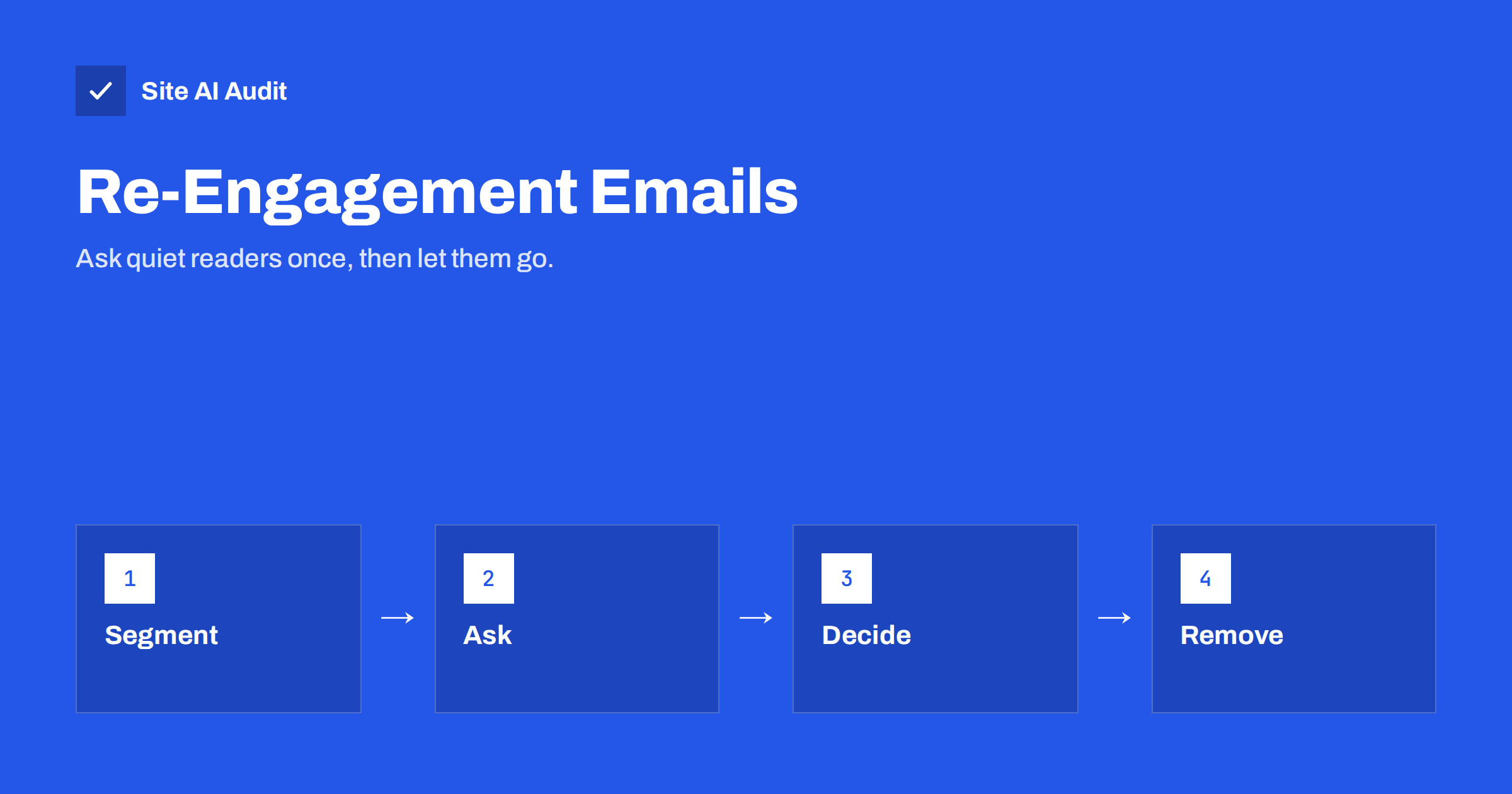
Short answer: A re-engagement campaign is a short series of emails sent to subscribers who have stopped opening or clicking. Its purpose is to find out who still wants your messages and to remove the rest. Done carefully, it protects your sender reputation and improves inbox placement. Done carelessly, for example as one big blast to an old list, it can trigger spam complaints and blocks.
Why inactive subscribers are a problem
Mailbox providers watch how recipients react to your messages. When many people ignore your emails, delete them without reading or mark them as spam, providers learn that your mail is not wanted, and they place more of it in the spam folder. The effect is not limited to the quiet contacts. It can lower delivery to your active readers as well. The relation between reactions and placement is explained in the article on email engagement and inbox placement.
Old addresses carry other dangers. People change jobs, abandon mailboxes and lose access to accounts. An abandoned address can bounce, or be turned into a spam trap, which is an address used to catch senders with poor list habits. The topic is covered in the guide to spam traps. A list that is mostly inactive is a list at risk.
Decide who counts as inactive
Choose a clear rule before you act. The right period depends on how often you send and how long customers usually need to buy again.
- Frequent senders (weekly or more) often use 90 to 180 days without a click.
- Occasional senders (monthly or less) may need 6 to 12 months.
- Shops can also consider the time since the last purchase or visit.
Be careful with open rates. Since mail apps began to pre-load images for privacy, many opens are automatic and say little about a person’s interest, as explained in the article on Apple Mail Privacy Protection. Clicks, replies, purchases, account logins and visits to your website are more reliable. Use a combination if your tool allows it.
Before you write: prepare the ground
- Clean the obvious problems first. Remove hard bounces and addresses that you have already marked as complaints. The steps are in the guide to email list hygiene.
- Segment the inactive group. Keep it separate from your active audience and do not mix the two in one send.
- Check your consent records. Know how each address was collected. If you do not have a valid basis to contact someone, do not email them. Rules differ by country, so check the local requirements.
- Warm up gently. If a group has been silent for a long time, send in small batches, not all at once. Large sudden volumes look suspicious, as discussed in the article on warming up a domain.
- Make sure authentication is in place. SPF, DKIM and DMARC should pass before you send anything to a cold list.
How to design the series
Two or three emails are enough. More than that begins to feel like pressure.
- Email one: a friendly check-in. Say that you have not heard from them for a while. Remind them what the list offers, in one or two sentences, and give a single clear button to stay on the list.
- Email two: a reason to return. Offer something useful, such as your best guide, a short summary of what they missed or a preference page where they can choose topics and frequency. A discount can work for a shop, but do not rely on it alone.
- Email three: the last call. Say plainly that you will stop sending unless they confirm interest. Keep it polite and honest, without false urgency.
Space the messages by several days to a week. Use a subject line that is clear and human, not a trick. The guide to spam trigger words shows that a plain subject is better than a loud one.
A short example shows the tone. A small online shop might write to someone who has not clicked for six months: “It has been a while since we heard from you. We still send a short note every Friday with new arrivals and care tips. If that is useful, press the button below and nothing changes. If you would rather hear from us less often, you can choose a monthly summary instead.” The message is short, it asks for one action and it gives a respectful way out. Compare that with a loud subject line and a countdown timer, which reads like pressure and invites a spam complaint.
What to write and what to avoid
- Write in a natural voice, with your real name and a reply address that someone reads.
- Explain what the reader gains by staying, not what you lose if they leave.
- Offer a choice: stay, change preferences or unsubscribe. A visible unsubscribe link is both polite and protective, as explained in the article on one-click unsubscribe.
- Avoid guilt-based subject lines and fake “your account will be deleted” claims.
- Do not attach files, and keep the layout light. Messages that are simple and short are friendlier to filters.
What happens after the series
Contacts who click or reply move back into your active list. Those who do not respond after the last message should be removed from regular mailings. You may archive them in your system, so you keep the history, but stop sending marketing email. This is called a sunset policy, and it is the most important part of the process. Many senders send the re-engagement series and then keep mailing the silent group anyway, which defeats the purpose.
Make it a routine. Run a similar check every quarter or half year, so that inactive contacts never pile up. Combined with a confirmed sign-up method, as discussed in the comparison of double and single opt-in, it keeps the list healthy without large clean-ups.
How to measure whether it worked
- Response rate. The share of the inactive segment that clicked or replied.
- Complaint and bounce rates. They should stay low. If they rise, stop and review.
- Delivery to the active list. Watch your open and click trends and any spam folder placement in test mailboxes.
- Provider tools. Mailbox providers’ own dashboards show spam rates and reputation, as covered in the guide to Google Postmaster Tools.
A smaller list that responds is more valuable than a large list that does not. Do not judge the campaign by how many names you lost.
Record what you learn from each round. Note the number of contacts in the segment, the date of each message, the response rate and how many contacts you removed. After two or three rounds you will know your normal response rate and can spot problems early. If very few people ever respond, your list probably contains many contacts who never wanted your mail, and the better investment is a stronger sign-up process, not a bigger win-back effort.
Finally, think about the reason people go quiet. Sometimes the content has drifted away from what they signed up for, or the frequency has grown too high. A re-engagement series is a good moment to ask. A one-question survey, such as “What would you like to hear about?”, gives you ideas and shows readers that you listen.
Common mistakes
- Emailing a very old list all at once. The result can be a flood of bounces and complaints.
- Using opens as the only measure. Automatic opens hide the truth.
- Offering a big discount as bait. It teaches readers to ignore you until the next sale.
- Hiding the unsubscribe link. People who cannot leave will press the spam button.
- Skipping the removal step. The campaign only works if the silent group really is removed afterwards.
- Buying addresses to replace lost ones. Purchased lists are full of traps and complaints, and they break the rules of the major providers described in the Gmail and Yahoo bulk sender requirements.
How Site AI Audit helps
Site AI Audit does not look at your mailing lists or campaigns. It checks the domain settings that decide whether your messages are trusted: MX records, SPF with its lookup limit, DKIM signatures and the DMARC policy. Having these right is the first condition for any email programme. The first check is free, covers up to 50 pages and needs no sign-up. You can run a free check of your website or see the plans for weekly monitoring and alerts.
Related reading
- Email List Hygiene: How to Clean Your List Without Losing Buyers
- How to Reduce Spam Complaints and Keep Your Spam Rate Low
- Email Deliverability Checklist: 20 Checks for Small Businesses
- Why Your Emails Land in the Gmail Promotions Tab
The bottom line
Re-engagement is a polite question followed by an honest decision. Segment inactive contacts, ask them in two or three friendly emails, keep the ones who answer and stop mailing the rest. A smaller, interested audience protects your reputation and reaches the inbox more often.
الأسئلة الشائعة
How long should a subscriber be silent before I run a re-engagement series?
It depends on your sending rhythm. Three to six months suits frequent senders, and six to twelve months suits occasional ones. Use clicks and purchases, not just opens.
Can a re-engagement campaign hurt deliverability?
Yes, if you send it in one large blast to an old list. Send in small batches, clean obvious bad addresses first and watch complaint rates.
Should I delete people who do not respond?
Stop sending them marketing email. You can archive their records, but keep them out of regular campaigns.
Is a discount necessary?
No. A clear reason to stay, a preference choice and a sincere tone are often enough. Discounts can attract bargain seekers who ignore you later.
Does this apply to transactional email?
No. Order confirmations and account notices are separate, and they should stay apart from marketing, as described in the guide to transactional vs marketing email.