ENEnglish
 LTLietuviškai
 DEDeutsch
 FRFrançais
 RUРусский
 ESEspañol
 PLPolski
 ITItaliano
 UKУкраїнська
 CSČeština
 PTPortuguês
 JA日本語
 LVLatviešu valoda
 ETEesti
 HUMagyar
 IDBahasa Indonesia
 TRTürkçe
 HIहिन्दी
 ELΕλληνικά
 ARالعربية
 THไทย
 VITiếng Việt
 RORomână
 MSBahasa Melayu
 BNবাংলা
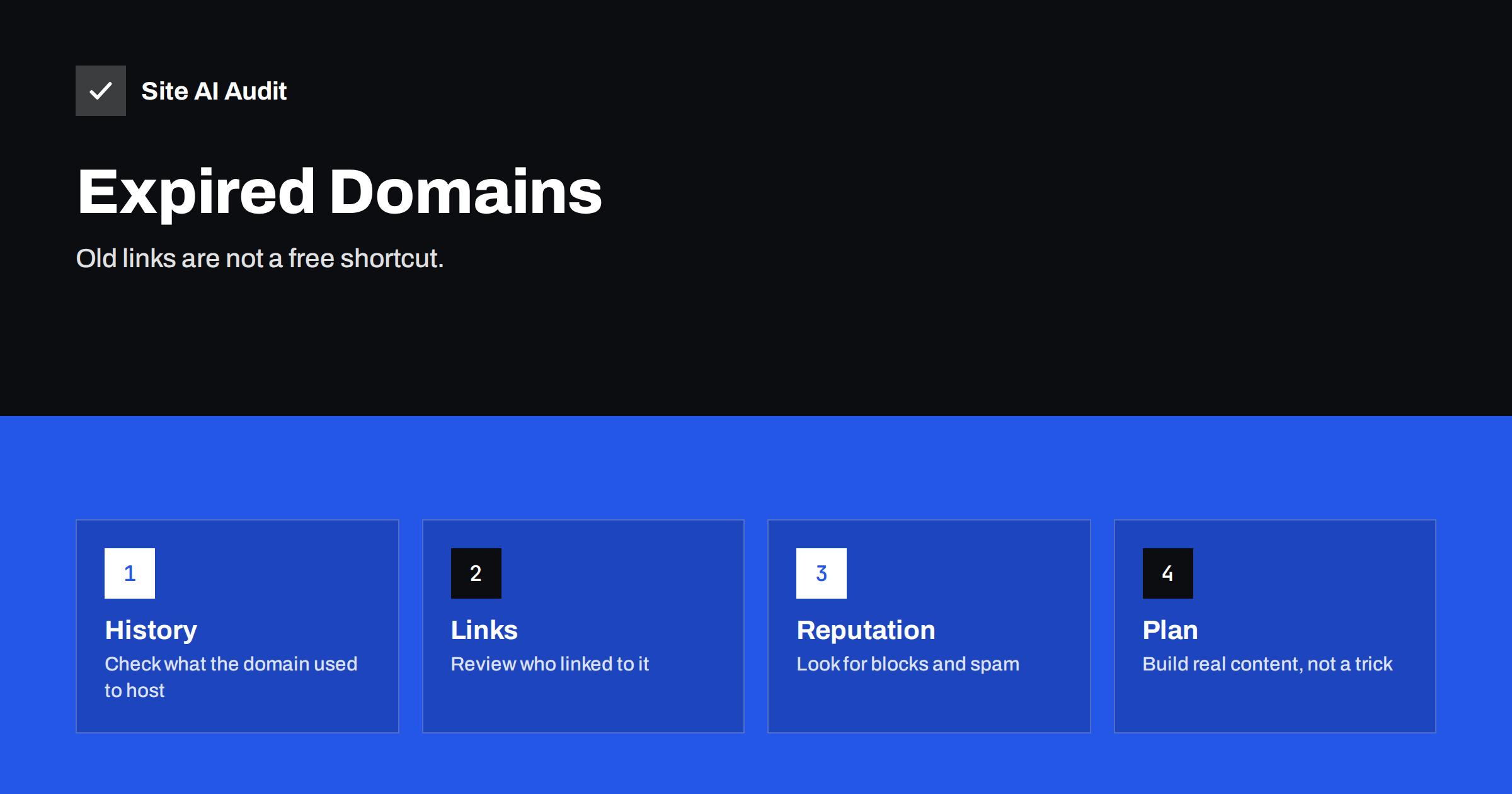
Short answer: Buying an expired domain because it has old backlinks is risky. The domain may carry a history of spam, a past penalty or links from poor sites, and Google does not hand over a former owner’s authority just because the name is yours now. Google also treats the use of expired domains to host low-value content for ranking purposes as spam. A domain can still be a good choice if it matches your brand, its past was clean and you build a real site on it. Check its history carefully before you pay.
Why people buy expired domains
When a domain registration lapses and nobody renews it, the name eventually returns to the market. Some of those names once belonged to busy websites that earned links from other pages. The idea is simple: buy the name, put a site on it, and enjoy the benefit of the old links without waiting years to earn your own.
The idea is older than most current search systems, and it has a long record of abuse. Sellers advertise names with impressive-looking metrics, and buyers hope for a quick lift in rankings. In practice, results are mixed at best, and often negative. Search engines learned to look at what changed when a domain changed hands, and not only at the links that came with it.
What Google says about it
Google’s spam policies include a rule against expired domain abuse. It describes the practice of buying an expired domain and using it mainly to host content that offers little value to visitors, in order to benefit from the domain’s past reputation. Sites that do this can lose visibility in search results.
The policy does not forbid owning a domain that expired before. A business that lets its name lapse by mistake and then buys it back is not abusing anything, and neither is a new company that picks a good available name and builds a genuine website. The line is drawn at intent and quality: a real, helpful site on a recycled name is fine, while a thin site that exists to borrow old authority is not.
The main risks
- A hidden penalty or a spam history. If the previous owner was punished for manipulation or hosted spam, the name may still be treated cautiously. A manual action does not necessarily vanish when the owner changes. The guide to manual actions in Search Console shows what such a notice looks like.
- Toxic backlinks. The links that make the name look strong may come from link farms, hacked sites or pages in unrelated languages. They add risk and little value.
- Irrelevant authority. Old links to a gardening site mean little for a new accounting firm. Relevance matters, and the old topic may not match yours.
- Old pages that still rank for the wrong things. Search results and other sites may still point to pages that no longer exist, which sends visitors to error pages.
- A damaged e-mail reputation. The name may have been used to send spam. Blocklists and mailbox providers remember. See how to check a blocklist and request removal.
- Brand and legal trouble. The previous brand may still be protected by a trademark, and customers may confuse your business with the old one.
- Unwanted traffic and links. Adult, gambling or pharmaceutical sites sometimes link to a name they once abused.
How to investigate before you buy
- Look at the past with a web archive. Browse snapshots over the years. Was it one consistent business, or did the content change from topic to topic? Sudden jumps to unrelated subjects, foreign languages or casino pages are warning signs.
- Search for the name in Google. Use the site operator, as in the guide to the site search operator, to see whether the domain still has pages in the index and what they show. A name with no indexed pages at all may have been removed for spam.
- Review the backlink profile. Use a backlink tool to list the linking domains. Check a sample by hand. Are they relevant, real sites?
- Check blocklists and reputation. Look the name up in public blocklists and safe browsing reports.
- Check the trademark. Search the names and the brand in your country’s trademark register.
- Review the registration history. Frequent changes of owner or very short ownership periods suggest a flipping market and a risky past.
None of these checks gives a guarantee. They only reduce the chance of an unpleasant surprise.
Marketplaces for expired names also add their own noise. Metrics shown in listings are calculated by third-party tools, and each tool counts links in its own way. A high score on a sales page does not mean that the links are relevant, current or even real. Treat the numbers as a starting point for questions, never as proof of quality.
Before you bid, write down why you want the name. If the reasons are about brand, memorability and a clean topic match, you are on safer ground. If the reasons are about links and metrics, pause and ask whether a new domain with honest promotion would serve you better.
Buy it back or buy a new name?
The cleanest case is your own name. If you lost a domain by accident, buy it back as soon as possible, and read what happens when a domain name expires to understand the stages. Recovering your own domain brings back real links from real customers and partners.
For someone else’s former domain, ask a plain question: would I still want this name if it had no links at all? If yes, it can be a good brand name that happens to be recycled. If the only reason to buy it is the old authority, the plan is built on something that you cannot control. A fresh name plus steady, honest work is usually safer and cheaper in the long run.
If you decide to use one
- Build a real site on a relevant topic. Publish helpful pages for people, not placeholder text.
- Do not redirect everything to another site. A mass redirect from an unrelated expired domain is exactly the pattern that search engines treat as manipulation. Redirect an old page only to a close equivalent, as the guide on reclaiming lost backlinks suggests.
- Verify the site in Search Console and watch for messages during the first weeks.
- Disavow only when needed. A disavow file is a last resort for clear link spam, not a routine step.
- Secure the registration. Turn on auto-renewal and a registrar lock, as in protecting a domain from hijacking, so that you do not lose it again.
- Be patient. Expect to earn rankings like any new site.
Signs it went wrong
If a recycled domain is in trouble, the first sign is often silence: pages are crawled but not indexed, or they appear and disappear. Other signs include a manual action message, unexplained drops after an early rise, warnings in the browser, or e-mail that lands in spam even though your authentication is correct. When this happens, stop adding pages and check the basics: the Search Console messages, the index status, the blocklists and the backlink sample. If the history is clearly toxic, moving to a new domain may be cheaper than trying to repair the old one.
How Site AI Audit helps
Site AI Audit does not judge a domain’s backlinks or its past. It checks the site you build on it: titles and descriptions, headings, broken links, redirects, the sitemap, robots.txt and noindex rules, together with speed, SSL, security headers and e-mail authentication, all explained in plain words and ranked by impact. The first check is free, covers up to 50 pages and needs no sign-up. You can run a free check of your website or see the plans for ongoing monitoring.
Related reading
- Domain Name Expiry: What Happens When Your Domain Lapses
- Backlinks for Small Businesses: What Helps and What Hurts
- Domain Authority: What the Score Means and What It Does Not
- Japanese Keyword Hack: How to Find and Remove SEO Spam Pages
The bottom line
An expired domain is not a shortcut to rankings. Its old links may be weak, irrelevant or harmful, and Google’s spam policies target the practice of borrowing past reputation for thin content. Buy back your own name when you can, and treat any other recycled domain as a normal brand name that must pass a careful history check. Then do the real work: build a useful site, earn links honestly and watch Search Console from the first day.
FAQ
Do old backlinks transfer to me when I buy an expired domain?
Not reliably. Search engines look at what changed, and links may lose value when a site’s content and owner change. Do not count on old links to rank a new site.
Is buying an expired domain against Google’s rules?
Owning one is not. Using it mainly to host low-value content in order to benefit from its past reputation is covered by Google’s spam policy on expired domain abuse.
Can a penalty stay with a domain after it changes owners?
It can. A manual action or a history of spam may continue to affect the name, so check the history and Search Console messages before you invest.
Is it safe to redirect an expired domain to my main site?
Be careful. Redirecting an unrelated domain in bulk is a common manipulation pattern. Redirect individual old pages only to closely matching pages on your site.
What if I lost my own domain by mistake?
Try to buy it back quickly, restore the old content and redirects, and renew it with auto-renewal. Your own history and real links usually help.