ENEnglish
 LTLietuviškai
 DEDeutsch
 FRFrançais
 RUРусский
 ESEspañol
 PLPolski
 ITItaliano
 UKУкраїнська
 CSČeština
 PTPortuguês
 JA日本語
JA日本語 LVLatviešu valoda
 ETEesti
 HUMagyar
 IDBahasa Indonesia
 TRTürkçe
 HIहिन्दी
 ELΕλληνικά
 ARالعربية
 THไทย
THไทย VITiếng Việt
 RORomână
 MSBahasa Melayu
 BNবাংলা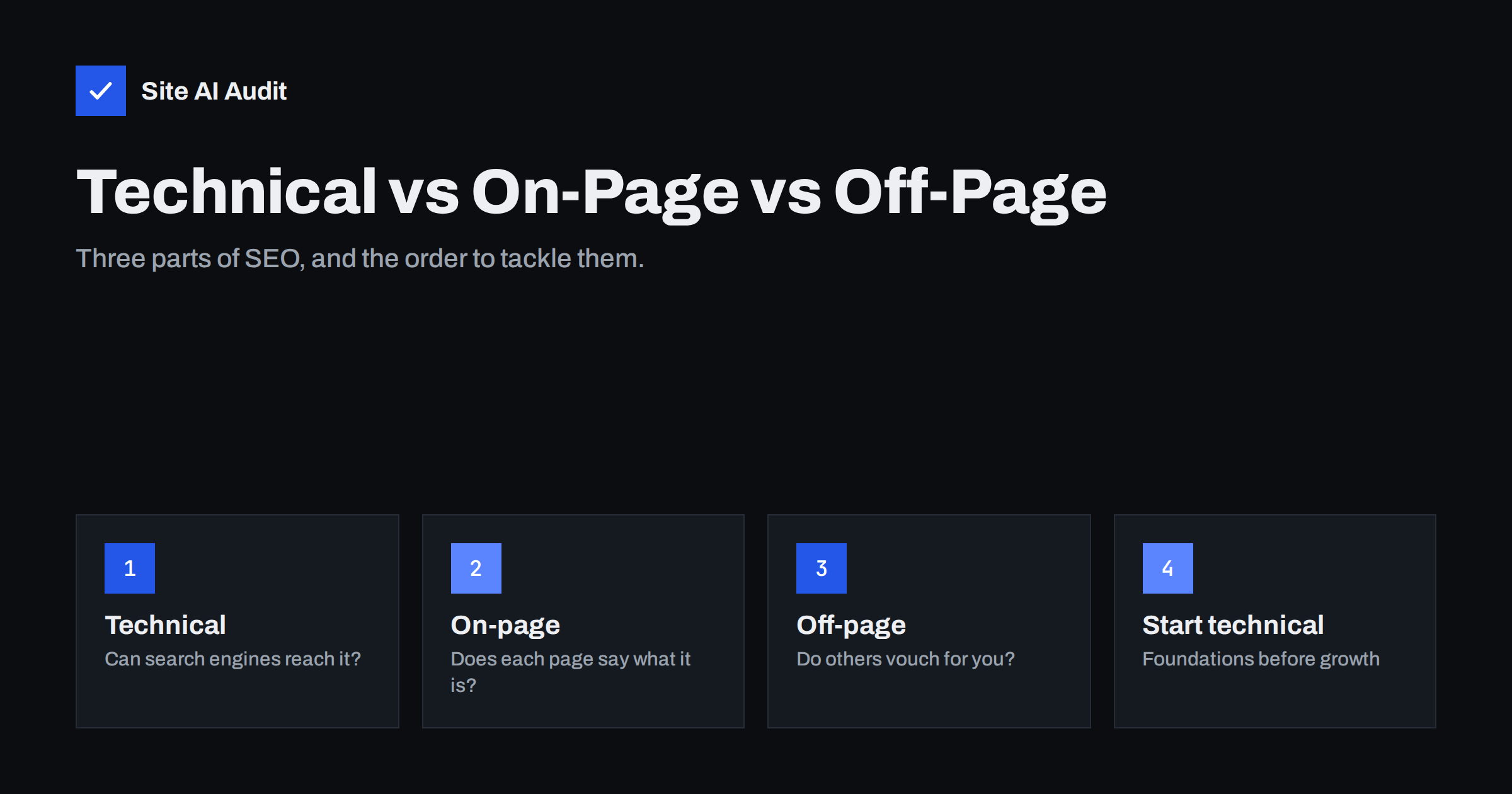
Short answer: Technical SEO makes sure search engines can crawl, render and index your site: robots.txt, sitemaps, status codes, redirects, canonicals, speed and security. On-page SEO makes each page clearly describe and deliver its topic: titles, descriptions, headings, content, images and internal links. Off-page SEO covers signals from outside your site, such as links, mentions, reviews and business profiles. Small businesses usually get the best return by fixing technical blockers first, then on-page basics, then building off-page reputation steadily.
Why the distinction is useful
SEO covers many different tasks, and lumping them together makes it hard to know where to start or whom to ask. Splitting them into three areas helps:
- it shows which tasks depend on others, since good content cannot rank if the page is blocked;
- it clarifies who should do what: developers, content writers or the business owner;
- it makes audit reports easier to read, because findings fall into recognisable groups.
The boundaries are not perfectly sharp. Internal links, for example, are part of both technical structure and on-page content. But the three-part model is a practical way to organise the work.
Technical SEO: can search engines use your site?
Technical SEO is about access and infrastructure. It answers the question: can search engines find, fetch, render and store your pages correctly? Typical areas:
- Crawling: robots.txt rules, crawlable links, crawl traps from parameters.
- Indexing: noindex directives, canonical tags, duplicate URL versions.
- Status codes and redirects: 404 errors, soft 404s, redirect chains and loops, correct use of 301 and 302.
- XML sitemaps: presence, accuracy and submission.
- Site architecture: URL structure, click depth, pagination.
- Performance: server response time, page speed, Core Web Vitals.
- Mobile: content parity and usability on phones.
- Security: HTTPS, valid certificates, no mixed content.
- International: hreflang and language versions.
- Structured data: valid markup that matches the content.
Technical problems are often invisible to visitors and can affect every page at once. A single wrong setting can hide an entire site. That is why technical checks come first.
On-page SEO: does each page say what it is?
On-page SEO is about the content and presentation of individual pages. It answers: does this page clearly describe its topic, match what searchers want and deserve to be shown? Typical areas:
- Title tags and meta descriptions: unique, specific, in customers’ words.
- Headings: one clear H1, logical H2 and H3 structure.
- Content: matching search intent, specific, accurate, original and complete.
- Keywords and language: the words customers use, used naturally.
- Images: alt text, file names, captions.
- Internal links: contextual links with descriptive anchor text.
- Trust signals: authorship, contact details, proof of experience.
On-page SEO is fully under your control and often the fastest area to improve once technical foundations are in place.
Off-page SEO: do others vouch for you?
Off-page SEO covers signals that come from outside your website. It answers: is this business known, trusted and referred to by others? Typical areas:
- Links from relevant, reputable websites.
- Brand mentions in media, blogs and forums, even without links.
- Reviews on your Business Profile and industry platforms.
- Business listings in directories with consistent details.
- Partnerships and memberships that list your business.
- Social presence that helps people find and discuss you.
Off-page signals take the longest to build and are the least under your direct control. They also carry risks when pursued with shortcuts: bought links and fake reviews break search engine policies and consumer rules.
Side-by-side comparison
| Technical SEO | On-page SEO | Off-page SEO | |
|---|---|---|---|
| Main question | Can search engines access and index it? | Is each page clear and useful? | Do others trust and reference it? |
| Scope | Whole site, templates, server | Individual pages | The wider web |
| Who usually does it | Developer, hosting, technical SEO | Owner, marketer, writer | Owner, marketer, PR |
| Speed of effect | Often quick once fixed | Weeks after recrawling | Months, cumulative |
| Control | High | Full | Partial |
| Typical tools | Site audit, Search Console, server logs | Audit, editor, keyword research | Business Profile, outreach, review platforms |
How the three depend on each other
Think of a shop. Technical SEO is the building: doors that open, lights that work, an address people can find. On-page SEO is the shop window and shelves: clear signs, well-presented products, prices. Off-page SEO is reputation: recommendations from neighbours, reviews and press. Great reputation will not help if the door is locked; a beautiful window will not help if nobody knows the street exists.
In practice:
- Off-page effort is wasted if technical problems keep pages out of the index.
- On-page improvements need technical access to be seen.
- Technically perfect pages with thin content rarely rank.
- Strong content earns links and mentions more easily, so on-page work feeds off-page results.
Where a small business should start
- Technical blockers. Make sure the site is indexable, secure, reachable on one domain version and free of broken key pages. This is usually a few hours of work, sometimes with a developer.
- On-page basics on key pages. Titles, descriptions, H1s and content for the home page, main services or categories and contact page.
- Local and off-page foundations. A complete Business Profile, consistent directory listings and a routine for requesting reviews.
- Content growth. Guides and pages that answer customer questions, linked to services.
- Ongoing maintenance. Regular audits and monitoring so technical and on-page problems do not creep back.
Sorting real problems into the three areas
When a small business site is not performing, the cause usually sits clearly in one of the three areas. Some typical examples:
- “Our new website gets no search traffic at all.” Almost always technical: a leftover noindex, a blocked robots.txt, or missing redirects from the old site.
- “We appear in Google, but for the wrong searches.” Usually on-page: titles, headings and content describe the business in jargon or cover several services on one page.
- “We rank on page two and cannot move up.” Often a mix: on-page depth compared with competitors, and off-page signals such as reviews and links from local organisations.
- “Competitors appear in the map results and we do not.” Mostly off-page and local: Business Profile completeness, category choice, reviews and consistent listings, plus clear location details on the site.
- “Traffic dropped suddenly last month.” Check technical changes first, such as redesigns, plugin updates, certificate or hosting changes, before assuming anything else.
Diagnosing the area first saves time and money, because each area needs different skills and different fixes.
Dividing your time
There is no universal formula, but a common pattern for small businesses is a burst of technical work at the start or after major changes, followed by steady on-page and content work, with a small, regular habit for off-page activity such as asking for reviews and maintaining listings. Once the foundations are sound, most of the ongoing time goes into content and reputation, with technical checks running in the background as monitoring.
Common misconceptions
- “SEO is mostly about links.” Links matter, but for many local and niche businesses, technical health, on-page clarity and a strong Business Profile matter more.
- “Technical SEO is only for big sites.” Small sites have fewer pages, but one wrong setting affects a larger share of them.
- “On-page SEO means keywords.” It means clear, useful pages; keywords are only one part.
- “Once it is done, it is done.” All three areas change over time and need maintenance.
Questions to ask an SEO provider
If you hire help, the three areas make it easier to understand what you are paying for. Ask which area the proposed work covers, how they will check technical health before and after, which pages they will improve on-page and how, and how they build off-page signals. Be cautious with offers that focus only on a number of links per month, promise specific rankings, or cannot explain their work in plain words.
How Site AI Audit helps
Site AI Audit covers the technical side and the on-page basics in one report: crawling and indexing rules, sitemaps, redirects, broken links, SSL and security headers, speed and Core Web Vitals, plus titles, descriptions, headings and alt text. It also checks e-mail authentication for your domain. Findings are ranked by impact with a plain-language fix for each. Run a free check to see where your foundations stand before investing in off-page work.
Related reading
- SEO Audit Checklist for Small Business Websites
- How to Prioritise SEO Audit Findings: What to Fix First
- Local SEO Basics: How Small Businesses Get Found Nearby
- How to Write Title Tags: A Practical Guide for Small Sites
The bottom line
Technical SEO makes your site accessible to search engines, on-page SEO makes each page clear and useful, and off-page SEO builds the reputation that makes others refer to you. They depend on each other, but the order matters: fix technical blockers first, then improve key pages, then build reputation steadily. Keep all three maintained, because none of them stays done on its own.
SSS
Which is more important, technical or on-page SEO?
Both are necessary. Technical SEO comes first because it decides whether pages can be indexed at all. On-page SEO then decides how well each page matches searches.
Can I do technical SEO without a developer?
Many checks and some fixes, yes, especially settings in your CMS. Server configuration, redirects at scale and template changes often need a developer.
Is off-page SEO just link building?
No. It also includes reviews, brand mentions, business listings and partnerships. For local businesses, reviews and a complete Business Profile are often the most important off-page signals.
How long does each type of SEO take to show results?
Technical fixes can show results within days or weeks once recrawled. On-page improvements often take weeks. Off-page reputation builds over months.
Where does page speed belong?
Usually under technical SEO, because it depends on hosting, code and resources. It also affects user experience, so it overlaps with on-page quality.