ENEnglish
 LTLietuviškai
 DEDeutsch
 FRFrançais
 RUРусский
 ESEspañol
 PLPolski
 ITItaliano
 UKУкраїнська
 CSČeština
 PTPortuguês
 JA日本語
 LVLatviešu valoda
 ETEesti
 HUMagyar
 IDBahasa Indonesia
 TRTürkçe
 HIहिन्दी
 ELΕλληνικά
 ARالعربية
 THไทย
 VITiếng Việt
 RORomână
 MSBahasa Melayu
 BNবাংলা
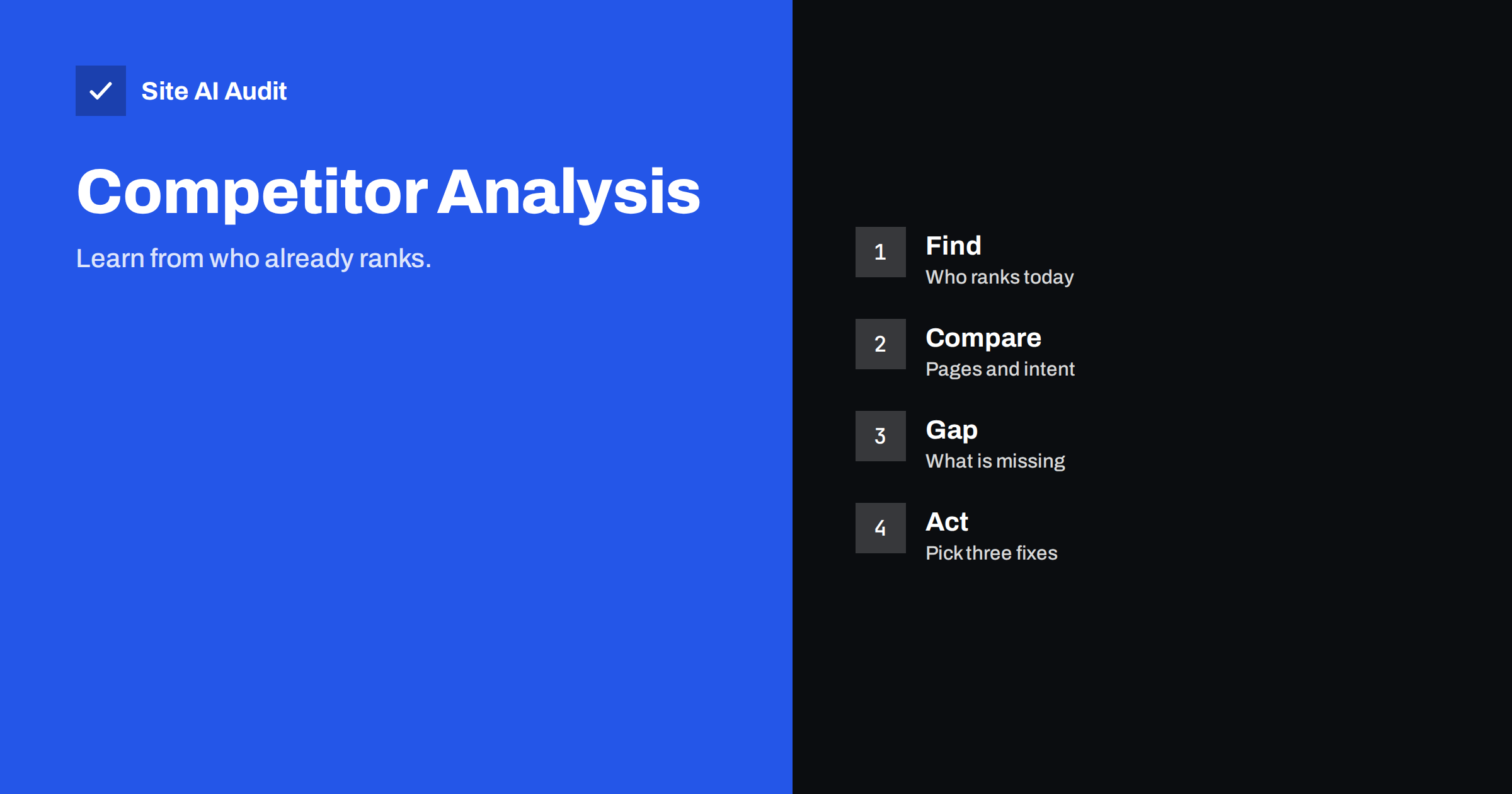
Short answer: An SEO competitor analysis looks at who ranks for the searches you want, why those pages deserve their position and what you can do better. You can do a useful one in an afternoon with only a search engine, Search Console and a spreadsheet. The goal is not to copy anyone but to find a few clear actions, such as a missing page, a weak title or a topic that nobody answers well.
Who your search competitors are
Your business competitors are the companies that sell what you sell. Your search competitors are the websites that appear when your customers search, and they are often different. A local plumber may compete in the results with directories, review sites, manufacturer pages and a council guide, as well as with other plumbers. A shop may compete with a big marketplace, a magazine and a forum thread.
This matters because the way to win differs by type. You cannot outrank a national marketplace on every product, but you may beat it for a local, specific or expert query. Knowing who actually holds the positions tells you which fights are worth taking.
Step 1: Choose the searches that matter
Start with a short list, between ten and thirty searches, that your customers would really type. Use the methods from the guide to keyword research for small businesses.
- Money searches. People who are ready to buy or book, such as “emergency plumber in Leeds” or “buy leather work boots”.
- Question searches. People who are learning, such as “how to bleed a radiator”. They are less ready to buy, but they build trust and traffic.
- Branded searches. Your own name and your products. Check what else appears there.
- Searches that you already get impressions for. Search Console lists them. See how to read the Performance report.
Write them in the first column of a spreadsheet. Add the type and the page on your site that should answer each one.
Step 2: See who ranks
Search for each term in a private window, so that your history does not change the results. Use the country and language of your customers. For each search, record the top ten results: the site, the type of page, and any special features such as a map pack, shopping results, videos, a featured answer or related questions.
After twenty searches, patterns appear. A few sites show up again and again. Those are your real search competitors. Write down the five to eight that matter most, and note whether they are direct rivals, directories, publishers or marketplaces. Also note which results you cannot reasonably beat, so that you do not waste effort on them.
Step 3: Match the search intent
Before you compare details, look at what kind of page wins. If the top ten are all guides, a product page will not break in. If they are all category pages, a blog post will struggle. The guide to search intent explains the types. Ask three questions.
- What does the searcher want? To learn, to compare, to buy, or to find a place.
- What format do the winners use? A list, a guide, a tool, a category page, a map listing or a video.
- Does your page match? If not, the fix may be a different page, not a better version of the same one.
Step 4: Compare the pages
Pick the top three or four results for your most important searches and open them. Compare them with your page, using a simple list of points.
- Title and description. How do they name the topic, and what promise do they make? See the guide to writing title tags.
- Depth. Which questions do they answer, and which sections do they include? Do not count words. Count useful answers.
- Freshness. Are they dated, current and updated?
- Proof. Do they show experience, such as photos, examples, prices, reviews or named authors? See showing trust on a small business website.
- Structure. Headings, lists, tables, images and a clear path to the next step.
- Speed and usability. Do they load well on a phone?
- Internal links. How do they connect the page with related content? See internal linking.
- Rich results. Do they use reviews, questions or other features that stand out?
Write what they do well and what they miss. The misses are your openings.
Step 5: Find the gaps
A gap is a place where you can offer something that the current results do not. Common kinds include these.
- Missing topics. Questions that nobody answers well. The “related questions” boxes are a rich source, as the article on People Also Ask shows.
- Missing detail. Pages that say what to do but not how much it costs, how long it takes or what goes wrong.
- Missing places or segments. A guide that serves everyone and no one. A page for a specific area or kind of customer can win. See location pages and service pages.
- Outdated pages. Results with old dates, old prices or old screenshots.
- Weak formats. A topic with only text, where a checklist, a calculator or a clear diagram would help.
- Cluster holes. Rivals that have a group of connected articles on a theme, where you have one. See topic clusters.
Step 6: Look at links, lightly
Links are part of why pages rank, and you can learn something without a paid tool. Look at the kinds of sites that link to your competitors: local organisations, suppliers, industry bodies, local news, directories and guides. Think about which of those you could earn a link from honestly, for instance through a sponsorship, a useful resource, a partnership or a real story. Do not buy links or copy tactics that break search engine rules. The guide to backlinks for small businesses lists what helps and what harms.
Turn findings into a short plan
The danger of any analysis is a long list that nobody acts on. End with no more than five actions, each with an owner and a date.
- Fix the quick wins, such as a weak title or an outdated section, using the advice in how to update old content.
- Write or rebuild one or two pages where there is a clear gap and a good chance of winning.
- Improve proof and detail on your most important pages.
- Plan one link opportunity that you can earn honestly.
- Set a review date, and measure impressions, clicks and positions for the pages that you changed.
Repeat the analysis every quarter, or when a new competitor appears. Rankings move slowly, as described in how long SEO takes, so judge the results over weeks and not days.
Mistakes to avoid
- Copying a competitor’s page. It is unethical, it can raise legal and duplicate content problems, and it yields at best an equal page.
- Chasing every competitor. Focus on the few that matter.
- Looking only at rankings. A high position for a search that never leads to a sale is not a win.
- Trusting tool scores blindly. Numbers such as authority are estimates by each tool. See what domain authority means.
- Ignoring your own site. Technical errors can cost more than any competitor does.
A short example
A small bakery that delivers across a city wants more orders for wedding cakes. It searches for ten phrases a couple might type and finds that the top results are a wedding directory, two large bakery chains and a magazine list of the best cake makers. A local bakery with a good portfolio ranks fourth for one phrase. Comparing the pages shows what the winners share: many photos, a clear price range, a section on dietary options and a booking form near the top.
The bakery’s own page has three photos, no prices and a contact link at the bottom. The gap is obvious, and the plan is short. Add a gallery with captions, show a price range with an honest note on what changes it, write a section on allergies and add a form. Then add a guide to choosing a cake size for the number of guests, because none of the top results answers that question properly. Six weeks later, the page appears on the first page for two more phrases. None of this needed a paid tool. It needed a clear look at what already works and what is missing.
How Site AI Audit helps
Site AI Audit does not analyse competitors or rankings, so it cannot show who ranks above you. It examines your own site, which is the part you control: titles and descriptions, headings, alt texts, broken links, redirects, your sitemap and robots.txt, together with speed, security and email authentication. Fixing those basics makes sure that your pages are ready to compete. The free check covers up to 50 pages and needs no sign-up. You can run a free check of your website or see the plans for weekly monitoring and alerts.
Related reading
- Keyword Research for Small Businesses: A Simple Method
- Search Intent Explained: Match Your Pages to What People Want
- Topic Clusters and Pillar Pages: Organise Your Content for SEO
- Local SEO Basics: How Small Businesses Get Found Nearby
The bottom line
Find out who really ranks for the searches that matter, match the type of page that wins and look for what they leave out. Keep the findings to a short list of actions, make the changes, and measure the results over a few weeks. A small, repeatable review beats a big report that nobody reads.
SSS
Do I need paid tools for competitor analysis?
No. A search engine, Search Console and a spreadsheet are enough to start. Paid tools add estimates of traffic and links, but they are optional.
How many competitors should I study?
Five to eight is plenty. More than that produces noise. Choose those that appear most often in the results for your key searches.
Should I copy what the top result does?
Learn from it, but do not copy it. Aim to answer the question better, with more useful detail, clearer structure and real evidence from your own work.
How often should I repeat the analysis?
Every three to six months for most small sites, and sooner after a large change in the results or a new rival.
What if big brands dominate the results?
Target narrower searches where they are weak, such as local, specific or expert queries, and build your strengths there.