ENEnglish
 LTLietuviškai
 DEDeutsch
 FRFrançais
 RUРусский
 ESEspañol
 PLPolski
 ITItaliano
 UKУкраїнська
 CSČeština
 PTPortuguês
 JA日本語
JA日本語 LVLatviešu valoda
 ETEesti
 HUMagyar
 IDBahasa Indonesia
 TRTürkçe
 HIहिन्दी
 ELΕλληνικά
 ARالعربية
 THไทย
THไทย VITiếng Việt
 RORomână
 MSBahasa Melayu
 BNবাংলা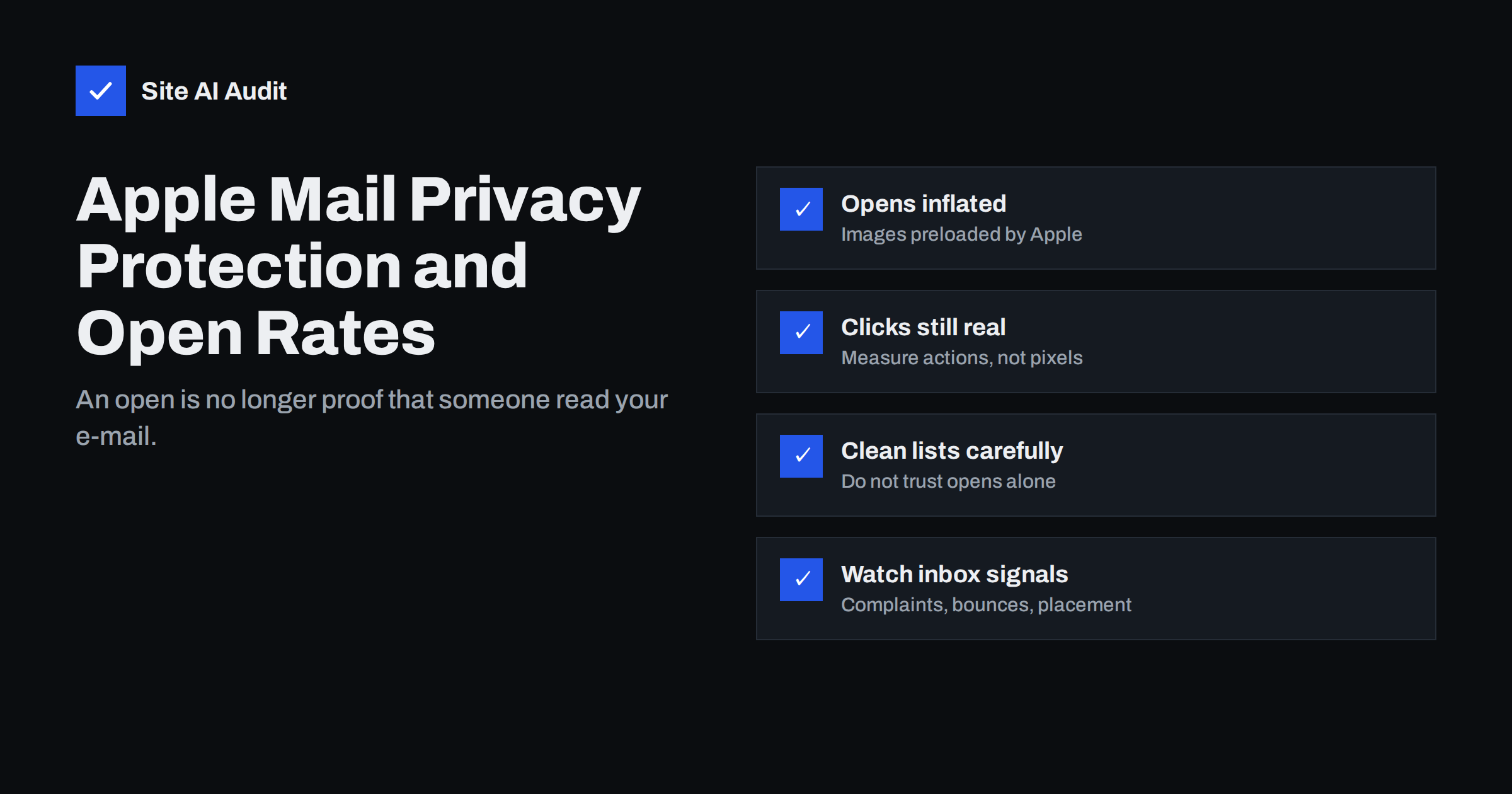
Short answer: Apple Mail Privacy Protection, introduced in 2021, downloads the images in e-mails through Apple’s servers in the background, often before and regardless of whether the person actually opens the message. That triggers the tracking pixel, so many recipients who use Apple Mail appear as “opened”. Open rates are therefore inflated and unreliable. Judge engagement by clicks, replies, conversions and complaints instead, and do not keep sending to people only because they seem to open.
What Apple Mail Privacy Protection does
Most e-mail marketing tools measure opens with a tiny invisible image, a tracking pixel. When the recipient’s mail app loads images, the pixel is requested from the sender’s server and the tool records an open, often together with the time, the IP address and an approximate location.
Apple Mail Privacy Protection, usually shortened to MPP, arrived with iOS 15 and macOS Monterey in 2021. When a user turns it on in the Apple Mail app, remote content in their e-mails is downloaded privately in the background, through proxy servers, instead of when the user opens the message. The sender sees an IP address from Apple’s proxy rather than the person’s own.
Two details are important:
- It applies to the Apple Mail app on iPhone, iPad and Mac, whatever the account behind it. A Gmail, Outlook or company address read in Apple Mail is affected too.
- Apple asks users about the feature when they set up Mail, and many choose to turn it on. That is why the effect on open rates became visible across the industry almost immediately.
Why your open rate went up
If a large share of your subscribers read e-mail in Apple Mail, and many of them have protection switched on, their messages will generate an “open” whether or not a human looks at them. The result is an open rate that looks healthier than reality.
The inflation is uneven. Lists with many iPhone users, which is common in consumer audiences in many countries, are affected more than business lists where desktop Outlook dominates. That makes comparisons between lists, campaigns and industries even less meaningful than before.
Other mail apps also change how images load. Gmail, for example, has for years fetched images through its own image proxy. Unlike MPP, however, Gmail still loads them when the message is actually opened, so opens from Gmail remain a rough signal. The combination means that “opens” now mix real reads, automatic prefetches and blocked images, and no tool can separate them perfectly.
What still works and what does not
| Metric or tactic | Still reliable? | Why |
|---|---|---|
| Open rate | No | Inflated by automatic image loading. |
| Subject line A/B tests based on opens | Weak | The “winner” may reflect Apple users, not the subject line. |
| Send-time optimisation based on opens | Weak | Prefetch time is not reading time. |
| Automations triggered by an open | Unreliable | They fire for people who never read the e-mail. |
| Location and device from opens | No | The proxy hides the real IP address. |
| Click rate | Mostly | Requires a real action, though security scanners can click links too. |
| Replies, purchases, sign-ups | Yes | Real outcomes, measured on your side. |
| Unsubscribes and spam complaints | Yes | Directly reported by recipients and mailbox providers. |
The deliverability risk: keeping the wrong subscribers
Open rates were never a deliverability metric in themselves. Mailbox providers such as Gmail and Outlook decide inbox placement from their own signals: complaints, how people move, delete or reply to messages, authentication, bounces and your sending history. They do not see your pixel data.
The real danger of MPP is indirect. Many senders clean their lists by removing people who have not opened in, for example, six months. With inflated opens, inactive subscribers who use Apple Mail look active forever. They stay on the list, never engage, and quietly lower the engagement that mailbox providers do see. Some of those addresses are abandoned mailboxes that may eventually become spam traps.
Our guide to email list hygiene explains how to clean a list without losing real buyers, and the article on spam traps shows why old, unengaged addresses are a risk.
How to measure engagement after MPP
You do not have to give up on measurement; you have to measure closer to what you care about.
- Use clicks as the primary engagement signal. Design e-mails with a clear link worth clicking. Be aware that corporate security scanners sometimes click links automatically, so very fast clicks on every link at once may not be human.
- Track outcomes on your website. Tag links with campaign parameters and look at visits, sign-ups and sales in your analytics. That is where value is created anyway.
- Encourage replies. For newsletters and customer e-mail, a question that invites a reply creates a strong, real signal for you and for the mailbox provider.
- Separate machine opens. Many e-mail platforms now flag or exclude opens they believe come from Apple’s proxy. Use that option in reports if available, and read its documentation to understand the method.
- Compare trends, not absolute numbers. A sudden drop in opens or clicks relative to your own history can still reveal a problem such as spam-folder placement.
Rethinking list cleaning and re-engagement
Because inactivity is harder to detect, build your sunset policy on several signals rather than on opens alone.
- Define “engaged” as a click, a reply, a purchase, a login or a form submission within a set period.
- Send a short re-engagement series to people with no such activity, asking them to click to stay subscribed.
- Remove or pause those who do not respond, even if your tool shows them as “opening”.
- Prefer confirmed opt-in for new sign-ups, so that addresses on your list are real and wanted from the start.
- Reduce frequency for less active segments instead of sending everything to everyone.
This approach is slightly stricter than open-based cleaning, and it may shrink the list. A smaller list of people who act on your e-mails is worth more, and it is much better for your sender reputation.
Checking inbox placement directly
If opens cannot tell you whether mail reaches the inbox, use tools that look at delivery directly.
- Mailbox provider dashboards. Gmail’s Postmaster Tools shows spam rate, authentication results and delivery errors for your domain. The guide to setting up Google Postmaster Tools explains how to read it.
- Seed or placement tests. Sending to a set of test addresses across providers shows whether a campaign lands in the inbox, the spam folder or a tab.
- Bounce and complaint reports. Your sending platform’s reports on hard bounces, deferrals and spam complaints are unaffected by MPP.
- Authentication. SPF, DKIM and DMARC alignment remain a foundation. They are easy to verify and do not depend on any tracking.
For a structured way to test before sending, see how to test email deliverability before you hit send.
Common mistakes since MPP
Several habits from the time when opens were meaningful still cause trouble. Watch for these in your own reporting and automations:
- Celebrating a higher open rate. A jump in opens after moving to a new platform or a new audience may simply mean more Apple Mail users.
- “Opened but did not click” follow-ups. Automations that send a second message to everyone who “opened” will reach people who never saw the first one, which can look like repetitive mail and prompt complaints.
- Benchmarking against old numbers. Open rates from before 2021 are not comparable with today’s. Reset your baselines.
- Reporting opens to clients or management as success. Agencies especially should switch client reports to clicks, conversions and complaint rates, and explain why.
- Ignoring the spam folder. Prefetching can even register opens for messages that later sit unread, so an apparently healthy open rate can hide real placement problems.
How Site AI Audit helps
Site AI Audit checks the e-mail foundations of your domain as part of a full website check: SPF and its lookup limit, DKIM signatures, the DMARC policy and MX records, next to SEO, speed, SSL and security headers. Findings are explained in plain words and ranked by impact. It does not measure opens or campaigns; it makes sure the technical side your inbox placement depends on is in place. You can start with a free check.
Related reading
- How to Reduce Spam Complaints and Keep Your Spam Rate Low
- Email Deliverability vs Delivery Rate: What’s the Difference?
- Double Opt-In vs Single Opt-In: Which Is Better for Your List?
The bottom line
Since Apple Mail Privacy Protection, an “open” often means only that Apple’s servers downloaded the images. Stop treating open rate as proof of reading or as a reason to keep sending. Measure clicks, replies and outcomes, clean lists on real activity, and check inbox placement with mailbox provider tools. Your reports will look less flattering, but they will describe reality.
DUK
Does Apple Mail Privacy Protection affect deliverability?
Not directly, because mailbox providers do not use your tracking pixel. It affects deliverability indirectly when inflated opens lead you to keep sending to people who never engage.
Does MPP affect Gmail users?
It affects anyone who reads e-mail in the Apple Mail app with protection turned on, including Gmail and Outlook accounts added to that app. Gmail’s own apps are not affected by MPP.
Are click rates still accurate?
Mostly. A click requires an action, but some corporate security systems scan links automatically. Treat very fast clicks on all links in a message with caution.
Can I tell which opens come from Apple’s proxy?
Many e-mail platforms now flag opens they believe are automatic. The detection is based on the proxy’s characteristics and is not perfect, so use it for trends rather than exact counts.
Should I stop sending subject line A/B tests?
Not necessarily, but judge them by clicks or conversions rather than opens. An open-based winner may simply reflect how many Apple Mail users were in each group.