ENEnglish
 LTLietuviškai
 DEDeutsch
 FRFrançais
 RUРусский
 ESEspañol
 PLPolski
 ITItaliano
 UKУкраїнська
 CSČeština
 PTPortuguês
 JA日本語
 LVLatviešu valoda
 ETEesti
 HUMagyar
 IDBahasa Indonesia
 TRTürkçe
 HIहिन्दी
 ELΕλληνικά
 ARالعربية
 THไทย
 VITiếng Việt
 RORomână
 MSBahasa Melayu
 BNবাংলা
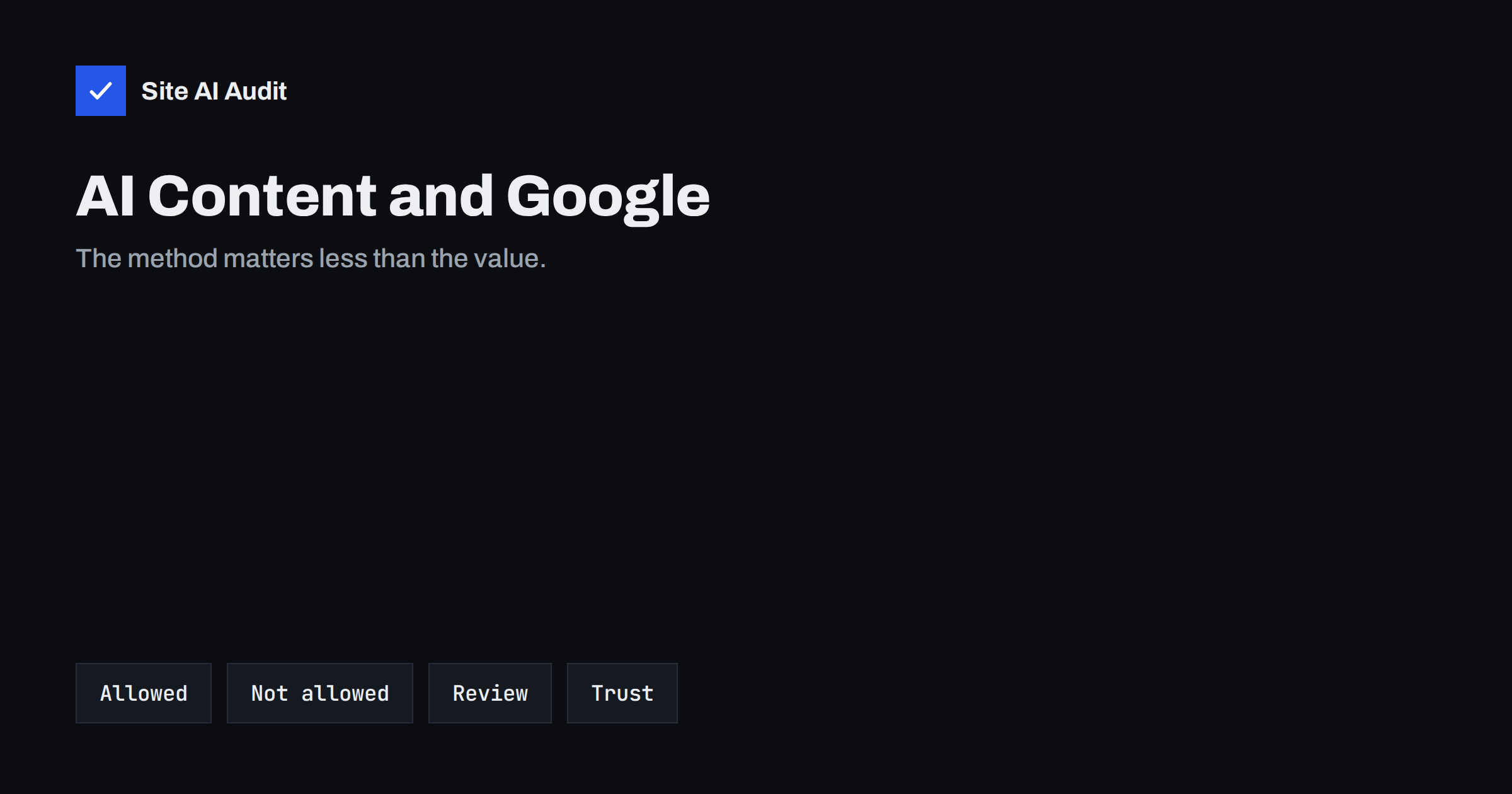
Short answer: Google does not ban content because a machine helped to write it. Its guidance says that what matters is whether the content is helpful and made for people, and its spam policies forbid producing large amounts of content mainly to manipulate rankings, however that content is made. Use automated tools as assistants, have a person check every fact, and publish only what you would be happy to stand behind.
What Google has said
Google has stated publicly that using automation or AI to create content is not against its guidelines by itself. The question is the purpose and the result. Content that exists mainly to capture search traffic, with little value for the reader, is a problem whether a person or a program wrote it. Content that answers a real need, is accurate and shows care is welcome whichever tools were involved.
The same guidance puts weight on the idea of people-first content, and on the qualities that it calls experience, expertise, authoritativeness and trust. These are the ideas behind the guide to showing trust on a small business website. A text that only repeats what is already on a hundred other pages, with no first-hand knowledge, is unlikely to stand out whether it was written in minutes or in days.
Where the real rule is: scaled content abuse
Google’s spam policies include a rule against what it calls scaled content abuse. It covers the creation of many pages mainly to manipulate search rankings and not to help users. The rule applies to the method of mass production in general: automation, human writers who are paid per page, or a mix of both. Typical examples are:
- Thousands of near-identical pages that differ only in a place name or a product term.
- Pages that combine text from other sites without adding anything useful.
- Large numbers of articles made by a program from a list of keywords, with no review.
- Rewritten copies of other people’s articles in the hope that they will not be recognised as copies.
The consequences can include lower visibility for the affected pages or for the whole site, and in serious cases a manual action, which is described in the article on manual actions in Search Console.
The practical risks of machine-written text
Apart from policy, machine-written text has real weaknesses that can hurt your site.
- Mistakes stated confidently. Tools can invent facts, prices, laws, product details or quotations. A wrong statement on a page that you publish is your responsibility.
- Sameness. Text produced from the same prompt looks similar across sites. It rarely contains your own experience, photos, data or opinions, which are what make a page worth citing.
- Thin content. Pages that sound fluent but add nothing new are exactly the kind that fall under the idea described in the article on thin content.
- Tone problems. Generic phrases and an unnatural style make readers distrust a business.
- Legal and safety risk. In areas such as health, money and law, wrong advice can harm people, and these topics are judged more strictly.
A responsible way to use AI tools
- Start with a real purpose. Decide who the page is for and which question it answers. If you cannot say it in one sentence, do not write the page.
- Bring your own substance. Add what only you have: customer questions, your process, local knowledge, measurements, photographs and examples. A tool cannot know them.
- Use tools for assistance. Drafting an outline, suggesting headings, tightening a paragraph or checking grammar are reasonable uses. Treat the output as a first draft, not as a finished page.
- Check every fact. Verify numbers, names, dates, claims and links against reliable sources. Remove anything that you cannot confirm.
- Edit for voice. Read the text aloud and change anything that sounds like nobody in particular. Add specific details.
- Show who is responsible. Use a real author or the business name and keep a contact page. The guide to author pages and bylines explains how.
- Review before publishing. Run through the blog post SEO checklist as you would for any article.
Disclosure
Google suggests that publishers think about the questions of who created the content, how it was made and why. Where readers would reasonably expect to know that automation was involved, a short note is helpful. This is a matter of honesty with your audience and not a ranking trick. A note is more important for content that looks like a personal review or a news report, and less important for routine text such as a product spec table. Each country also has its own rules on advertising and consumer information, so keep your claims truthful.
What not to do
- Do not publish hundreds of pages at once without review.
- Do not stuff keywords into generated text. The guide to keyword stuffing and over-optimization explains why this backfires.
- Do not generate fake reviews, fake authors or fake expert quotes.
- Do not rewrite other sites’ articles to avoid duplicate detection.
- Do not leave visible leftovers such as “as an AI” phrases or placeholder text.
- Do not ignore old pages. Keep the existing ones accurate, as discussed in the article on updating old content.
Examples of good and poor use
Concrete cases make the difference easier to see.
- Good: a plumber’s FAQ. The owner lists the twenty questions customers ask most often, drafts rough answers from experience, asks a tool to tidy the wording, then corrects prices, response times and safety advice by hand. The page reflects real work and real knowledge.
- Good: a summary of your own report. A tool shortens a long document that you wrote into a clear introduction, and you edit it so that it is accurate.
- Poor: five hundred city pages. The same paragraph repeated with a different town name, with no local detail. It looks like a page factory, and visitors gain nothing.
- Poor: an unchecked how-to. A tool describes a configuration step that does not exist in the current version of the software. Readers follow it and break their sites.
- Poor: a made-up expert. A page quotes a professional who does not exist. This is deceptive, and it can harm people who rely on it.
The good examples save time without lowering standards. The poor ones trade away trust for volume, and volume is rarely worth it. A small number of excellent pages usually does more for a business than a large number of forgettable ones.
How to tell if your content is good enough
Ask yourself a few honest questions before you publish. Would a customer find this page more useful than the first three results for the same question? Does it contain something that cannot be found elsewhere? Could the author explain every statement if a reader asked? Does the page lead the reader towards what they need, without hiding the answer? If the answer to any of these is no, the page needs more work, regardless of how it was produced.
Also look at results over time. Pages that earn clicks, links and enquiries are doing their job. Pages that earn nothing after several months should be improved, merged with others or removed. The overall health of a site matters more than the number of pages, which is why updates such as those in the article on Google core updates reward sites that consistently publish helpful material.
A useful habit is to keep a short editorial policy for your site, even if you are the only writer. Two or three lines are enough: which tools you use and for what, who reviews each page, and which topics need an expert’s check before publication. When an employee, a freelancer or an agency joins, the policy keeps the standard steady, and when a customer asks how your pages are produced, you have a clear and honest answer.
How Site AI Audit helps
Site AI Audit does not judge the quality of your writing or detect how text was produced. It checks the technical SEO basics that every page needs: titles and descriptions, headings, image alt texts, broken links, redirects, sitemap, robots.txt and noindex settings across up to 50 pages in the free check, plus speed, security and e-mail authentication. The first check is free and needs no sign-up. You can run a free check of your website or see the plans for weekly monitoring and alerts.
Related reading
- E-E-A-T Explained: Showing Trust on a Small Business Website
- Thin Content: What It Is and How to Fix It on Your Website
- Duplicate Content in SEO: Common Causes and How to Fix Them
- AI Overviews and Your Website: What Site Owners Can Control
The bottom line
The tool is not the issue. Helpful, accurate and original pages made for readers are welcome, and mass-produced pages made to game search are not. Use machines to save time on drafts, and spend the time you save on facts, experience and care.
DUK
Will Google penalise a page because AI wrote it?
Not for that reason alone. Google judges helpfulness and whether content is mass-produced to manipulate rankings. Low-value pages can lose visibility whoever wrote them.
Do I have to say that I used AI?
Google suggests explaining how content was made where readers would expect it. It is not a ranking factor but it builds trust, especially for reviews and reports.
Can AI tools replace a human editor?
No. They can help with drafts and wording, but a person must check facts, add experience and decide what is worth publishing.
Is it safe to use AI for product descriptions?
Yes, if each description is accurate, unique to the product and reviewed. Near-identical descriptions across hundreds of items are a risk.
How can I recover if my site is hit by a quality update?
Improve or remove weak pages, add real expertise and sources, fix technical problems and wait. Recovery usually follows sustained improvements, not quick fixes.