ENEnglish
 LTLietuviškai
 DEDeutsch
 FRFrançais
 RUРусский
 ESEspañol
 PLPolski
 ITItaliano
 UKУкраїнська
 CSČeština
 PTPortuguês
 JA日本語
JA日本語 LVLatviešu valoda
 ETEesti
 HUMagyar
 IDBahasa Indonesia
 TRTürkçe
 HIहिन्दी
 ELΕλληνικά
 ARالعربية
 THไทย
THไทย VITiếng Việt
 RORomână
 MSBahasa Melayu
 BNবাংলা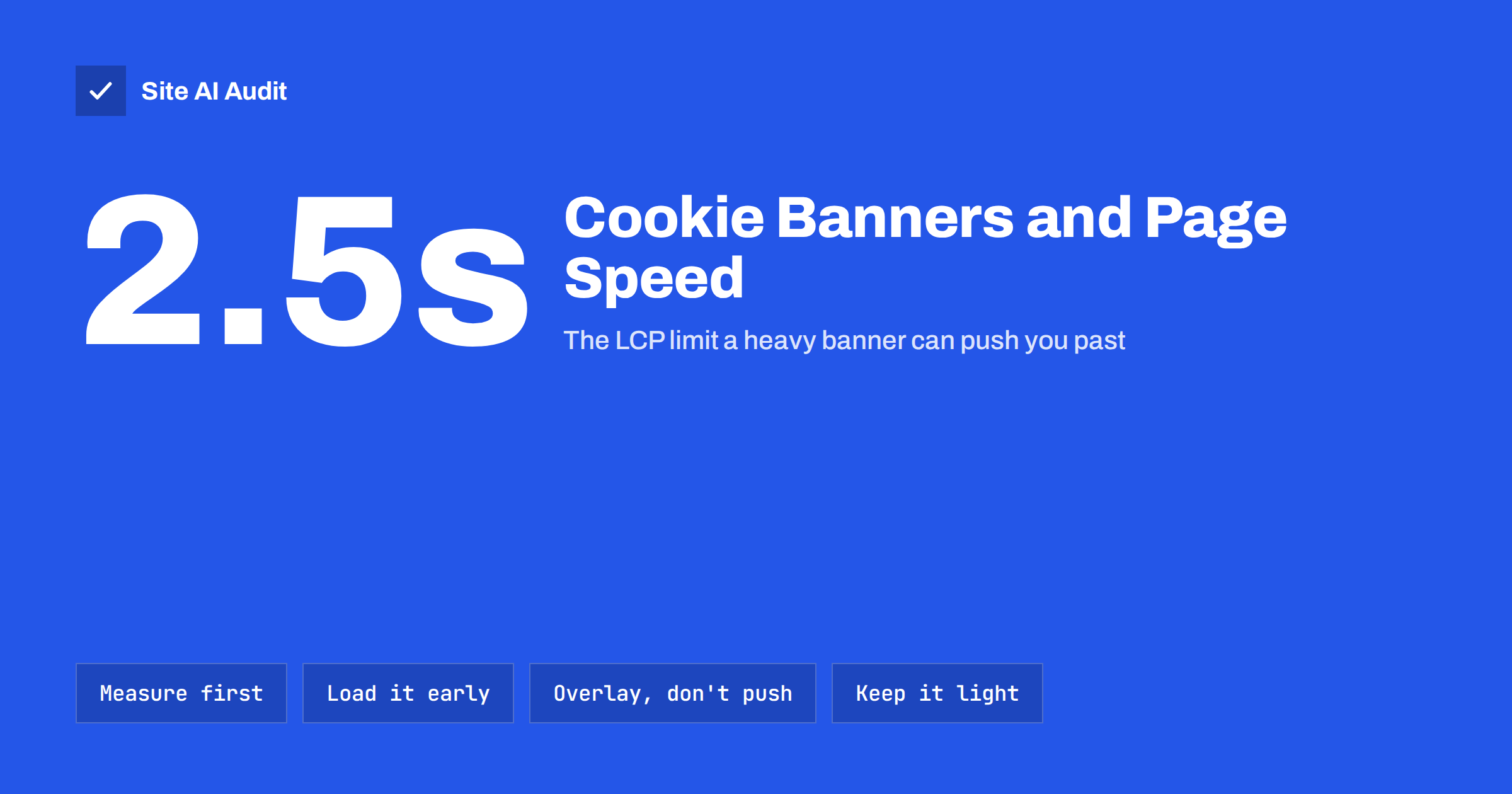
Short answer: A cookie consent banner can slow a page in three ways: its script delays rendering, the banner itself can become the largest element on screen, and a banner that pushes content down causes layout shift. Load the consent script early and directly rather than through a chain of other scripts, show it as a fixed overlay, keep its code small, and measure Core Web Vitals with and without it. Done well, a banner costs very little speed.
Why a consent banner affects speed at all
A consent banner looks like a small box of text with two buttons. Behind it there is usually a consent management script, a stylesheet, a list of vendors and purposes, and code that decides which other scripts may run. On many small business sites the banner is the first thing a visitor sees and the first thing the browser has to finish before the page feels ready.
Because it appears on every page for every new visitor, and because Google’s Core Web Vitals are collected from real visitors, a slow banner does not only hurt one page. It can drag down the field data for the whole site. New visitors, who have not yet chosen, are exactly the group that sees the banner, and they are also the group you most want to convert.
None of this is an argument against consent. In many countries you must ask before setting non-essential cookies. The goal is to ask quickly, so that compliance and speed stop pulling in opposite directions.
The three Core Web Vitals a banner can hurt
Each of the three metrics can be affected in a different way, so it helps to look at them separately.
- Largest Contentful Paint (LCP). The browser reports the largest visible element as the LCP element. On a phone, a banner with a long paragraph of text can be larger than your hero heading. If the banner script loads late, the banner renders late, and your LCP time becomes the banner’s time. Our guide to improving Largest Contentful Paint explains how the LCP element is chosen and how to check which one it is.
- Cumulative Layout Shift (CLS). A banner inserted at the top of the page that pushes the header and content down is a classic layout shift. A banner that slides in at the bottom as a fixed overlay usually does not count, because it does not move other content.
- Interaction to Next Paint (INP). Clicking “Accept” often triggers a lot of work at once: saving the choice, firing consent signals and loading every analytics and marketing tag that was waiting. If that work runs on the main thread in one block, the click feels slow and the next paint is delayed.
The good news is that each of these has a specific, well-understood fix, and none of them requires removing the banner.
How to measure what your banner costs
Before changing anything, find out whether the banner is really the problem. A few simple tests usually answer that within an hour.
- Check the LCP element. Run the page in PageSpeed Insights or in Chrome DevTools (Performance panel) and look at which element is reported as LCP. If it is the banner’s text or container, the banner is directly on your critical path.
- Compare with and without the banner. Test the page in a private window, where the banner appears, and again after accepting, when it does not. In a lab tool you can also block the consent script’s domain and compare the waterfall.
- Look at the waterfall. Note when the consent script starts downloading. If it begins only after a tag manager, a theme script and a plugin script have loaded, you have a chain.
- Record an accept click. In the Performance panel, record while clicking “Accept” and look for long tasks right after the click.
- Check field data. In Search Console’s Core Web Vitals report, see whether the whole site or only certain templates are affected. A banner problem usually shows up everywhere at once.
If you are unsure how to read the lab results, the walkthrough on reading a PageSpeed Insights report explains the difference between the field section at the top and the lab diagnostics below it.
Fix 1: load the consent script early and directly
The single most common cause of a slow banner is a loading chain. The page loads a tag manager, the tag manager loads the consent platform, the consent platform loads its configuration and language file, and only then does the banner appear. Each step waits for the previous one.
- Load the consent script directly in the page head, not from inside a tag manager, unless your platform specifically documents that setup as supported and fast.
- Add a
preconnecthint for the consent provider’s domain if the script is hosted elsewhere, so the connection is ready when it is needed. - If your platform offers a self-hosted or first-party option, consider it. Serving the file from your own domain removes a DNS lookup and a new connection.
- Check the size of the configuration it downloads. A vendor list with hundreds of entries is heavy; many small sites need only a few categories.
Be careful with async and defer here. The consent script usually has to run before other tags, so deferring it blindly can let tracking fire before consent, which defeats its purpose. Follow the vendor’s documented placement and remove the chain around it instead.
Fix 2: show the banner as a fixed overlay
How the banner is positioned decides whether it causes layout shift.
| Banner style | Layout shift risk | Notes |
|---|---|---|
| Fixed bar at the bottom | Low | Sits on top of content; nothing moves. |
| Fixed box in a corner | Low | Good on desktop; check it does not cover key buttons on phones. |
| Full-screen modal | Low for CLS | No shift, but it often becomes the LCP element. |
| Bar inserted at the top of the page flow | High | Pushes the header and content down when it appears. |
| Bar that animates height from zero | High | Every frame of the animation can count as a shift. |
If a design requirement forces the banner into the page flow, reserve its space in the initial HTML so nothing moves when it arrives. Our article on fixing Cumulative Layout Shift covers the general technique of reserving space for late content.
Fix 3: stop the banner from becoming the LCP element
When a large banner or modal is the biggest thing on a phone screen, it becomes the element that LCP measures. There are two honest ways to deal with this.
- Make the banner render fast. If the banner HTML and CSS arrive with the page instead of being built by a script later, the banner paints early and LCP stays low even when it is the largest element.
- Make the banner smaller. A compact bar with a short sentence and clear buttons is often smaller than your hero heading or image, so the page’s real content stays the LCP element. Put the detailed purpose list behind a “Settings” button.
Avoid tricks that hide the banner from measurement tools while showing it to people. They do not change what real visitors experience, and field data comes from real visitors.
Fix 4: keep the accept click light
The moment a visitor clicks “Accept” is often the heaviest moment of the whole visit. Everything that was waiting for consent starts at once: analytics, advertising pixels, chat widgets, heatmaps. To keep that click responsive:
- Close the banner and paint the result first, then load the waiting tags after the next frame.
- Review which tags really need to run on every page. Removing unused marketing tags helps both speed and privacy.
- Load chat widgets and similar tools on interaction, not on consent.
- Check the INP of the consent click in the Performance panel after each change.
This is the same discipline that applies to any external code. The guide on how third-party scripts slow down your website explains how to audit and trim them.
Choosing a consent tool with speed in mind
Consent tools differ a lot in size and in how they load. When you compare options, ask practical questions rather than relying on marketing claims:
- How large is the script, after compression, for a typical small site configuration?
- Does the banner render from HTML and CSS in the page, or is it built entirely by JavaScript after download?
- Can it be self-hosted or served from your own domain?
- Does it support the consent signals your analytics and advertising tools require, without extra scripts?
- Can you test it on a staging site and compare Core Web Vitals before switching?
For WordPress sites, check whether the consent plugin adds its own scripts and styles to every page, and whether your caching or optimisation plugin combines or delays them in a way that breaks the order of consent and tracking.
How Site AI Audit helps
Site AI Audit runs a Google PageSpeed measurement of your mobile speed and Core Web Vitals as part of a full website check, alongside SEO, SSL, security headers and e-mail authentication. The report explains each finding in plain words and ranks it by impact, so you can see whether slow LCP, layout shift or interaction delay is worth fixing first. You can start with a free website check, and paid plans can re-check after each change.
Related reading
- Core Web Vitals Explained for Small Business Websites
- Interaction to Next Paint (INP): How to Fix Slow Interactions
- Total Blocking Time Explained: What It Means and How to Cut It
The bottom line
A consent banner is a legal requirement in many places, but it does not have to be a speed problem. Measure first, load the consent script early without a chain, show the banner as a fixed overlay, keep it compact, and make the accept click light. Then check Core Web Vitals again, because the only proof that the banner is fast is the measurement.
GYIK
Does a cookie banner affect Core Web Vitals?
Yes, it can. A late banner can become the LCP element, a banner that pushes content causes layout shift, and a heavy accept click can hurt INP. A well-built banner has little effect.
Why is my cookie banner shown as the LCP element?
On phones, a banner with a lot of text can be the largest visible element. Make it render early from the page HTML and keep it compact so your real content stays largest.
Can I load the consent script with defer?
Be careful. The consent script usually has to run before other tags so tracking does not fire before consent. Follow the vendor’s documented placement and remove loading chains instead.
Does a bottom cookie bar cause layout shift?
A fixed bar that overlays content usually does not, because nothing else moves. A bar inserted into the page flow at the top does shift content and adds to CLS.
Should I remove the banner to make my site faster?
No. If you need consent under the law that applies to you, keep the banner and make it efficient. Removing it may create a legal problem that is much bigger than a speed score.