ENEnglish
 LTLietuviškai
 DEDeutsch
 FRFrançais
 RUРусский
 ESEspañol
 PLPolski
 ITItaliano
 UKУкраїнська
 CSČeština
 PTPortuguês
 JA日本語
JA日本語 LVLatviešu valoda
 ETEesti
 HUMagyar
 IDBahasa Indonesia
 TRTürkçe
 HIहिन्दी
 ELΕλληνικά
 ARالعربية
 THไทย
THไทย VITiếng Việt
 RORomână
 MSBahasa Melayu
 BNবাংলা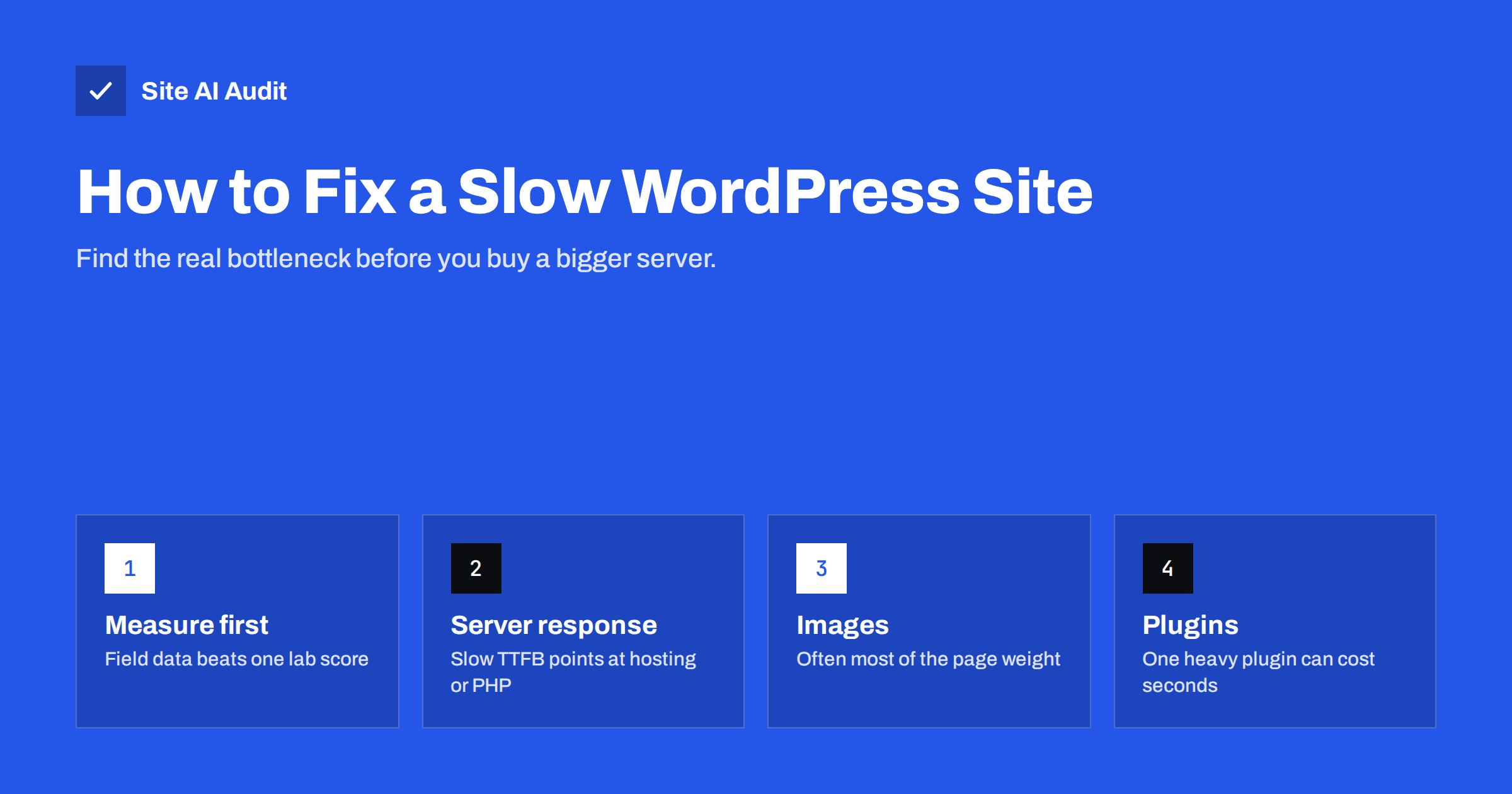
Short answer: To fix a slow WordPress site, measure first, then work from the server outwards: check server response time, turn on page caching, compress and resize images, and remove or replace heavy plugins and scripts. Most slow WordPress sites have one or two dominant causes, and fixing those gives far more than dozens of small tweaks.
WordPress itself is not slow. A clean install on decent hosting loads quickly. What slows it down is everything added over the years: a heavy theme, a page builder, twenty plugins, uncompressed photos, marketing tags and a hosting plan that was chosen when the site had ten visitors a day. The good news is that the causes are predictable, and you can check them in a fixed order.
Step 1: Measure before you change anything
Guessing is the most expensive way to speed up a website. Before you install a caching plugin or call your host, record where you are today. That gives you a baseline to compare against and tells you which part of the load is slow.
- Test the pages that matter. The home page, your most visited landing page, a blog post and, for shops, a product page and the cart. They often have very different problems.
- Test on mobile. Google evaluates your site mainly on phones, and mobile results are usually much worse than desktop.
- Look at real-user data when it exists. PageSpeed Insights shows Core Web Vitals from real Chrome users at the top of the report if your site has enough traffic. Lab scores below it are a simulation.
- Write the numbers down. Largest Contentful Paint (LCP), Cumulative Layout Shift (CLS), Interaction to Next Paint (INP), server response time and total page weight.
Run each test two or three times. Lab scores move a few points between runs, and you do not want to celebrate or panic over normal noise.
Step 2: Check server response time (TTFB)
Time to First Byte is how long the server takes to start sending the page. If it is slow, everything else waits. For a cached WordPress page, a response well under half a second is a reasonable target; if uncached pages regularly take more than a second, the server or the code behind it is the bottleneck.
Common causes of slow server response in WordPress:
- No page caching, so PHP and the database rebuild every page for every visitor.
- An outdated PHP version. Newer PHP releases are noticeably faster at running WordPress, and old versions no longer get security fixes.
- Overloaded shared hosting, where your site competes with hundreds of others for CPU.
- A plugin running slow database queries on every request, often related searches, statistics, or badly built filters.
- A server far away from your visitors. A site for customers in Germany hosted in the United States adds latency on every request.
If response time is fine, the server is not your main problem, and upgrading hosting will not help much. Move on to the front end.
Step 3: Turn on page caching the right way
Page caching stores a finished HTML copy of each page, so most visitors get it without PHP or database work. It is usually the single biggest improvement for a slow WordPress site.
- Check what your host already provides. Many managed hosts have server-level caching built in. Adding a second caching plugin on top can cause conflicts or stale pages.
- Use one caching solution, not three. Several caching plugins at once is a common reason for broken layouts and odd bugs.
- Exclude dynamic pages. Cart, checkout, account pages and anything personalised must not be cached for everyone.
- Enable browser caching for static files such as images, CSS and JavaScript, so returning visitors do not download them again.
- Consider object caching (Redis or Memcached) for busy sites with logged-in users or shops, where full-page caching cannot help every request.
After enabling caching, test again in a private browser window. If server response time dropped sharply, caching is working.
Step 4: Fix images, the usual heaviest item
On many small-business WordPress sites, images make up most of the page weight. A single photo uploaded straight from a phone or camera can be several megabytes, while the page displays it at a fraction of that size.
- Resize before or on upload. A hero image rarely needs to be wider than about 2,000 pixels, and content images are usually much smaller.
- Use modern formats. WebP is supported by all current browsers and is typically much smaller than JPEG at similar quality. AVIF can be smaller still.
- Let WordPress serve responsive sizes. WordPress generates several sizes and adds
srcset, so phones get smaller files. Themes that hard-code full-size images break this. - Do not lazy-load the main image. Lazy loading helps images below the fold, but lazy-loading the hero image delays your LCP. It should load first, ideally with high fetch priority.
Step 5: Audit your plugins and theme
The number of plugins matters less than what they do. Ten small, well-written plugins can be lighter than one bloated one. What you need to find is the plugin that adds work to every page load.
- List what each plugin does and remove the ones nobody uses anymore. Deactivated plugins do not slow the front end, but deleting them reduces risk.
- Look for plugins that load assets everywhere. A contact form plugin that loads its CSS and JavaScript on every page, when the form is only on one, is a typical example.
- Use a profiling tool. A developer plugin such as Query Monitor shows slow database queries and which plugin or theme caused them.
- Test on a staging copy. Deactivate plugins one by one on staging and measure. Never do this experiment on a live shop.
- Be honest about the theme. Multipurpose themes and page builders ship a lot of CSS and JavaScript. Sometimes the real fix is a lighter theme at the next redesign.
Step 6: Reduce render-blocking CSS and JavaScript
Browsers must download and process CSS, and any synchronous JavaScript in the head, before they can show the page. On a phone, that can add seconds.
- Load non-essential scripts with
deferso they do not block the first render. - Remove scripts you do not need: old analytics tags, abandoned A/B testing tools, chat widgets on pages where nobody chats.
- Combine or minify files only if your setup benefits from it; on HTTP/2 servers, combining matters less than it used to.
- Test after every change. Deferring the wrong script can break menus, sliders or forms.
Step 7: Check fonts, embeds and third-party tags
Web fonts, embedded videos, maps, social feeds and tracking pixels all download extra resources from other servers. Each adds a connection and often a lot of JavaScript.
- Limit fonts to the weights you actually use, and consider hosting them locally.
- Replace embedded videos with a lightweight preview image that loads the player only when clicked.
- Load maps and social feeds only where they are needed, not in the footer of every page.
- Review tags in your tag manager at least once a year. Old tags rarely get removed on their own.
Which fix should come first?
Use your measurements to decide. This table maps common symptoms to the most likely first fix.
| What you see | Likely cause | Fix first |
|---|---|---|
| Slow server response on every page | No caching, old PHP, weak hosting | Page caching, PHP upgrade, then hosting |
| Fast response, slow LCP | Large hero image, render-blocking files | Compress and prioritise the main image |
| Layout jumps while loading | Images without size, late banners, fonts | Set image dimensions, reserve space |
| Page loads but reacts slowly to taps | Heavy JavaScript, third-party tags | Remove or defer scripts |
| Only admin area is slow | Plugins, database, cron tasks | Profile queries, clean database |
How Site AI Audit helps
Site AI Audit checks a website from the outside, the way visitors and search engines see it. The speed part of the report includes the Google PageSpeed score for mobile, Core Web Vitals (LCP, CLS and INP), server response time, compression and page weight, together with SEO, SSL, security header and e-mail checks. Findings are ranked by impact and explained in plain words, so you know which of the steps above to start with. The first check of a website is free; paid plans add re-checks after every fix and weekly monitoring. See the plans for details.
Related reading
- Why Your Website Got Slower After a Redesign (and How to Fix It)
- How to Choose a WordPress Caching Plugin for Your Hosting
- 12 Website Speed Optimization Mistakes and How to Avoid Them
The bottom line
A slow WordPress site is rarely a mystery. Measure on mobile, check server response time, make sure page caching works, fix images, and then deal with plugins, scripts and third-party tags. Change one thing at a time and measure again, so you know what actually helped. Most sites get dramatically faster from the first three or four steps alone.
KKK
Why is my WordPress site so slow all of a sudden?
A sudden slowdown usually follows a change: a plugin or theme update, a new plugin, a new tracking script, or a problem at the host. Check what changed around the date the slowdown started and test server response time first. If response time jumped, contact your host or roll back the last update on a staging copy.
Do too many plugins slow down WordPress?
The number matters less than what each plugin does. A few heavy plugins that run database queries or load scripts on every page cost far more than many small ones. Profile the site and remove or replace the plugins that add the most work.
Will a caching plugin fix a slow WordPress site?
Page caching often gives the biggest single improvement, because it removes PHP and database work for most visitors. It will not fix oversized images, heavy JavaScript or slow logged-in pages. Treat it as step one, not the whole solution.
Should I change hosting to speed up WordPress?
Only if server response time stays slow after caching and a PHP upgrade. If the server answers quickly but the page is still slow, the problem is in the front end, and new hosting will not solve it. Measure first so you do not pay for the wrong fix.
What is a good load time for a WordPress page?
Google treats an LCP of 2.5 seconds or less as good, measured at the 75th percentile of real visits. Aim for that on mobile, not only on your office computer. Also keep CLS at 0.1 or less and INP at 200 milliseconds or less.