ENEnglish
 LTLietuviškai
 DEDeutsch
 FRFrançais
 RUРусский
 ESEspañol
 PLPolski
 ITItaliano
 UKУкраїнська
 CSČeština
 PTPortuguês
 JA日本語
JA日本語 LVLatviešu valoda
 ETEesti
 HUMagyar
 IDBahasa Indonesia
 TRTürkçe
 HIहिन्दी
 ELΕλληνικά
 ARالعربية
 THไทย
THไทย VITiếng Việt
 RORomână
 MSBahasa Melayu
 BNবাংলা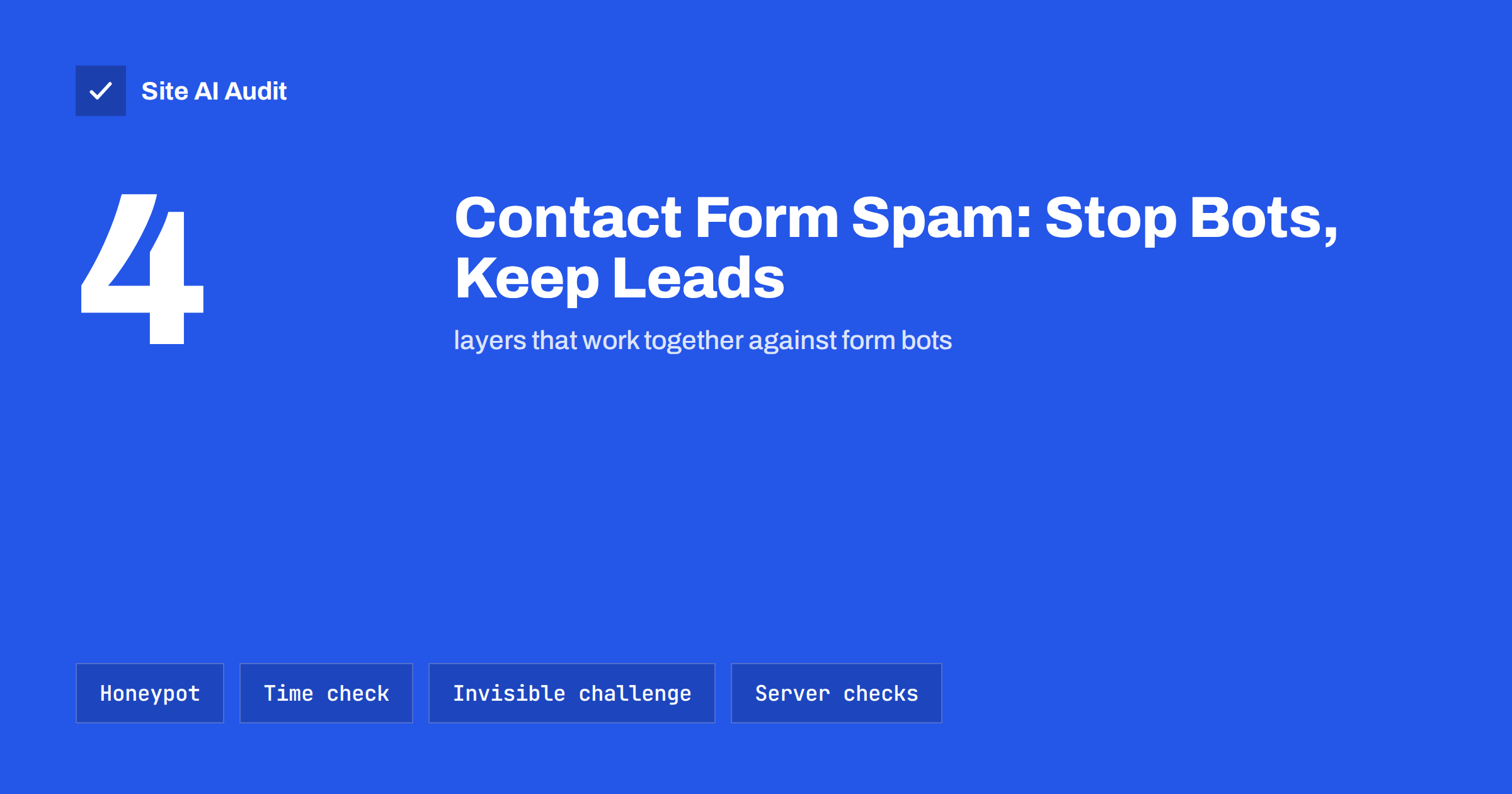
Short answer: Stop contact form spam with several light layers rather than one heavy one: a hidden honeypot field that only bots fill in, a check that the form was not submitted impossibly fast, an invisible or low-friction challenge service, and server-side validation with rate limiting and content filtering. Avoid sending automatic copies of the message to whatever address was entered, send form notifications from your own authenticated domain, and review filtered messages now and then so real leads are not lost.
Why contact forms attract spam
Automated bots crawl the web looking for forms. They do not care what your business does; a form is simply a free way to deliver text to a real person or to a website’s database. The messages usually fall into a few groups:
- Advertising and SEO spam. Offers of marketing services, links to dubious sites and attempts to get links published.
- Phishing and malware. Messages with links to fake login pages or harmful downloads, sometimes disguised as complaints or invoices.
- Abuse of your form’s e-mails. Bots enter someone else’s address so your website sends them a copy or confirmation, turning your form into a tool for flooding a victim’s inbox.
- Probing. Attempts to inject code or test whether the form is vulnerable.
Forms are attractive targets because they are everywhere and easy to find. A bot does not need to guess a password or find a vulnerability; it only needs to fill in a few fields and press send. Once a form address is known to spam networks, the volume often grows steadily over time.
Some spam is also sent by people paid to fill in forms by hand. No automated method stops all of it, which is why the goal is to remove the bulk, not to achieve zero.
The real costs of form spam
Form spam is more than an annoyance:
- Lost leads. When the inbox fills with junk, real enquiries are overlooked or answered late.
- Email reputation damage. If your form sends confirmations or copies to addresses entered by bots, those messages go to people who never asked for them, generating bounces and spam complaints against your domain. Our guide on WordPress emails going to spam explains how this affects all mail from the site.
- Security risks. Staff may click links in convincing spam, and unvalidated form input can be an entry point for attacks.
- Server load and clutter. Stored submissions fill the database, and heavy bot traffic uses server resources.
Layer 1: a honeypot field
A honeypot is an extra form field that is hidden from human visitors with CSS, for example labelled “Leave this field empty”. People never see it, but simple bots fill in every field they find. If the field contains anything, the submission is rejected.
- It is invisible to real users and costs nothing in convenience.
- Hide it with CSS rather than the
type="hidden"attribute, which bots often recognise. - Give it a plausible name and exclude it from the tab order and screen readers with
tabindex="-1"andaria-hidden="true"on its container, plusautocomplete="off"so browsers do not autofill it.
Check that the honeypot really stays hidden in every layout, including on mobile and with CSS disabled, and that its label clearly tells anyone who does see it to leave it empty.
Most popular form plugins include a honeypot option. It will not stop sophisticated bots, but it removes a large share of simple ones.
Layer 2: a time check
A person needs at least a few seconds to read a form and type a message. Many bots submit within a second of loading the page. Record the time the form was loaded, in a signed or server-side token, and reject submissions that arrive faster than a sensible minimum. Also reject forms submitted with a token from hours or days ago, which suggests replayed requests. Keep the threshold low so fast typists and autofill users are not blocked. Like the honeypot, this check is completely invisible to genuine visitors, which is what makes it so useful.
Layer 3: a challenge that people barely notice
Challenge services check whether a visitor behaves like a human, often without showing any puzzle. Common options include Google reCAPTCHA, hCaptcha and Cloudflare Turnstile. When choosing and configuring one:
- Prefer invisible or low-friction modes. Image puzzles frustrate real people, especially on phones, and some visitors give up.
- Consider accessibility. Visual and audio puzzles exclude some users; the W3C paper on the inaccessibility of CAPTCHA explains the problems and alternatives.
- Consider privacy. These services load third-party scripts and may process visitor data, which may need to be covered in your privacy notice and consent setup.
- Consider speed. Load the challenge script only on pages with forms, not site-wide.
- Verify on the server. The challenge token must be checked by your server with the provider; a check only in the browser is easy to skip.
Layer 4: server-side validation and limits
Everything in the browser can be bypassed by a bot that sends requests directly. The server has to make the final decision:
- Validate every field. Check that the e-mail looks like an e-mail, that required fields are present, and that lengths are sensible. Reject HTML where it is not expected.
- Limit links. Real enquiries rarely contain several links. Rejecting or flagging messages with many URLs catches a lot of spam.
- Rate-limit submissions. Allow only a few submissions per IP address in a short period, as with login brute-force protection.
- Use content filtering. Anti-spam services and plugins compare submissions with known spam patterns and flag suspicious messages instead of discarding them.
- Block at the edge if needed. A web application firewall or CDN bot rules can stop heavy bot traffic before it reaches the site.
Make the form’s e-mails safe
How your form sends notifications matters as much as what it blocks:
- Do not send copies to the visitor’s address by default. If you want to confirm receipt, show a message on the page instead. If an e-mail confirmation is important, keep it short, send it only after the spam checks pass and do not include the submitted text.
- Send from your own domain. The notification should come from an address on your domain, through authenticated SMTP or a transactional mail service, with SPF, DKIM and DMARC passing.
- Put the visitor’s address in Reply-To, not From. Using the visitor’s address as the sender fails authentication and is often filtered. Reply-To still lets you answer with one click.
- Monitor delivery. Send a test submission after every change to the form, plugin or mail setup.
Do not lose real leads
Every spam filter makes mistakes. Protect genuine enquiries:
- Store submissions in the website as well as sending them by e-mail, so nothing depends on a single delivery.
- Prefer “flag as spam” over “delete” for content filters, and check the flagged list weekly.
- Give a clear error message when a submission is rejected, with another way to contact you, such as a phone number or e-mail address.
- Avoid over-strict rules, such as blocking all messages with a link or from certain countries, unless you are sure no customer would be affected.
- Test the form yourself from a phone and a different network after changes.
Put together, a well-protected contact form has the following in place:
- Honeypot field enabled.
- Minimum submission time check.
- Invisible or low-friction challenge, verified on the server, loaded only where forms are.
- Server-side validation, link limits and rate limiting.
- No automatic copies to entered addresses.
- Notifications sent from your authenticated domain with the visitor in Reply-To.
- Submissions stored, flagged spam reviewed weekly.
- Form plugin and CMS kept updated.
How Site AI Audit helps
Site AI Audit does not submit your forms, but it checks what your form notifications depend on: the SPF record and its lookup limit, DKIM, DMARC and MX records for your domain. It also covers the security basics visible from the outside, such as the SSL certificate, HTTPS redirect, security headers and exposed software versions. Each finding is explained in plain words and ranked by impact. You can run a free check of your website.
Related reading
- Website Security for Small Businesses: Where to Start
- Order Confirmation Emails Not Arriving? Fix Your Shop’s Mail
- WordPress Security Checklist: 20 Steps That Actually Matter
The bottom line
Contact form spam is best stopped by layers: a honeypot, a time check, a low-friction challenge and firm server-side validation with rate limits. Make sure your form never sends mail to addresses bots enter, send notifications from your own authenticated domain, and keep an eye on flagged messages so no real customer is lost along the way.
FAQ
What is the best way to stop contact form spam?
Combine several layers: a honeypot field, a minimum time check, an invisible challenge verified on the server, and server-side validation with rate limiting. Together they stop most automated spam without bothering visitors.
Is a CAPTCHA necessary on a contact form?
Not always. Many sites stop most spam with a honeypot, time check and server validation. If spam continues, add an invisible or low-friction challenge rather than an image puzzle.
Why does my contact form still get spam with CAPTCHA?
Some spam is sent by people or by bots that solve challenges, and some forms only check the CAPTCHA in the browser. Verify tokens on the server and add content filtering and rate limits.
Can form spam hurt my email deliverability?
Yes, if the form sends copies or confirmations to addresses entered by bots. Those unwanted messages cause bounces and complaints against your domain.
Should the form notification come from the visitor’s address?
No. Send it from an address on your own domain with proper authentication and put the visitor’s address in Reply-To, so you can still answer directly.