ENEnglish
 LTLietuviškai
 DEDeutsch
 FRFrançais
 RUРусский
 ESEspañol
 PLPolski
 ITItaliano
 UKУкраїнська
 CSČeština
 PTPortuguês
 JA日本語
JA日本語 LVLatviešu valoda
 ETEesti
 HUMagyar
 IDBahasa Indonesia
 TRTürkçe
 HIहिन्दी
 ELΕλληνικά
 ARالعربية
 THไทย
THไทย VITiếng Việt
 RORomână
 MSBahasa Melayu
 BNবাংলা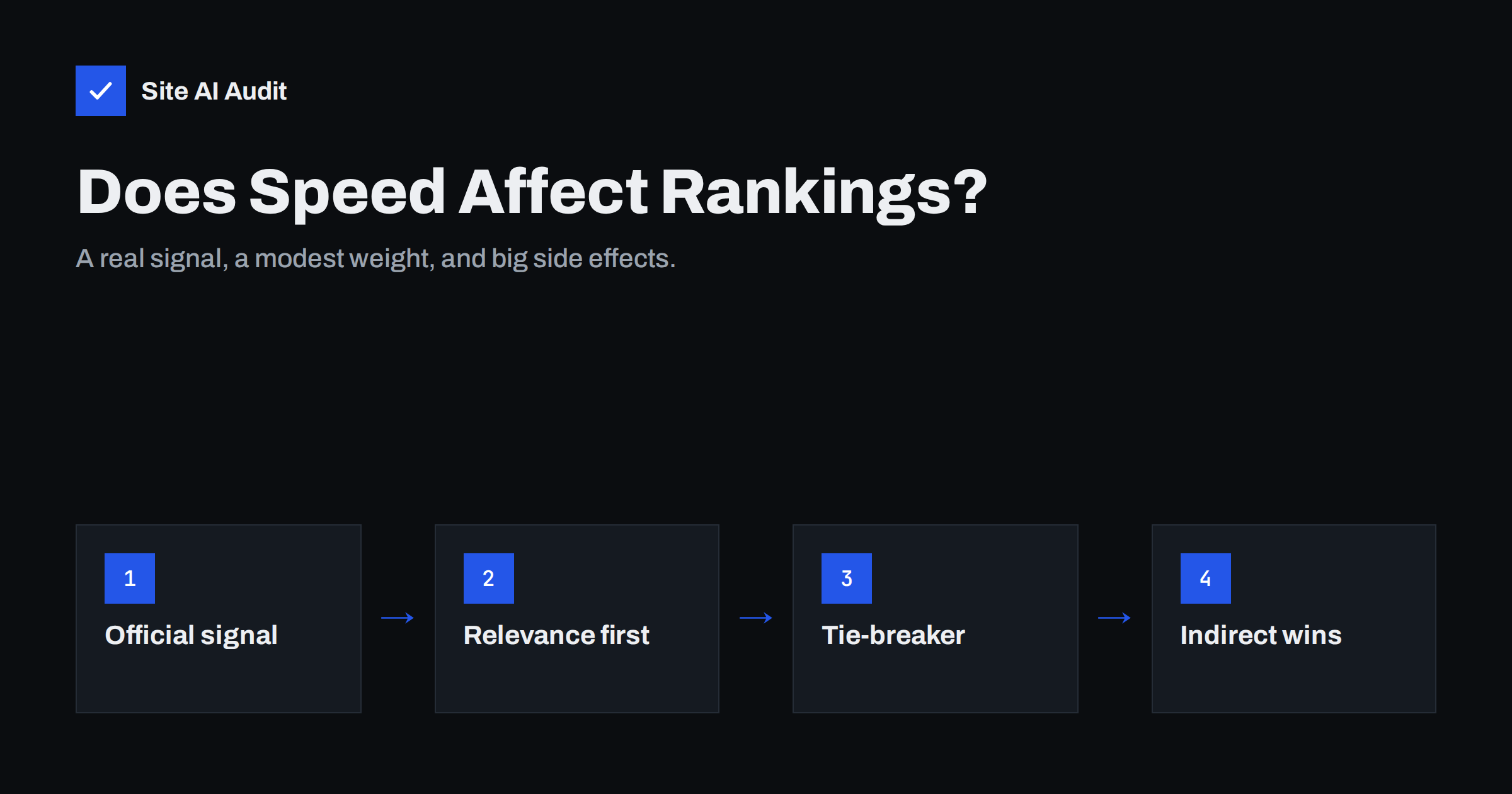
Short answer: Yes, page speed affects Google rankings, but less than many people think. Google has used speed as a signal for desktop search since 2010 and for mobile since 2018, and Core Web Vitals became part of its page experience signals in 2021. Google has stated repeatedly that relevance and helpful content matter more, and that good page experience is most likely to make a difference when several pages are similarly relevant. The bigger business effect of speed is usually indirect: visitors stay, read and convert more.
Few topics in SEO attract as many exaggerated claims as page speed. Some agencies sell speed work as a ranking miracle; some developers dismiss it as irrelevant to search. Both are wrong. This article summarises what Google has actually said publicly, what that means in practice, and how to decide how much speed work your SEO strategy needs.
What Google has said over the years
- 2010: Google announced that site speed would be used as a ranking signal in desktop search, affecting a small percentage of queries.
- 2018: The “Speed Update” extended speed as a ranking factor to mobile search. Google said it would only affect pages delivering the slowest experience to users.
- 2020–2021: Google introduced Core Web Vitals and folded them into page experience signals, together with things like HTTPS and the absence of intrusive interstitials. The rollout completed for mobile and then desktop in 2021.
- 2024: Interaction to Next Paint replaced First Input Delay as the responsiveness metric in Core Web Vitals.
- Ongoing guidance: Google’s documentation on page experience states that its core ranking systems reward content that provides a good page experience, but that relevant, helpful content is still what matters most, and good Core Web Vitals alone do not guarantee top rankings.
Google’s Search Central documentation on page experience is the authoritative source for the current position.
How much weight does speed carry?
Google does not publish weights for ranking signals, so nobody outside Google knows precisely. What Google has communicated consistently is:
- Speed and Core Web Vitals are real signals, not myths.
- They are less important than the relevance and quality of the content for the query.
- They are most likely to matter when many pages offer similarly relevant content, acting somewhat like a tie-breaker.
- There is no bonus for scoring 100 in a lab test; the signals are based on real-user data from Chrome, assessed against thresholds.
In practice, this means a very slow site can be held back, while a site that already passes Core Web Vitals will rarely gain more rankings by becoming even faster.
What Google measures: field data, not lab scores
Google’s page experience signals use field data from the Chrome User Experience Report, meaning real visits from Chrome users, collected over 28 days. That has several consequences:
- The Lighthouse performance score shown in PageSpeed Insights is not what Google uses for ranking.
- Improvements take weeks to show up in the data Google sees.
- Pages with too little traffic may have no page-level data; Google can then use data for similar pages or the whole origin.
- Mobile and desktop are assessed separately, and mobile is what counts most for most sites under mobile-first indexing.
The Core Web Vitals report in Google Search Console shows how Google groups your URLs into good, needs improvement and poor, which is the closest view you can get of how your site is assessed.
Where speed has the most SEO value
| Situation | Likely SEO value of speed work |
|---|---|
| Site is very slow and fails Core Web Vitals badly on mobile | Meaningful; worth fixing as part of SEO |
| Competitive query where top results are similarly relevant | Can make a difference at the margin |
| Large site where slow servers limit crawling | Helps crawl efficiency as well as users |
| Site already passes Core Web Vitals | Little additional ranking benefit; focus on content |
| Thin or irrelevant content | Speed will not compensate |
The indirect effects are often bigger
Even where the direct ranking effect is small, speed influences the things you get from rankings:
- More visitors reach the content. A search click on a page that does not load is wasted. Faster pages keep more of the traffic you earn.
- Better engagement and conversions. Visitors on fast, stable pages read more and are more likely to contact you or buy.
- More efficient crawling. Googlebot adjusts how many requests it makes based on how quickly and reliably your server responds. Very slow servers can limit how quickly large sites are crawled.
- Better paid campaigns. Landing page experience is a factor in ad quality, so speed also affects paid search.
Common myths about speed and SEO
- “You need a PageSpeed score of 90+ to rank.” No. Google does not use the lab score, and many top-ranking pages score poorly in lab tests.
- “Speed is the most important ranking factor.” No. Google has been clear that relevance and helpful content come first.
- “Speed does not matter for SEO at all.” Also wrong. It is an official signal and matters most for very slow sites.
- “Passing Core Web Vitals guarantees higher rankings.” No. It removes a potential disadvantage; it does not create relevance.
- “AMP is required for top positions.” No. AMP is not required for any special placement in Google Search today.
How speed interacts with other page experience signals
Core Web Vitals are not the only part of page experience. Google’s guidance also mentions serving pages securely over HTTPS, providing a good experience on mobile devices, avoiding intrusive interstitials that cover content right after a visitor arrives from search, and making it easy to distinguish the main content from ads. These factors work together. A fast page that hides its content behind a large pop-up, or a site with a broken HTTPS setup, can still give a poor experience. When you review speed for SEO purposes, review these basics at the same time; they are often quicker to fix than a slow LCP.
What if your competitors are faster?
It is common to compare your PageSpeed score with competitors and worry when theirs is higher. Before reacting, check three things. First, compare field data, not lab scores, because that is what Google uses. Second, check whether you both pass Core Web Vitals on mobile; if you do, the remaining difference is unlikely to decide rankings. Third, compare the content: if a competitor ranks above you with a slower site, relevance, depth and links are doing the work, and that is where your effort should go. Speed becomes a priority when you fail the thresholds and they pass, especially for your most important commercial pages. In that case, fixing the failing metric is a reasonable part of your SEO plan, alongside the content work.
A sensible approach for small business sites
- Check the Core Web Vitals report in Search Console and PageSpeed Insights field data for your main pages on mobile.
- If you fail, fix the biggest issues first: server response with caching, the main image, heavy scripts and layout shift.
- Once you pass, spend most of your SEO effort on content, internal links, technical indexing issues and local presence.
- Monitor speed so that new plugins, tags or designs do not undo the work.
- Judge speed work by its effect on users and conversions, not only on rankings.
How Site AI Audit helps
Site AI Audit combines speed and SEO basics in one report. It runs Google PageSpeed for mobile with Core Web Vitals, measures server response time and page weight, and crawls up to 50 pages on the free check for titles, descriptions, headings, broken links, redirects, sitemap, robots.txt and noindex issues, alongside SSL, security headers and e-mail checks. Findings are ranked by impact, so you can see whether speed or another SEO issue deserves your time first. Run a free check.
Related reading
- Core Web Vitals Explained for Small Business Websites
- Mobile-First Indexing Explained: What Your Site Needs
- Crawl Budget Explained: Does It Matter for Your Website?
- How Website Speed Affects Sales, Leads and Conversions
The bottom line
Page speed is a genuine but modest ranking signal, measured through real-user Core Web Vitals rather than lab scores. It matters most when a site is very slow or competing with similarly relevant pages. Fix speed until you pass Core Web Vitals on mobile, then put most of your SEO effort into content and technical indexing, and value speed for what it does for visitors and conversions.
SSS
Is page speed a Google ranking factor?
Yes. Google has used speed as a signal since 2010 for desktop and 2018 for mobile, and Core Web Vitals are part of its page experience signals. Google also says relevance and helpful content matter more.
Does Google use the PageSpeed Insights score for rankings?
No. The 0–100 performance score comes from a lab test. Google’s page experience signals use field data from real Chrome users, reported as Core Web Vitals.
Will improving Core Web Vitals increase my rankings?
It can help if your site was clearly failing, especially for queries where competing pages are similarly relevant. If you already pass, further speed gains rarely change rankings noticeably. The effect on visitors and conversions is often larger.
How long does it take for speed improvements to affect rankings?
Field data covers a rolling 28-day window, so improvements appear gradually in Search Console over about a month. Any ranking effect follows after that and depends on many other factors.
Does a slow server affect crawling?
Yes. Googlebot adjusts its crawl rate based on how quickly and reliably your server responds. Very slow or error-prone servers can reduce how much of a large site is crawled in a given period.