ENEnglish
 LTLietuviškai
 DEDeutsch
 FRFrançais
 RUРусский
 ESEspañol
 PLPolski
 ITItaliano
 UKУкраїнська
 CSČeština
 PTPortuguês
 JA日本語
JA日本語 LVLatviešu valoda
 ETEesti
 HUMagyar
 IDBahasa Indonesia
 TRTürkçe
 HIहिन्दी
 ELΕλληνικά
 ARالعربية
 THไทย
THไทย VITiếng Việt
 RORomână
 MSBahasa Melayu
 BNবাংলা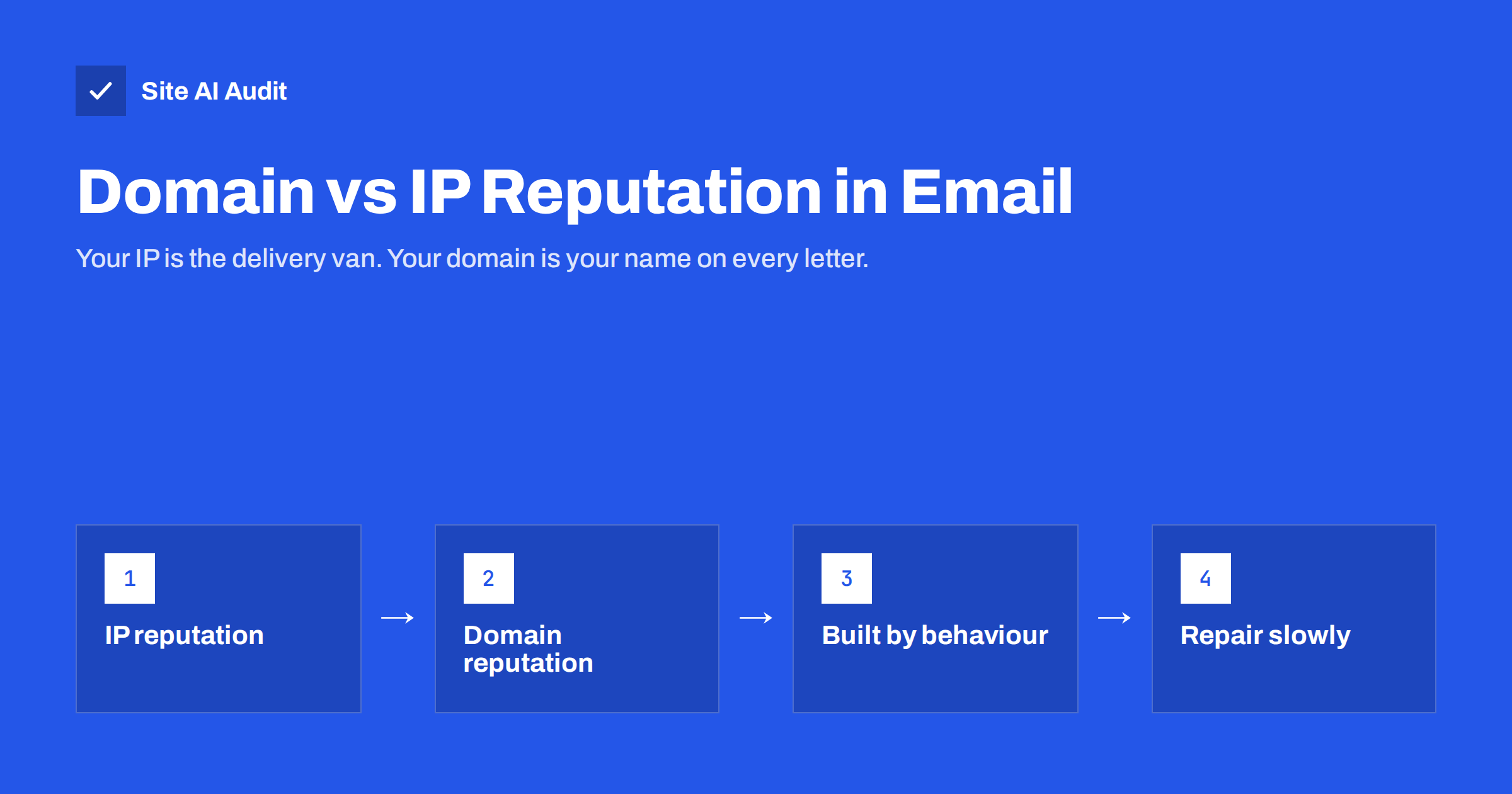
Short answer: IP reputation is the trust mailbox providers place in the server address that sends your mail; domain reputation is the trust attached to your domain name, wherever the mail is sent from. When you use a shared e-mail service, the IP reputation is mostly the provider’s, while your domain reputation is yours alone and follows you if you switch providers. Both are built from the same behaviour: authenticated mail, low complaints, few bounces and recipients who want your messages. Today, domain reputation usually matters more for small senders.
Why mailbox providers track reputation at all
Gmail, Outlook, Yahoo and other mailbox providers receive enormous volumes of mail, and a large share of it is unwanted. They cannot judge every message only by its content, so they also ask: who sent this, and how has that sender behaved before? That history is reputation.
Historically, the “who” was mainly the sending IP address. It was easy to measure and hard to fake. As more mail moved to large shared platforms and cloud services, and as authentication standards such as SPF, DKIM and DMARC made domains verifiable, providers increasingly attached reputation to domains as well. Today both are used, alongside many other signals.
No provider publishes its exact formula, and the weighting differs between them. What is well established is the kind of behaviour that improves or damages each type of reputation, and that is what you can control.
What IP reputation is
IP reputation belongs to the address of the server that hands your message to the recipient’s mail system. It is built from everything sent from that IP, by anyone.
- On a shared IP, used by an e-mail marketing platform or a business mail provider, you share the reputation with other customers. Good providers police their customers carefully, so the shared reputation is usually solid.
- On a dedicated IP, the reputation is yours alone. That gives control, but also responsibility, and it needs enough steady volume to be meaningful.
- On your own mail server, you are responsible for the IP’s configuration too, including reverse DNS and not being an open relay.
IP reputation is damaged by spam complaints, hitting spam traps, sending to many invalid addresses, sudden volume spikes and appearing on IP blocklists. Our comparison of shared and dedicated IPs for email helps decide which setup suits your volume.
What domain reputation is
Domain reputation is attached to the domain names in your messages, not to the server. Mailbox providers can see several of them:
- The domain in the visible From address.
- The domain that signs the message with DKIM (the
d=value). - The domain in the Return-Path, used for bounces and checked by SPF.
- Domains in the links and images inside the message.
When these are authenticated and aligned with DMARC, the provider can be confident that mail really comes from your domain, and can build a reliable history for it. That is one reason authentication matters so much: without it, your domain’s good behaviour cannot be credited to you properly, and others can damage your name by spoofing it.
The key practical difference is that domain reputation travels. If you move from one sending platform to another, the IP changes but your domain stays the same, and so does its history, good or bad.
Domain vs IP reputation compared
| IP reputation | Domain reputation | |
|---|---|---|
| Attached to | Sending server address | Your domain names in the message |
| Shared with others? | Yes, on shared IPs | No, it is yours alone |
| Changes when you switch provider? | Yes | No, it follows you |
| Depends on authentication? | Partly (reverse DNS, SPF) | Strongly (DKIM, SPF, DMARC alignment) |
| Typical blocklists | IP-based lists | Domain and URL-based lists |
| Who mainly manages it | Your sending provider, unless dedicated | You |
What builds and damages both
Although they are measured separately, both types of reputation respond to the same behaviour.
Builds reputation
- Full authentication: SPF, DKIM signing with your own domain, and a DMARC policy.
- Sending only to people who asked for your mail, ideally confirmed.
- Consistent, predictable volume rather than bursts.
- Recipients who open, reply, move messages out of spam or add you to contacts.
- Easy unsubscribing, including one-click unsubscribe for bulk mail.
Damages reputation
- Spam complaints, the single strongest negative signal.
- Many hard bounces from old or purchased lists.
- Hitting spam traps, which exist precisely to catch careless senders.
- Sudden large sends from a quiet domain or IP.
- Links to domains that are themselves on blocklists, such as some URL shorteners.
- Your domain being spoofed by others because DMARC is missing or weak.
Damage does not always come from your own campaigns. A contact or newsletter form on your website that bots fill with thousands of fake addresses can make your system send confirmation e-mails to strangers and spam traps. A single compromised mailbox, with a guessed or phished password, can send spam from your domain overnight. And an old tool you forgot about, such as a legacy CRM or a web shop plugin, may keep sending unauthenticated mail in your name. When reputation drops suddenly and you have not changed anything, check these sources first.
How to check your reputation
You cannot see a single reputation score, but several sources show useful pieces of it.
- Google Postmaster Tools. After you verify your domain, it shows data for mail sent to Gmail users, such as spam rate, authentication results and delivery errors. The guide to setting up Google Postmaster Tools explains what to look at. Note that it needs a certain daily volume to Gmail before data appears.
- Microsoft SNDS. If you control your own sending IPs, Microsoft’s Smart Network Data Services shows how Outlook.com sees them.
- Blocklist checks. Check both your sending IPs and your domain against major blocklists. See how to check blocklists and get delisted.
- Your sending platform’s reports. Complaint rates, bounce rates and deferrals by provider often reveal trouble before anything else does.
- Bounce messages. Rejections that mention reputation, policy or blocking, and which IP or domain they refer to, tell you which of the two is the problem.
Subdomains, new domains and switching providers
Several common strategies are really attempts to manage one reputation or the other.
- Sending marketing from a subdomain, such as
news.example.com, separates its reputation somewhat from your main domain, so a problem with campaigns is less likely to affect invoices and personal mail. It does not give complete isolation, because providers can also look at the parent domain. The pros and cons are covered in sending marketing email from a subdomain. - Switching platform gives you new IPs but keeps your domain’s history. If the problem was the old platform’s shared IPs, moving can help; if the problem was your list or content, it will follow you.
- Registering a new domain to escape a bad reputation is a pattern filters know well from spammers. New domains start with no reputation and are treated cautiously, and the underlying behaviour still has to change.
Repairing a damaged reputation
Reputation recovers when the causes are removed and good behaviour is sustained for a while. There is no instant reset.
- Find the cause: a purchased or old list, a compromised account sending spam, a website form abused by bots, or a sudden campaign to inactive contacts.
- Stop the harmful sending immediately and remove invalid and inactive addresses.
- Fix authentication gaps so all legitimate mail is aligned with DMARC.
- Restart with your most engaged recipients and increase volume gradually, as described in warming up a domain or IP.
- Request blocklist removal only after the cause is fixed.
- Watch complaint and bounce rates closely for several weeks.
How Site AI Audit helps
Site AI Audit checks the technical foundation of your domain’s e-mail reputation: SPF and its lookup limit, DKIM signatures, the DMARC policy and MX records, reported alongside SEO, speed, SSL and security headers. It does not measure your sending behaviour, but missing or broken authentication is one of the most common reasons good behaviour is not credited to your domain. A free check shows where you stand; plans with daily e-mail monitoring are on the pricing page.
Related reading
- What Is Email Deliverability? A Plain-English Guide for Owners
- Spam Traps Explained: What They Are and How to Avoid Them
- How to Reduce Spam Complaints and Keep Your Spam Rate Low
- How to Authenticate Third-Party Email Senders for Your Domain
The bottom line
IP reputation belongs to the server that sends your mail and is often shared; domain reputation belongs to your name and follows you everywhere. Both grow from the same habits: complete authentication, wanted mail, clean lists, steady volume and low complaints. For most small businesses on reputable platforms, the domain is the reputation to protect, because nobody else can repair it for you.
SSS
Which matters more, domain or IP reputation?
Both are used, and providers do not publish their weighting. For small senders on shared platforms, domain reputation is usually the one they control and the one that follows them, so it deserves most attention.
Does switching email provider fix a bad reputation?
It changes your IP reputation but not your domain reputation. If the problem came from your list or sending habits, it will continue on the new platform.
Can a shared IP hurt my deliverability?
It can if other customers on the same IP send poorly, but reputable providers monitor and separate bad senders. For low volumes, a good shared IP is usually better than a dedicated one.
How long does it take to repair domain reputation?
Typically weeks rather than days. Once the cause is fixed, steady sending to engaged recipients with low complaints gradually rebuilds trust.
Does authentication improve reputation by itself?
Not by itself, but it allows providers to attribute your good behaviour to your domain and prevents others from damaging it through spoofing. It is a precondition for a strong domain reputation.