ENEnglish
 LTLietuviškai
 DEDeutsch
 FRFrançais
 RUРусский
 ESEspañol
 PLPolski
 ITItaliano
 UKУкраїнська
 CSČeština
 PTPortuguês
 JA日本語
JA日本語 LVLatviešu valoda
 ETEesti
 HUMagyar
 IDBahasa Indonesia
 TRTürkçe
 HIहिन्दी
 ELΕλληνικά
 ARالعربية
 THไทย
THไทย VITiếng Việt
 RORomână
 MSBahasa Melayu
 BNবাংলা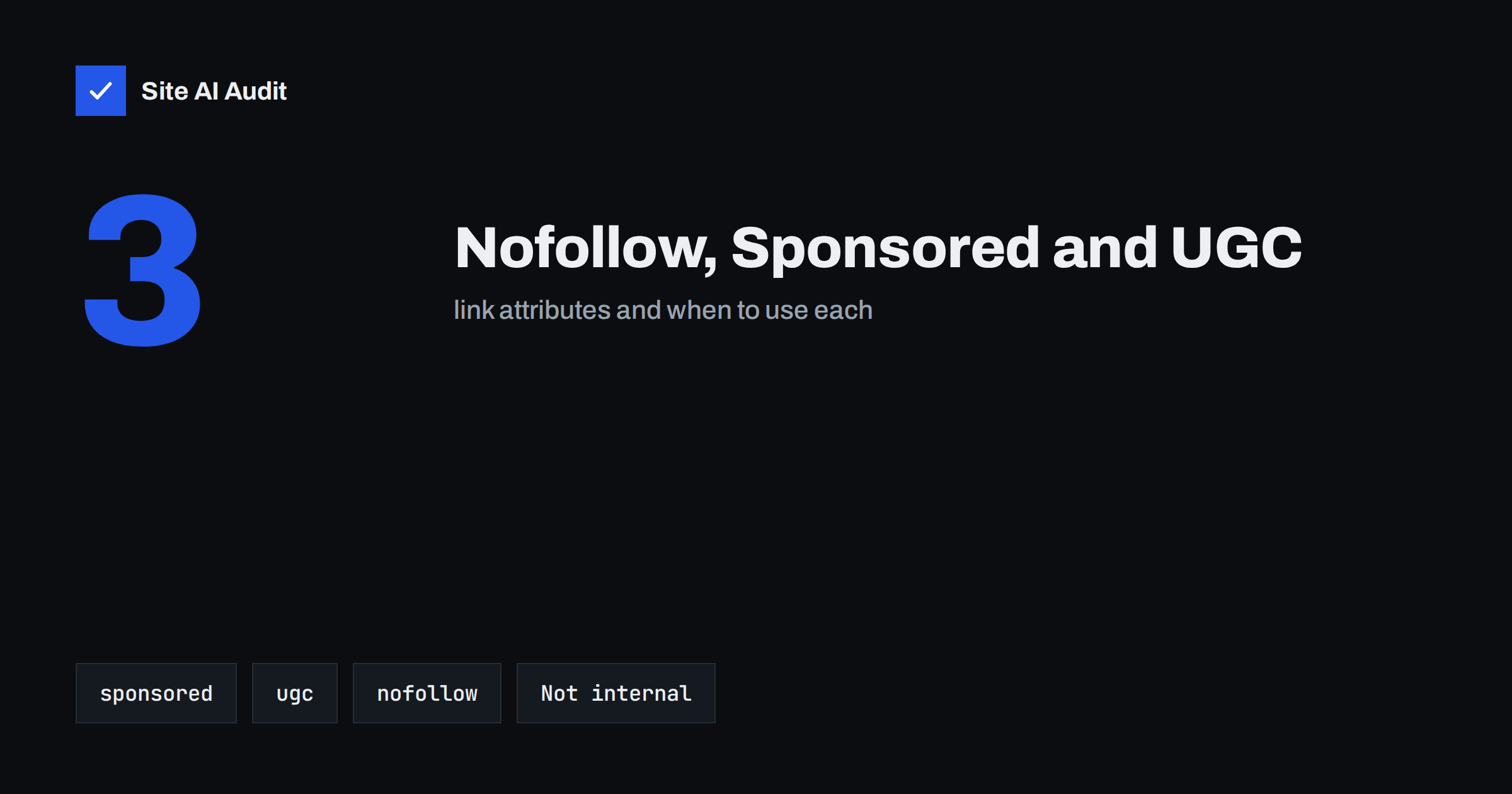
Short answer: Link attributes tell search engines how you relate to the pages you link to. Use rel="sponsored" for paid, affiliate or gifted links, rel="ugc" for links in user-generated content such as comments and forum posts, and rel="nofollow" for other links you do not want to vouch for. Leave normal editorial links and your own internal links without these attributes. Search engines treat all three as hints, and using sponsored for paid links is a requirement, not an option.
Why link attributes exist
Links are one of the ways search engines judge which pages are useful and trustworthy. A link from one site to another works a little like a recommendation. That system can be abused: people buy links, sell links, or flood comment sections with links to their own sites to manipulate rankings.
Link attributes let site owners say: “I am linking to this, but it is not an editorial recommendation.” They are added to the rel attribute of the link, for example <a href="…" rel="sponsored">. Visitors see no difference; the link works normally.
The three attributes
| Attribute | Meaning | Typical use |
|---|---|---|
| rel=”sponsored” | The link exists because of payment or another arrangement | Advertisements, affiliate links, sponsored posts, links given in exchange for free products |
| rel=”ugc” | The link is in content created by users | Blog comments, forum posts, reviews, community profiles |
| rel=”nofollow” | You do not want to endorse or pass signals to the page | Links you cannot vouch for, when sponsored or ugc do not fit |
You can combine values, such as rel="ugc nofollow". Nofollow is the oldest of the three and is still accepted for any of these cases; the newer values simply give search engines more detail. Google’s guidance on qualifying outbound links describes each value.
Hints, not commands
Since 2020, Google treats nofollow, sponsored and ugc as hints rather than strict instructions. That means Google may still use such links for discovery or to understand the web, but generally does not treat them as endorsements for ranking purposes. For site owners, the practical meaning is unchanged: mark paid and user-generated links accordingly, and you are following the rules.
Other search engines have their own policies, but all major ones support nofollow, and the sponsored and ugc values are widely recognised.
When sponsored is required
Google’s spam policies treat buying or selling links that pass ranking signals as link spam. If a link exists because money, products, services or other value changed hands, it should be marked rel="sponsored" (or nofollow). This applies to:
- paid banner and text ads that link to advertisers;
- affiliate links that earn you a commission;
- sponsored articles and guest posts written in exchange for payment;
- reviews of products you received for free, where the review links to the seller;
- links included in exchange for a discount, a service or a reciprocal favour.
Separate from SEO, consumer protection rules in many countries also require that paid content and affiliate relationships are disclosed to readers. The link attribute and a visible disclosure are two different obligations.
When ugc makes sense
Any area where visitors can add links, such as comments, forums, reviews, Q&A sections and user profiles, can attract spam links. Marking those links as ugc tells search engines you did not write them and do not necessarily endorse them. Most blog and forum software adds nofollow or ugc to user-submitted links by default.
If a trusted community member consistently adds valuable links, some platforms let you remove the attribute for them. That is your choice; it signals that you stand behind those links.
When plain nofollow is useful
Use nofollow for outbound links that are not paid and not user-generated, but that you do not want to vouch for. Examples:
- a link to a page you are criticising or warning about;
- a link to a source you must reference but do not trust;
- links in widgets or embedded content you do not fully control.
For ordinary editorial links to sources you trust, such as official documentation, research or partners you genuinely recommend, no attribute is needed. Linking to good sources is normal and helpful; there is no benefit in nofollowing everything.
Do not nofollow your own internal links
An old tactic called “PageRank sculpting” involved adding nofollow to internal links, such as links to the contact, login or privacy pages, supposedly to concentrate ranking value on important pages. It does not work that way, and it can cause harm:
- it does not redirect the value to other links;
- it can weaken discovery of the linked pages;
- it sends confusing signals about which of your own pages you trust.
If you do not want a page in search results, use noindex on that page. If you do not want crawlers wasting time on a set of URLs, use robots.txt. Leave your internal links as normal links.
Do nofollowed links still have value?
For your own site, links from other sites marked nofollow, sponsored or ugc usually do not pass ranking value in the traditional sense. They can still be valuable: they bring visitors, build awareness and may help search engines discover your pages. A mention in a popular forum or a well-read news article with a nofollow link can be worth far more in real customers than a followed link on an obscure site.
Do not chase links based only on their attributes. Chase links from places where your customers actually are.
Real-world scenarios
- A local bakery writes about its flour supplier because it genuinely likes the product, and nobody paid for the mention. A normal link is right.
- The same bakery gets free flour in exchange for a blog post. The link should be sponsored, and the post should say the flour was provided free.
- A travel blog earns commission from hotel booking links. Every booking link is an affiliate link and should be sponsored.
- A software company’s community forum lets users post links in answers. Those links get ugc automatically.
- A news site links to a scam website to warn readers. Nofollow makes sense, because the site does not want to endorse it.
- A web agency adds “Website by Agency” to the footer of client sites. If the credit is part of a paid contract, many consider it safer to make it nofollow, or to limit it to a single credit on the home page.
How to add the attributes
Most people never edit HTML to add these values:
- WordPress block editor. Link settings in many SEO plugins add checkboxes for nofollow and sponsored when you insert a link. Otherwise, the HTML view of a block lets you add the rel value by hand.
- Affiliate link plugins usually add sponsored or nofollow to every managed link automatically. Check their settings once.
- Comment and forum systems apply ugc or nofollow to user links by default.
- Ad networks and banner tools generally add the attributes to ad links, but it is worth confirming for directly sold banners.
Common mistakes
- Old sponsored posts and paid directory listings left with followed links.
- Plugins that nofollow every external link, including trusted sources.
- Nofollow added to menu, footer and other internal links.
- Assuming that a nofollow link makes a paid link acceptable without a visible disclosure to readers.
How to check and fix your links
- List your outbound links. A crawl shows external links and their attributes on every page.
- Check paid and affiliate links. Make sure every one has rel=”sponsored” or nofollow, including old sponsored posts.
- Check user-generated areas. Confirm that comment and forum links get ugc or nofollow automatically.
- Remove nofollow from internal links unless there is a specific reason.
- Look for broken outbound links while you are there, and update or remove them.
- Check plugins and themes. Some add attributes to all external links automatically, which may or may not be what you want.
How Site AI Audit helps
Site AI Audit follows the links on your pages and reports broken links and redirects, both internal and external, with the pages where they appear. It is a quick way to review your link health as part of a regular check, alongside titles, headings, indexing rules, speed and security. Run a free check of up to 50 pages.
Related reading
- Internal Linking for SEO: A Practical Guide for Small Sites
- How to Find and Fix Broken Links on Your Website
- Robots.txt vs Noindex: Which One Should You Use?
The bottom line
Use rel=”sponsored” for any link that exists because of payment or another benefit, rel=”ugc” for links added by users, and rel=”nofollow” for other links you do not want to endorse. Leave editorial links to trusted sources and your own internal links untouched. The attributes are hints for search engines, but marking paid links correctly is essential to stay within search engine policies.
FAQ
Do I have to use rel=”sponsored” instead of nofollow?
No. Nofollow remains acceptable for paid links. Sponsored is more precise and recommended, but either one keeps paid links within Google’s rules.
Should all external links be nofollow?
No. Normal editorial links to sources you trust do not need any attribute. Nofollowing every external link offers no benefit and ignores the purpose of linking.
Do affiliate links need rel=”sponsored”?
Yes. Affiliate links are paid relationships, so they should be marked sponsored or nofollow. Many countries also require a visible disclosure for readers.
Can I use nofollow on internal links to save crawl budget?
It is not a reliable method and can stop discovery of your pages. Use robots.txt for crawl control and noindex to keep pages out of search.
Do nofollow links help SEO at all?
They usually do not pass ranking signals, but they can bring visitors, awareness and discovery. Links in places your customers read are valuable regardless of attributes.