ENEnglish
 LTLietuviškai
 DEDeutsch
 FRFrançais
 RUРусский
 ESEspañol
 PLPolski
 ITItaliano
 UKУкраїнська
 CSČeština
 PTPortuguês
 JA日本語
JA日本語 LVLatviešu valoda
 ETEesti
 HUMagyar
 IDBahasa Indonesia
 TRTürkçe
 HIहिन्दी
 ELΕλληνικά
 ARالعربية
 THไทย
THไทย VITiếng Việt
 RORomână
 MSBahasa Melayu
 BNবাংলা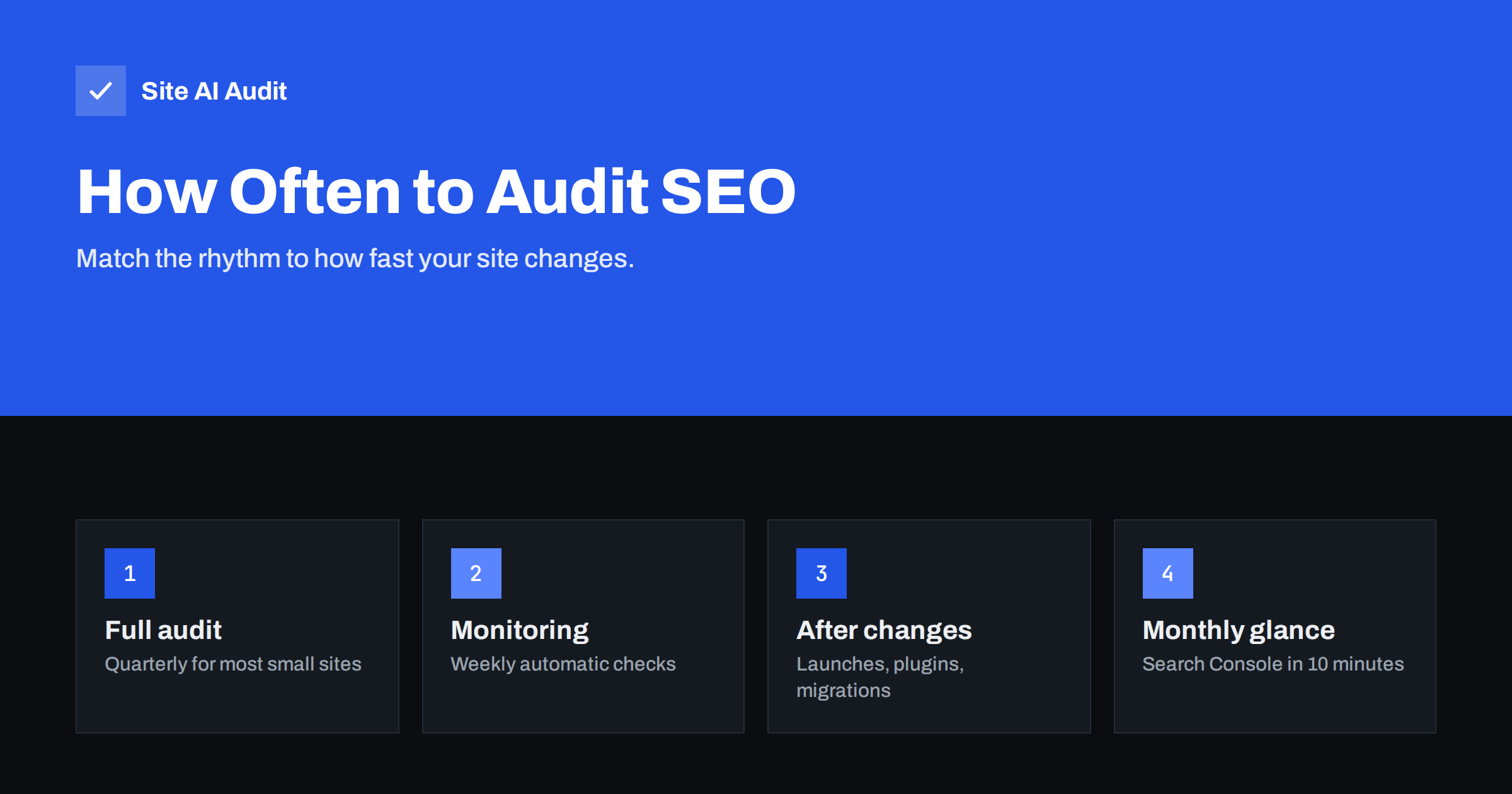
Short answer: Most small business websites benefit from a full SEO audit every three to six months, a quick monthly look at Google Search Console, and automatic monitoring that checks critical items weekly or daily. On top of that schedule, always run a check after events that commonly break things: launches, redesigns, migrations, theme or plugin changes, hosting moves and large content updates. Sites that change daily, such as shops and publishers, need more frequent checks.
Why one audit is not enough
A website is not a finished product. Pages are added and removed, plugins update themselves, certificates expire, a developer changes a template, a product range is discontinued, a hosting company changes server settings. Each change can introduce problems that nobody notices, because most SEO issues are invisible to visitors: a noindex tag, a broken redirect, a duplicated title, a robots.txt rule.
A single audit gives you a snapshot. It shows what was wrong on that day. Without follow-up, new issues accumulate, and by the time traffic drops, it can be hard to tell when and why the problem started. Regular checks turn SEO from occasional repair into routine maintenance.
Three layers of checking
It helps to think of audits in three layers, each with a different depth and frequency:
| Layer | What it covers | Typical frequency |
|---|---|---|
| Monitoring | Critical, fast-breaking items: SSL expiry, site reachability, broken key pages, e-mail authentication, noindex on important pages | Daily or weekly, automated |
| Regular review | Search Console performance and indexing reports, new errors, traffic trends | Monthly, about 10–30 minutes |
| Full audit | Crawl of the whole site: titles, descriptions, headings, links, redirects, sitemap, robots.txt, speed, content quality, structure | Every 3–6 months for most small sites |
Monitoring catches emergencies quickly. The monthly review spots trends. The full audit finds the slower build-up of smaller issues and gives you a prioritised to-do list.
A schedule by type of site
Small brochure website (up to about 50 pages, few changes). A full audit every six months, a monthly Search Console glance, and weekly monitoring of critical items. Add a check after any change to the theme, plugins or hosting.
Growing business site with a blog. A full audit every three months, because new content regularly adds titles, links and images that can go wrong. Monthly Search Console review. Weekly monitoring.
Online shop. A full audit every one to three months, depending on how often products and categories change. Product removals, stock changes and filters constantly create broken links, redirects and duplicates. Daily monitoring of SSL, availability and key pages is sensible, because downtime and certificate problems cost sales directly.
Large or fast-changing sites. Continuous crawling and monitoring, with full reviews monthly, plus log analysis for crawl behaviour.
Agencies managing client sites. Monitoring for every client, a full audit at onboarding, and regular audits built into the maintenance contract, often monthly or quarterly with a short report.
Events that always need a check
Regardless of the schedule, run a check straight after:
- Launching a new website or making a site live after development. Leftover noindex and robots.txt rules are common.
- A redesign or theme change, which can change headings, titles, internal links and structured data.
- A migration: new domain, new platform, HTTPS change, URL restructure.
- Installing, removing or replacing an SEO, caching, security or redirect plugin.
- Major core, theme or plugin updates, especially if they change settings.
- A hosting or CDN change, which can affect redirects, SSL, speed and server errors.
- Bulk content changes: deleting old posts, importing products, merging categories.
- A sudden drop in traffic or enquiries, to rule out technical causes first.
A good habit is to run a quick check before the change as well, so you have a baseline to compare against.
What to look at each time
Weekly or daily monitoring:
- Is the site reachable and responding quickly?
- Is the SSL certificate valid, and when does it expire?
- Do key pages return 200 and remain indexable?
- Are SPF, DKIM and DMARC records still in place for the domain?
Monthly review:
- Clicks and impressions compared with the previous period and the same month last year.
- New reasons in the Page indexing report, and whether important pages moved to “not indexed”.
- New security or manual action messages.
- Pages that gained or lost the most.
Full audit:
- Indexing and crawling: robots.txt, noindex, canonicals, sitemap.
- Links: broken links, redirect chains, orphan pages.
- On-page: titles, descriptions, headings, alt text, duplicates.
- Speed and mobile experience.
- Content: thin, outdated or overlapping pages; gaps compared with what customers search for.
What problems look like when nobody checks
The value of regular audits is easiest to see in the problems they catch early. These situations are typical on small business sites that go unchecked for a long time:
- The forgotten noindex. A developer ticks “discourage search engines” while fixing something on the live site and forgets to untick it. Traffic slowly fades over the following weeks as pages drop out of the index.
- The silent certificate expiry. Automatic renewal fails after a DNS change. One morning, visitors see a full-page browser warning and most of them leave.
- Link rot after a product clean-up. Two hundred discontinued products are deleted without redirects. Category pages, blog posts and external links now lead to error pages.
- The plugin swap. A new SEO plugin is installed and the old one removed. Custom titles and descriptions written for key pages are lost and replaced with templates.
- The spam folder. A new e-mail service is added without updating the SPF record, and customer e-mails start landing in spam.
Each of these is quick to fix once found. The damage comes from the weeks or months in which nobody knew.
Who should run the audit
For small businesses, the owner or marketing lead can usually run the regular checks with an automated tool and Search Console, then pass technical findings to a developer. What matters is that one named person is responsible for looking at the results on a schedule. If an agency or freelancer maintains the site, ask for audit reports as part of the arrangement, and make sure you receive monitoring alerts yourself as well, so a missed e-mail on their side does not leave a problem unnoticed.
Signs you should audit sooner
- Organic traffic or enquiries dropped noticeably without an obvious seasonal reason.
- Important pages disappeared from search results.
- Search Console sent an e-mail about new indexing issues.
- Visitors report errors, broken links or security warnings.
- Someone other than your usual team worked on the site.
- You cannot remember when the site was last checked.
Audits and seasonal businesses
If your business has a busy season, such as garden services in spring, gift shops before the holidays or tax advisers before filing deadlines, time your full audit six to eight weeks before the peak. That leaves time to fix issues and for search engines to recrawl the changes before demand rises. Avoid large technical changes during the peak itself; if something goes wrong then, it costs the most.
Making audits useful rather than overwhelming
An audit is only valuable if its findings are acted on. A few habits help:
- Prioritise by impact. Fix what removes pages from search or breaks key journeys first, then template-level issues, then individual pages.
- Keep a change log. Note what you fixed and when, so later reports and traffic changes make sense.
- Re-check after fixing. Confirm that the fix worked and did not create new problems.
- Compare with the previous audit. The trend in the number and type of findings is more informative than any single report.
- Assign owners. Decide who handles technical fixes and who handles content.
How Site AI Audit fits the schedule
Site AI Audit covers the full-audit layer for SEO basics, speed, SSL, security headers and e-mail authentication in one report, ranked by impact. The free check gives every website one audit of up to 50 pages. Paid plans add unlimited re-checks after every fix and monitoring with alerts when an SSL certificate is about to expire or a page breaks: weekly on Monitor, and daily SSL and e-mail checks on higher plans. See the plans or start with a free check.
Related reading
- SEO Audit Checklist for Small Business Websites
- How to Read the Search Console Performance Report
- New Website SEO Checklist: What to Do Before and After Launch
- Website Migration SEO: How to Move a Site Without Losing Traffic
The bottom line
Audit your site in layers: automatic monitoring for critical items weekly or daily, a monthly Search Console review, and a full audit every three to six months for most small sites, more often for shops and fast-changing sites. Always check after launches, redesigns, migrations, plugin and hosting changes. Act on the findings in order of impact, and re-check to confirm each fix.
FAQ
How often should a small business do an SEO audit?
A full audit every three to six months is enough for most small business sites, combined with a monthly Search Console review and automatic monitoring of critical items.
Is a one-time SEO audit worth it?
Yes, as a starting point. It shows current problems and priorities. But websites change constantly, so regular checks are needed to keep them healthy.
What should be monitored continuously?
Items that break suddenly and cause immediate harm: site availability, SSL certificate validity, key pages returning errors or noindex, and e-mail authentication records.
Should I audit after every WordPress update?
Not a full audit, but a quick check after major core, theme or SEO plugin updates is wise, because settings and output can change.
How long does an audit take?
Automated tools collect the data in minutes for small sites. Reviewing and prioritising findings takes an hour or two; fixing them depends on what you find.