ENEnglish
 LTLietuviškai
 DEDeutsch
 FRFrançais
 RUРусский
 ESEspañol
 PLPolski
 ITItaliano
 UKУкраїнська
 CSČeština
 PTPortuguês
 JA日本語
 LVLatviešu valoda
 ETEesti
 HUMagyar
 IDBahasa Indonesia
 TRTürkçe
 HIहिन्दी
 ELΕλληνικά
 ARالعربية
 THไทย
 VITiếng Việt
 RORomână
 MSBahasa Melayu
 BNবাংলা
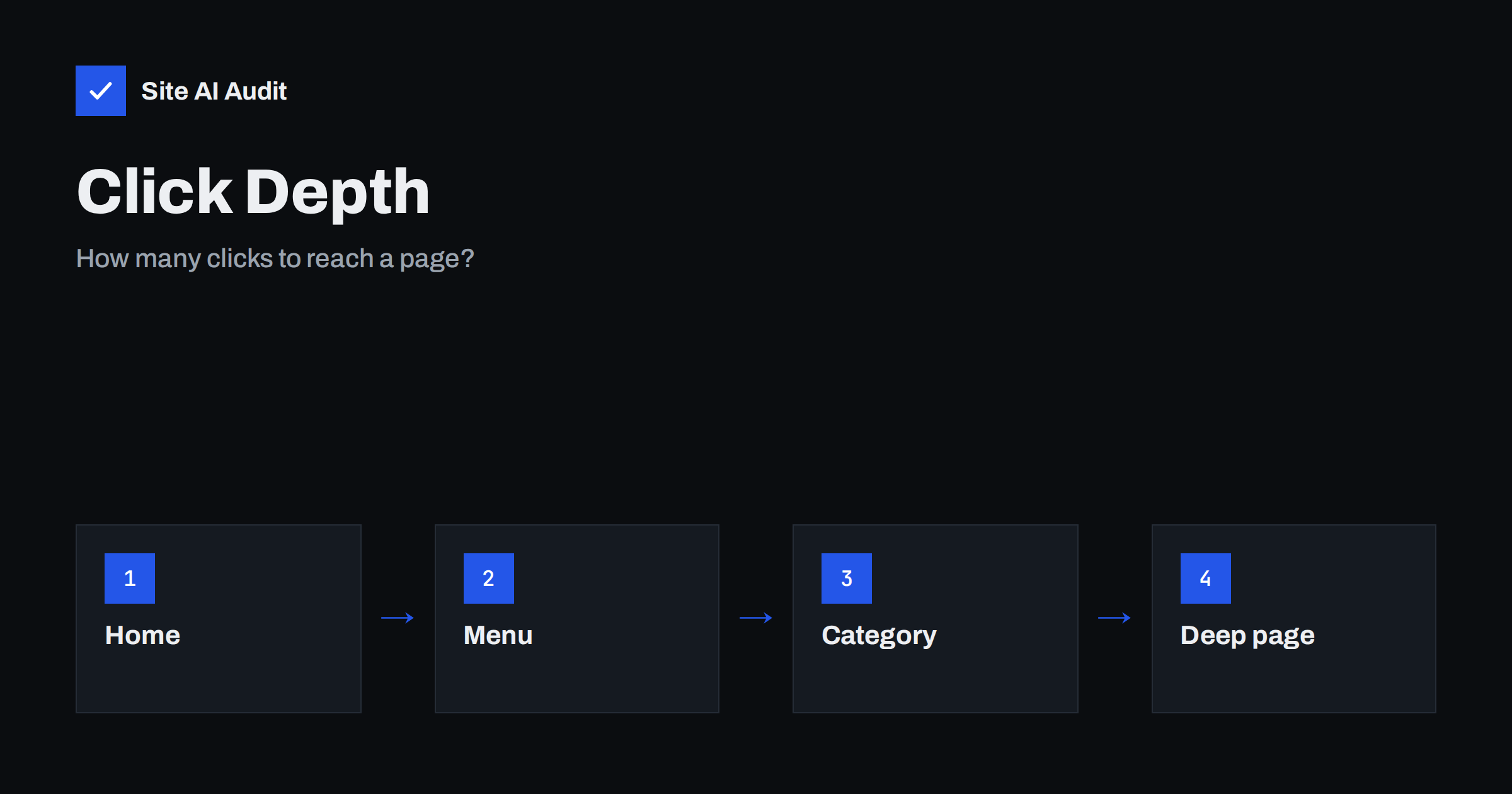
Short answer: Click depth is the smallest number of clicks needed to get from your home page to another page by following links. Pages that sit one to three clicks from home are found quickly by visitors and by search engines. Pages buried five or six clicks deep are crawled less often, receive less internal importance and are easier to miss. For most small and medium websites, keeping every important page within three clicks is a sound target.
What click depth means
Imagine your website as a building. The home page is the entrance hall. A page linked directly from the home page or its main menu is one click away. A page linked from that page is two clicks away, and so on. The number does not depend on the address of the page. A page with a short address such as /services/ can sit five clicks deep if the only link to it is hidden inside another page, and a page with a long address can be one click away if it is linked from the menu.
This is the difference between click depth and the URL structure. A tidy address does not fix a hidden page, and a deep folder structure does not matter if links make the page easy to reach. Our guide to SEO-friendly URL structure covers addresses, while this article is about the links between pages.
Why depth matters for search
Search engines find pages by following links, starting from pages they already know. The home page usually has the most authority, because it receives the most links from other websites. That strength is passed on through internal links, and it becomes weaker with each step. A page one click from home receives a large share, while a page at depth six receives very little.
There are three practical effects:
- Crawling frequency. Google visits shallow pages more often. Deep pages may be crawled rarely, so changes appear slowly. If your site is large, this connects with the idea of crawl budget.
- Perceived importance. Pages that the site itself keeps near the top look more important than pages that need many steps.
- Discovery. A page that is reachable only by a long chain can be missed entirely. In the worst case it has no links at all and becomes an orphan, a problem described in our guide to orphan pages.
Visitors behave in the same way. Each extra click loses people. If your best product or service needs four clicks to reach, many visitors never see it.
What counts as a good depth
There is no official limit, and Google has said that it is more about how pages are linked than about a fixed number. Still, a simple guideline works well for most small business sites:
- Depth 0-1: the home page and main sections such as services, products, blog and contact.
- Depth 2: categories, individual services and key landing pages.
- Depth 3: individual products, articles and detailed pages.
- Depth 4 and more: only old archives, filters and pages that you do not need to rank.
Small sites with fewer than a hundred pages rarely have a depth problem, and the goal is easy to meet. Large shops, blogs with years of articles and sites with filters are where depth grows quickly, as one new level of categories can push thousands of pages down.
How to measure it
You can measure click depth with a crawler. A crawler starts at the home page, follows links and records how many steps each page needed. Many SEO tools show this as a column called depth or crawl depth, and some draw a map of the structure. Sort pages by depth and look at the deepest ones. For each, ask whether it matters. If it does, it should be closer.
A manual check also works for small sites. Open the home page and try to reach five important pages without using search. Count the clicks. Do the same on a phone, because mobile menus sometimes hide links that appear on desktop, and Google uses the mobile version of your site first, as explained in our article on mobile-first indexing.
Compare your crawl with the XML sitemap. A sitemap helps search engines discover pages, but it does not replace internal links. A page that appears only in the sitemap is still weakly connected. Our XML sitemap guide explains what the file can and cannot do.
How to flatten a deep structure
You rarely need to rebuild the whole site. A few targeted changes usually produce a flatter structure:
- Improve the main menu. Link the most important categories and services directly. Avoid hiding them in dropdowns that need hover on a phone.
- Add links from strong pages. Put links to important deep pages on the home page, on popular articles and on category pages. A “popular” or “featured” block is a simple way to do this.
- Use hub pages. A pillar page that links to all related articles brings them closer to the top. See our guide to topic clusters and pillar pages.
- Link related content to each other. A short list of related pages at the end of each article creates cross-links that shorten paths. Our internal linking guide shows how to choose anchors.
- Add breadcrumbs. They give every page a link back to its parents. See breadcrumbs for SEO.
- Review pagination. Long lists split into many pages push old items far from home. Larger pages, or links to older items from the category page, help. Our article on pagination best practices goes into detail.
- Remove or merge weak pages. Fewer pages mean a shorter structure.
Mistakes to avoid
Do not try to put everything in the main menu. A menu with sixty items confuses visitors and dilutes the value of each link. Aim for a clear, short list and use other areas for secondary links.
Do not rely only on search boxes, filters or scripts to show pages. Links that appear only after a user action may not be found. Make sure that important pages have normal links in the HTML.
Do not chase a perfect number. A page at depth four is not a disaster if it is not important. The target is about priority: pages that earn money or answer common questions should be close, while archives and rarely needed pages can sit deeper. Finally, avoid creating endless filter combinations that generate many deep pages, a trap described in our article on faceted navigation.
Depth on different types of sites
The right approach depends on what you run. On a brochure site for a local business, everything should be reachable from the menu or the home page, and depth is almost never a problem. On a blog, new articles are near the top while old ones slide down the archive pages. Link to your best older articles from new ones, and keep a page that lists the most useful guides. On an online shop, categories and subcategories can multiply, so check that products are not hidden behind several levels of filters. Our guide to category pages for e-commerce covers this in detail.
On a multilingual site, each language version has its own structure, and a language switcher that leads only to the home page leaves translated pages weakly linked. Make sure that each version has its own menu and links.
A worked example
Take an imaginary small training company with a blog of eighty articles and ten service pages. A crawl shows that the service pages are at depth two, which is fine, but the five most useful guides sit at depth five, because they were published two years ago and are now on page seven of the blog archive. They get almost no search traffic, although the topics are popular.
The fix takes an afternoon. The company adds a “Start here” page with links to the ten best guides and puts it in the main menu. It adds a block of featured guides to the home page and links to the guides from three recent articles. The guides move to depth one or two. In a case like this Search Console can show more impressions for such guides after a few weeks, because Google tends to crawl better-linked pages more often. The structure did not change, only the links did.
What Site AI Audit can and cannot tell you
Site AI Audit crawls up to 50 pages of your website the way a search engine does. It reports titles, descriptions, broken links, redirects, the XML sitemap and robots.txt status, and pages blocked by noindex. Broken and redirected internal links, which weaken your structure, show up in the report. It does not draw a map of your site or rank every page by click depth, so use a dedicated crawler for a full depth analysis of a large site. You can run a free check of your website or see the plans.
Related reading
- Internal Linking for SEO: A Practical Guide for Small Sites
- Orphan Pages: How to Find Pages With No Internal Links
- Crawl Budget Explained: Does It Matter for Your Website?
- Breadcrumbs for SEO: Why They Help and How to Add Them
The bottom line
Click depth shows how easy it is to reach a page by links. Keep valuable pages within about three clicks, link to them from strong pages, and use menus, hubs, breadcrumbs and related links to shorten the paths. Measure with a crawler, fix the pages that matter most first and accept that unimportant pages can sit deeper.
FAQ
What is a good click depth for SEO?
For most sites, within three clicks of the home page for all important pages. Less important archives and filters can be deeper.
Is click depth the same as the number of folders in the URL?
No. Click depth counts the steps of links needed to reach a page. A short address can be deep, and a long address can be shallow.
Does Google ignore pages that are more than three clicks deep?
No, there is no hard limit. But deep pages are usually crawled less often and receive less internal importance, so they can perform worse.
Does the XML sitemap fix a depth problem?
It helps discovery, but it does not pass importance the way internal links do. A page that is only in the sitemap is still weakly connected.
How do I find my deepest pages?
Run a crawler that reports crawl depth, sort pages from deepest to shallowest and review those that you want to rank.