ENEnglish
 LTLietuviškai
 DEDeutsch
 FRFrançais
 RUРусский
 ESEspañol
 PLPolski
 ITItaliano
 UKУкраїнська
 CSČeština
 PTPortuguês
 JA日本語
 LVLatviešu valoda
 ETEesti
 HUMagyar
 IDBahasa Indonesia
 TRTürkçe
 HIहिन्दी
 ELΕλληνικά
 ARالعربية
 THไทย
 VITiếng Việt
 RORomână
 MSBahasa Melayu
 BNবাংলা
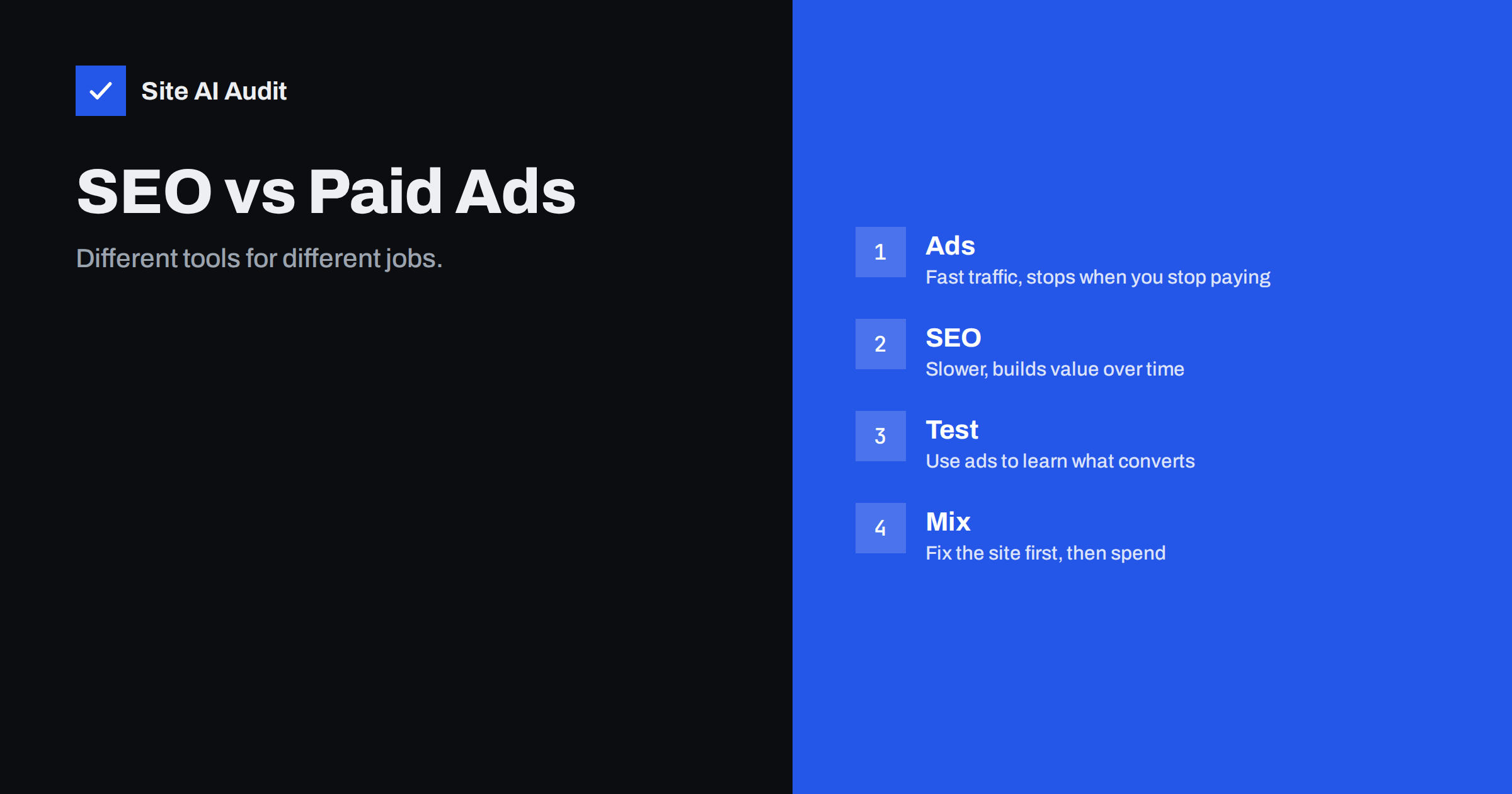
Short answer: Paid ads bring visitors quickly and stop when the budget stops, while SEO takes longer to build and keeps working without a payment for every click. Neither is better in every case. Small businesses with urgent needs or a new offer often start with ads, and those with steady demand and limited budgets should invest in SEO. Most do best with a mix, once the website itself is ready to turn visitors into customers.
What each option actually is
SEO, or search engine optimisation, is the work of making your website easy for search engines to find, understand and trust, so that your pages appear in the ordinary results without payment. You pay in time, skills and sometimes an agency, but not per click.
Paid search advertising places your message at the top of the results for chosen phrases. You pay each time someone clicks, or sometimes each time the ad is shown, and you choose the phrases, the message, the budget and the audience. The ad is labelled as an advertisement, so visitors know that it is paid.
The two are not rivals in the sense that one replaces the other. They draw from the same pool of searches, but they work on different clocks and with different risks.
Speed: days against months
An ad campaign can send visitors within hours of approval. That makes ads useful for a launch, a seasonal offer, an event or a business that needs customers this month. If a campaign does not work, you find out quickly and can change it.
SEO moves slowly. Technical fixes can be noticed within weeks, but visible growth in traffic usually takes months, and competitive phrases longer. The slow start is the main cost of SEO. The reward is that a page that ranks well can bring visitors for a long time. If you cannot wait, plan for ads in the meantime.
Cost: a tap you turn on or an asset you build
With ads, every visitor has a price, and the price depends on competition for the phrase. Popular commercial phrases can be expensive, especially in crowded local markets. Costs rise when more advertisers bid, and a campaign that was profitable last year can stop being profitable without any change on your side.
With SEO, the cost is mostly upfront and ongoing effort: writing and improving pages, fixing technical problems, earning mentions. Once a page ranks, additional visitors cost nothing extra, so the cost per visitor falls over time. The risk is that you spend months and see little, because rankings depend on factors you cannot fully control.
A fair comparison looks at cost per customer, not cost per click. A cheap click that never converts is worse than an expensive click from someone ready to buy.
It also helps to count your own time. Writing pages, checking reports and fixing technical problems take hours, and those hours have a price even when no invoice arrives. If you do the work yourself, estimate how many hours a month it needs and decide whether that time is better spent elsewhere. If you hire help, ask what exactly is included and how progress will be reported.
Control and certainty
Ads give you precise control. You choose the exact phrase, the wording, the page the visitor lands on, the hours and the locations. You can pause or increase spending the same day. This makes ads good for testing.
SEO gives less control. You can improve your pages, but you cannot choose your position, and algorithm changes can move rankings in either direction. Our article on SEO myths for small businesses lists promises that nobody can keep, such as guaranteed first place.
Trust and click behaviour
People know that ads are paid for, and many prefer to click ordinary results, especially when they research a purchase or want advice. Pages that rank well can feel more credible, and informative content builds trust before the visitor ever speaks to you. On the other hand, ads sit at the top and are seen first, which helps when the search shows strong buying intent, such as a person who needs an urgent repair.
The type of search matters. Questions and comparisons suit SEO and content. Urgent and high-intent searches suit ads, particularly when your listing needs to stand out. Our guide to search intent explains how to read the difference.
When each option makes more sense
When ads fit better
- You are launching. A new business or offer has no rankings yet, and ads can bring the first visitors and first data.
- The offer is time-limited. A sale, an event or a seasonal service cannot wait six months.
- You need to test. Ads show quickly which phrases and messages produce enquiries, before you invest in long-term content.
- Organic competition is too strong. If the top results are dominated by large brands, ads may be the only practical route for a while.
- The value of a customer is high. If one new client pays for many clicks, even expensive phrases can work.
When SEO fits better
- Demand is steady. Services that people need all year, such as accounting or plumbing, reward a lasting presence.
- The budget is limited. A small, steady investment in content and technical quality can outlast a short burst of spending.
- Customers research before buying. Guides, comparisons and answers bring people who are still deciding.
- You have knowledge to share. Expertise turns into pages that others link to and cite, as described in backlinks for small businesses.
- You serve a local area. Local visibility has its own tools, covered in local SEO basics.
Seasonality matters too. If your best months are short, ads can concentrate spending into those weeks, while SEO pages built in the quiet months are ready when demand returns. Looking at the last two years of enquiries by month, even in a simple spreadsheet, shows when each approach would have helped most. That plan costs nothing and often changes where the first euro is spent.
Using both without wasting money
The best results usually come from using the two together, each for what it does best. Ads cover the gap while rankings grow, and the data from ads guides what to write. Pages that rank can later allow you to reduce spending on the same phrases.
- Start with the website. Ads and SEO both send visitors to the same pages. If those pages are slow, broken or unclear, you pay for visitors who leave. Our guide to landing page speed for paid ads shows how speed affects results.
- Run a small ad test. Use a limited budget to learn which phrases lead to enquiries, not only clicks.
- Build content around the winners. Phrases that convert in ads are good candidates for pages and guides.
- Measure the whole path. Track enquiries, calls and sales, not only visits. Connect Search Console for organic data and use the ad platform’s reports for paid data.
- Reduce ad spend where organic is strong. If a page already ranks well for a phrase and brings customers, check whether the ad adds enough extra to justify its cost.
Mistakes to avoid
The most expensive mistake is sending paid traffic to a weak page. A site that loads slowly or confuses visitors wastes every click. The second is stopping all SEO work because ads are running, and then finding that the traffic disappears when the budget ends. A third is judging SEO after two months and giving up just before it starts to show. The first-year view in small business SEO mistakes covers more of these traps.
How Site AI Audit helps
Whichever route you choose, visitors arrive at your website, and Site AI Audit checks that the basics hold up. The free check crawls up to 50 pages and reports on-page problems such as missing titles, descriptions and headings, broken links and redirects, along with speed measures such as the PageSpeed score, LCP, CLS and INP, security headers, SSL and e-mail authentication. Each finding comes with a plain-language fix. It does not manage ad campaigns or predict rankings. The Monitor plan repeats the check every week and sends e-mail alerts when something breaks. You can run a free check of your website or see the plans.
Related reading
- Keyword Research for Small Businesses: A Simple Method
- How Website Speed Affects Sales, Leads and Conversions
- How to Prioritise SEO Audit Findings: What to Fix First
- Does Page Speed Affect Google Rankings? What We Actually Know
The bottom line
Choose ads when you need visitors now, want to test or have a high-value offer. Choose SEO when you can wait and want a lasting source of visitors. Combine them when you can, but make sure that the website is fast, clear and working before you spend on either. A good page serves both, and a bad page wastes both.
FAQ
Is SEO cheaper than paid ads in the long run?
Often it is, because a ranking page keeps bringing visitors without a charge per click. The result depends on competition and quality, so there is no guarantee.
Can paid ads improve my organic rankings?
Not directly. Ads do not change how pages are ranked in the ordinary results, though they can bring visitors who later link to or search for your brand.
Should a new business start with SEO or ads?
Many start with a small ad budget for fast data and begin SEO work at the same time, since SEO takes time to show results.
How much should I spend on ads?
Start with an amount you can afford to lose while you learn, and judge it by cost per enquiry or sale. Increase it only when the numbers support it.
What happens to traffic if I stop running ads?
Traffic from the ads stops with the budget. Organic visitors continue, which is why a mix is more stable than relying on one source.