ENEnglish
 LTLietuviškai
 DEDeutsch
 FRFrançais
 RUРусский
 ESEspañol
 PLPolski
 ITItaliano
 UKУкраїнська
 CSČeština
 PTPortuguês
 JA日本語
JA日本語 LVLatviešu valoda
 ETEesti
 HUMagyar
 IDBahasa Indonesia
 TRTürkçe
 HIहिन्दी
 ELΕλληνικά
 ARالعربية
 THไทย
THไทย VITiếng Việt
 RORomână
 MSBahasa Melayu
 BNবাংলা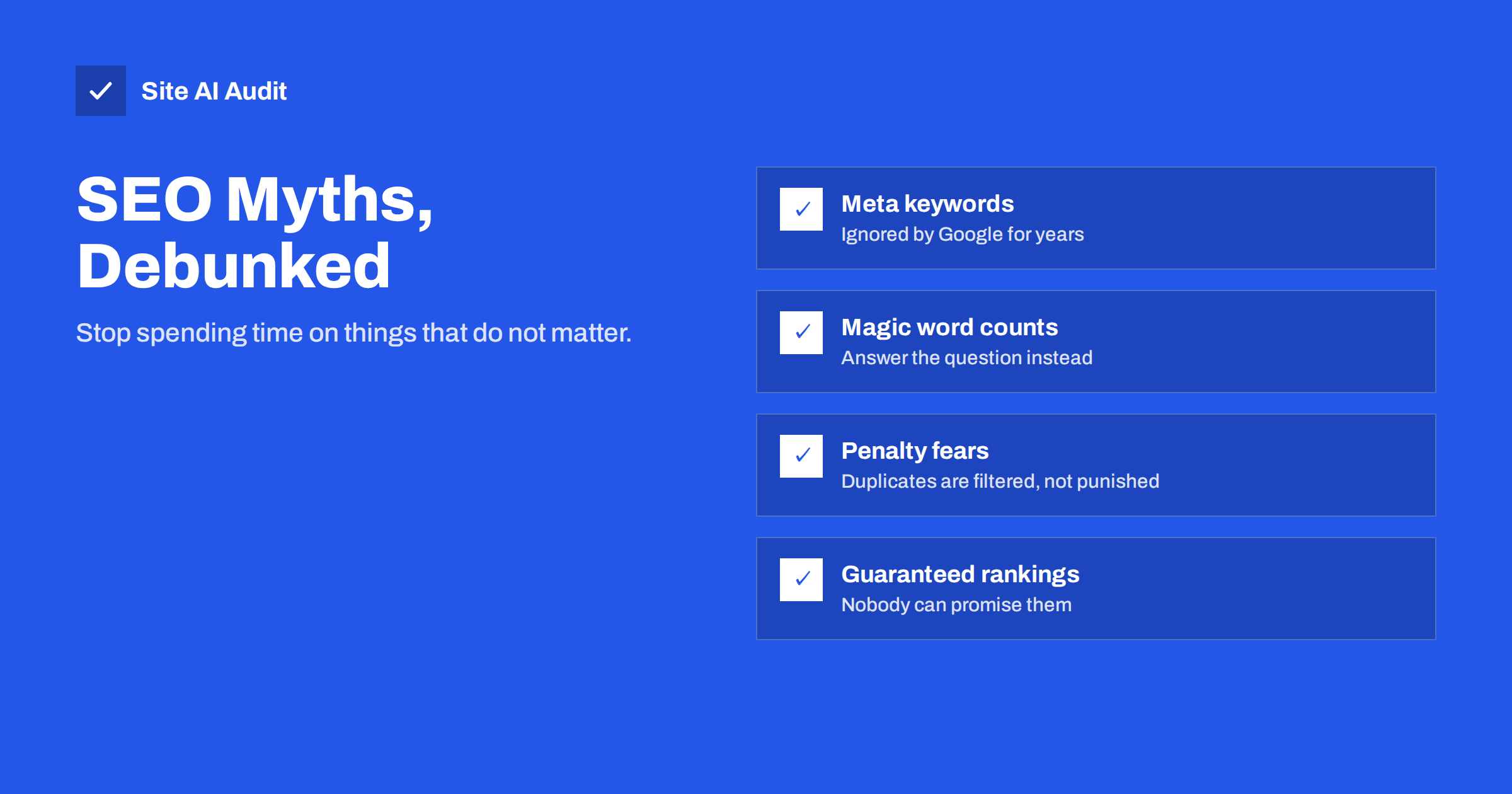
Short answer: Many popular SEO beliefs are outdated or were never true: Google ignores the meta keywords tag, there is no ideal word count, you do not need to submit your site repeatedly, duplicate content is rarely a penalty, and nobody can guarantee rankings. What actually matters for most small businesses is simpler: pages search engines can crawl and index, clear titles and content that match what customers search for, a sound technical setup, genuine reviews and patience.
Why myths persist
SEO has changed a great deal over twenty-five years. Advice that was true in 2005 or 2012 still circulates in old articles, forums and sales pitches. Some myths survive because they sound logical, others because someone profits from them. For a small business with limited time, believing them is costly: effort goes into tasks that do nothing while the real problems stay unfixed.
Here are the myths that come up most often, and what is true instead.
Myth 1: “You need meta keywords”
The <meta name="keywords"> tag was abused so heavily that Google stopped using it for ranking back in 2009, and said so publicly. Filling it in does not help and reveals your target keywords to competitors. What matters instead: the title tag, headings and content, written in the words customers use.
Myth 2: “Every page needs at least 2,000 words”
There is no minimum or ideal word count for ranking. Search engines look for pages that answer the searcher’s need. A question about opening hours needs one line; a guide to choosing a heat pump may need thousands of words. What matters instead: completeness and usefulness for the specific intent. Look at what currently ranks, then be clearer and more helpful, not just longer.
Myth 3: “You must submit your site to Google regularly”
Search engines discover pages through links and sitemaps. Paid “submission to 500 search engines” services are useless, and resubmitting the same pages daily does nothing. What matters instead: verify the site in Google Search Console once, submit an XML sitemap, link new pages from existing ones and request indexing for important new or changed pages.
Myth 4: “Duplicate content gets you penalised”
For normal websites, duplicate content is filtered, not punished. Search engines pick one version to show. Penalties are for deliberate, large-scale copying and spam. What matters instead: consolidating duplicates with redirects and canonical tags so the right version shows, and writing original content where it matters, such as product descriptions.
Myth 5: “Keyword density should be exactly X percent”
Search engines understand topics, synonyms and context. Repeating a phrase a set number of times does not help and makes text read badly. What matters instead: using the main phrase naturally in the title, H1 and opening, covering the related questions and terms a complete answer would include, and writing for people.
Myth 6: “SEO is a one-time job”
A website changes constantly, as do competitors and search engines. Certificates expire, plugins update, pages are added and removed. What matters instead: a solid initial setup followed by routine maintenance: regular audits, monitoring and content updates.
Myth 7: “More pages always means more traffic”
Publishing large numbers of thin, similar or auto-generated pages rarely helps and can make it harder for your best pages to stand out. What matters instead: fewer, stronger pages that each answer a real need, plus merging or removing weak ones.
Myth 8: “Social media likes improve rankings”
Likes and shares are not a direct ranking factor. Social activity can bring visitors, awareness and sometimes links, which have value in their own right. What matters instead: treat social media as a channel to reach customers, not as an SEO lever.
Myth 9: “You need hundreds of backlinks”
For many local and niche businesses, a small number of genuine, relevant links and mentions, together with a strong Business Profile and good reviews, is enough to compete. Bought links in bulk break search engine policies and can harm you. What matters instead: being worth mentioning, and joining the local and industry organisations that naturally list you.
Myth 10: “HTTPS, speed and mobile do not matter for small sites”
Browsers show warnings on sites without valid HTTPS, most local searches happen on phones, and Google uses page experience signals, including Core Web Vitals, as part of its ranking systems. What matters instead: a valid certificate, a mobile-friendly design and reasonable speed on phones. These are basics, not extras.
Myth 11: “Someone can guarantee first place on Google”
No one outside Google controls its rankings, and Google itself warns against anyone guaranteeing a top position. Offers that promise specific rankings in a set time are a warning sign. What matters instead: providers who explain what they will fix and improve, how they will measure it, and who are honest about uncertainty.
Myth 12: “Changing the date makes content fresh”
Updating the published date without changing the substance does not fool search engines and can mislead readers. What matters instead: real updates: correcting facts, adding what is missing and improving structure, then showing an honest update date.
Myth 13: “Good content will be found automatically”
Excellent content can stay invisible if the page is blocked by noindex, has a vague title, is not linked from anywhere, or sits on a broken or slow site. What matters instead: pairing good content with technical health and internal links.
Myth 14: “AI search means SEO no longer matters”
AI-driven answers and summaries still rely on web pages as sources. Pages that are crawlable, clearly structured, accurate and trustworthy are the ones most likely to be understood and cited. What matters instead: the same fundamentals, with extra attention to direct answers, clear headings and genuine expertise.
Myth 15: “Paying for ads improves organic rankings”
Google has long stated that advertising with it does not influence organic search rankings. Ads and organic results are separate systems. Ads can still be useful for immediate visibility and for learning which searches convert, and that knowledge can guide your content. What matters instead: treat ads and SEO as separate channels that can inform each other.
Myth 16: “An SEO plugin does SEO for you”
SEO plugins are helpful tools: they let you edit titles and descriptions, generate sitemaps and set indexing rules. But a green traffic light in a plugin only checks a few mechanical items, such as whether a phrase appears in the title. It cannot judge whether the page is useful, accurate or matches search intent. What matters instead: use the plugin for technical settings and treat its content scores as reminders, not verdicts.
Myth 17: “Small businesses cannot compete with big brands”
Large brands dominate broad searches, but small businesses often win specific and local ones: a particular service in a particular town, a niche product, a detailed answer from someone who does the work every day. Big sites rarely cover these as well. What matters instead: focus on the specific searches where your experience and location give you an advantage.
How to evaluate SEO advice
When you meet a new tip, ask a few questions. Does it come from the search engine’s own documentation, or can the author point to it? Is it dated, and could it be from an earlier era of SEO? Does it make the page better for a real visitor, or only for a machine? Does it promise a specific result, such as a ranking position or a percentage increase? Advice that improves the experience for people and is consistent with official guidance is usually safe. Advice that relies on tricks, secrecy or guarantees usually is not.
What actually moves the needle for small businesses
- Make sure search engines can crawl and index your important pages.
- Give each page a clear, unique title, one H1 and content that matches what customers search for.
- Build proper service, product and location pages instead of thin ones.
- Fix broken links, redirect changed URLs and keep one version of each page.
- Keep the site secure, mobile-friendly and reasonably fast.
- Complete your Business Profile and collect genuine reviews.
- Check regularly, because websites drift.
How Site AI Audit helps
Site AI Audit focuses on the things that do matter: crawlability and indexing rules, titles, descriptions, headings and alt text, broken links and redirects, mobile speed from Google PageSpeed, SSL and security headers, and e-mail authentication. Each finding is explained in plain words, ranked by impact and paired with a fix, so you can spend your time on real problems rather than myths. Run a free check.
Related reading
- Common SEO Mistakes Small Businesses Make (and How to Fix Them)
- Technical SEO vs On-Page SEO vs Off-Page SEO: The Differences
- Duplicate Content in SEO: Common Causes and How to Fix Them
- Does page speed affect Google rankings?
The bottom line
Most SEO myths either describe tactics that stopped working long ago or promise shortcuts that do not exist. Skip meta keywords, word-count targets, repeated submissions, keyword density formulas and guaranteed rankings. Put the time into what works: indexable, well-structured, genuinely useful pages on a secure, fast site, supported by real reviews and regular checks.
BUJ
Does Google use the meta keywords tag?
No. Google stopped using it for ranking in 2009. You can leave it out entirely.
Is there an ideal length for SEO content?
No. The right length depends on the question being answered. Complete, clear answers matter more than word counts.
Can duplicate content get my site penalised?
Normal duplicates caused by URLs, templates or shared product text are filtered, not penalised. Deliberate large-scale copying is a different matter.
Can an SEO company guarantee first place?
No. Nobody outside Google controls rankings, and guarantees of a specific position are a warning sign.
Does SEO still matter with AI search?
Yes. AI-driven search features draw on web pages, so crawlable, clear and trustworthy content remains essential to being found and cited.