ENEnglish
 LTLietuviškai
 DEDeutsch
 FRFrançais
 RUРусский
 ESEspañol
 PLPolski
 ITItaliano
 UKУкраїнська
 CSČeština
 PTPortuguês
 JA日本語
 LVLatviešu valoda
 ETEesti
 HUMagyar
 IDBahasa Indonesia
 TRTürkçe
 HIहिन्दी
 ELΕλληνικά
 ARالعربية
 THไทย
 VITiếng Việt
 RORomână
 MSBahasa Melayu
 BNবাংলা
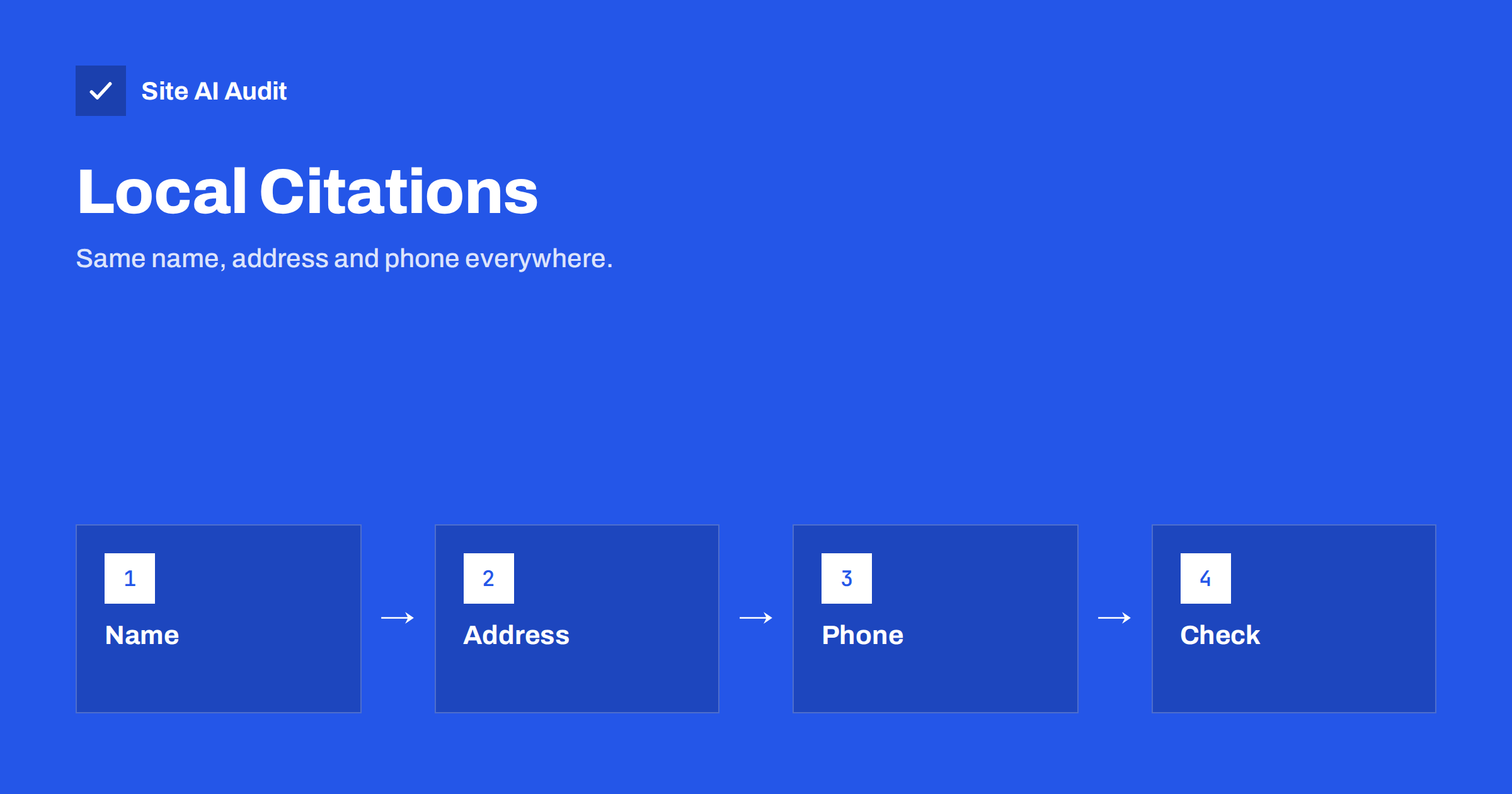
Short answer: A local citation is any place online that mentions your business name, address and phone number, with or without a link. NAP stands for those three details. When they match on your website, your map listing and every directory, search engines and customers can trust them. When they differ, people go to the wrong place and your listings can be mixed up.
What a local citation is
A citation is a mention of your business details on a page you do not fully control. It may be a business directory, a chamber of commerce member list, a social media profile, a review site, a map service, an industry association page or a local news article about an event you sponsored. A citation does not need to contain a link to your website. The details themselves are what counts.
Citations matter most for businesses that serve customers in a particular area: shops, clinics, restaurants, repair services, trades and professional offices. For a business that sells only online, they play a much smaller role, although a consistent name and contact details still help people recognise you.
What NAP consistency means
NAP is short for name, address and phone number. Consistency means that each of these is written the same way everywhere, so that a person or a machine can see at once that two listings describe the same business.
- Name. Use the real name that customers see on your sign or invoice. Do not add keywords to it in some places and leave them out in others. “Green Valley Dental” and “Green Valley Dental Clinic Best Dentist Cheap” look like two different businesses.
- Address. Choose one format and keep it. Decide whether you write “Street” or “St.”, whether the suite number comes before or after the street and how you spell the district or city.
- Phone. Use the same number with the same country code. If you have a tracking number for advertising, treat it with care and keep the main number the one that appears in most places.
Small differences such as an abbreviation are usually understood by search systems, but big differences, such as an old address or a different phone number, cause real confusion.
Where citations appear
It helps to think in three groups, because each group is checked in a different way.
- Core listings. Your Google Business Profile and the map and search listings of other search engines. These are the most important and usually the ones customers see first.
- General and industry directories. Business directories, trade associations, local guides and review platforms for your sector.
- Your own and partner pages. Your website, social media profiles, supplier or partner pages, event pages and press mentions.
Most small businesses have between ten and thirty places where their details appear, even if they do not remember creating them. Some were added by staff, some by former agencies and some by automated data collection.
Why inconsistent details hurt
Search engines build a picture of a business from many sources. When the sources agree, the picture is clear. When they disagree, the system has to guess, and a guess can go against you. Google states that local results are based mainly on relevance, distance and prominence, and prominence includes how well known a business is across the web. A confusing set of details makes it harder for a business to be recognised as one well-known entity.
There is also a very practical cost. A customer who finds an old address drives to the wrong place. A customer who finds a disconnected phone number gives up and calls a competitor. These losses are invisible in your reports, because the customer never reaches your website.
Inconsistency is not a penalty, and no one can promise a ranking jump from fixing it. The honest claim is smaller: correct and matching details remove a source of confusion and lost customers, and they support the effort described in the guide to local SEO basics.
How to audit your citations
A manual audit takes an afternoon and does not need paid tools.
- Write down the correct details. Record the exact name, address, phone number, opening hours, website address and main category. This is your master record.
- Search for your business. Look for your name, your phone number and your address on their own. Phone and address searches often reveal listings under old names.
- List what you find. Put each listing in a spreadsheet with its address, the details shown and whether you have a login for it.
- Mark the differences. Highlight anything that does not match the master record, including opening hours and website address.
- Look for duplicates. Two listings for the same location, one of them old, are a common problem. Duplicates split reviews and confuse customers.
Repeat the exercise after any move, rebrand, change of phone number or change of opening hours.
How to fix messy listings
Work from the most visible listings to the least visible ones. Fix your main map listing first, then the largest directories, then the rest.
- Claim the listing if you have not done so, and update it through the official owner process.
- Edit, do not recreate. Where a listing already exists, correct it instead of creating a new one. New listings produce duplicates.
- Ask for removal of true duplicates. Most platforms have a form for reporting a duplicate or closed location.
- Be patient. Changes can take days or weeks to appear and to be copied by sites that take data from others.
- Keep a log. Write down the date and what you changed, so the next person who works on it does not start from nothing.
Do not buy large bundles of low-quality listings from sellers who promise hundreds of citations. They create exactly the clutter you are trying to remove, and they are hard to correct later.
Keep your own website aligned
Your website is the one source you fully control, so make it the cleanest. Show the full name, address and phone number in the footer or on a contact page, in the same format as in your listings, and write them as text, not as an image. Use a clickable phone link on mobile. The article on privacy, terms and contact pages explains why a clear contact page is a trust signal for visitors and search engines.
If you have more than one location, give each its own page with its own details, as described in the guide to location pages for SEO, and avoid placing several addresses in a single footer. You can also describe the business in structured data. The pieces needed for a small business are listed in the beginner guide to structured data, and the markup should repeat exactly the same details that are visible on the page.
Common mistakes to avoid
- Leaving the old address after a move. Moving is the most frequent cause of wrong citations. Make a list of every listing before you move and update them in the same week.
- Using a different business name on social profiles. A short nickname is fine for chat, but the profile name should match the official one.
- Listing a home address that you want to keep private. If you work from home and serve customers at their location, many platforms allow you to hide the address and show a service area instead. Choose one approach and use it everywhere.
- Forgetting opening hours. Holiday hours and seasonal changes are often updated on the map listing but not on the website, or the other way around. Visitors trust whichever they see first.
- Ignoring closed or merged locations. A listing for a branch that no longer exists makes your business look careless and sends customers to an empty shop.
A short written procedure helps. Name one person who owns the master record, and require that any change to contact details goes through that person. In a small team this can be a single page in a shared document.
How Site AI Audit helps
Site AI Audit does not check directories or map listings, so it cannot tell you whether an outside listing is wrong. It checks your own website, which is where the master details should live: titles and descriptions, headings, broken links, redirects, your sitemap and robots.txt, together with speed, SSL, security headers and email authentication. A contact page that returns an error or a footer link that is broken shows up in the report. The free check covers up to 50 pages and needs no sign-up. You can run a free check of your website or see the plans for weekly monitoring and alerts.
Related reading
- Local SEO Basics: How Small Businesses Get Found Nearby
- Location Pages for SEO: How to Rank in Every Area You Serve
- Organization Schema: Tell Search Engines Who You Are
- Privacy, Terms and Contact Pages: Small Trust Signals for SEO
The bottom line
Local citations are small, but they add up to the way a business looks across the web. Decide on one correct set of details, write them down, compare every listing against them and fix the differences, starting with the most visible places. Keep your own website as the cleanest source, and repeat the check whenever something about the business changes.
BUJ
What does NAP stand for?
NAP stands for name, address and phone number. These are the basic details that identify a local business wherever they appear online.
Do citations need a link to my website?
No. A citation is any mention of your details. A link can add value, but the main benefit of a citation is that the details are present and correct.
How many citations do I need?
There is no magic number. Correct details on your main map listing, the directories that matter in your sector and your own website matter more than a large count.
Should I use a call tracking number?
Be careful. A different number in some listings creates inconsistency. If you track calls, keep the main number visible in your core listings and use tracking numbers only where you can control them.
How often should I check my listings?
Check twice a year, and after any move, rebrand, change of phone number or change of opening hours.