ENEnglish
 LTLietuviškai
 DEDeutsch
 FRFrançais
 RUРусский
 ESEspañol
 PLPolski
 ITItaliano
 UKУкраїнська
 CSČeština
 PTPortuguês
 JA日本語
JA日本語 LVLatviešu valoda
 ETEesti
 HUMagyar
 IDBahasa Indonesia
 TRTürkçe
 HIहिन्दी
 ELΕλληνικά
 ARالعربية
 THไทย
THไทย VITiếng Việt
 RORomână
 MSBahasa Melayu
 BNবাংলা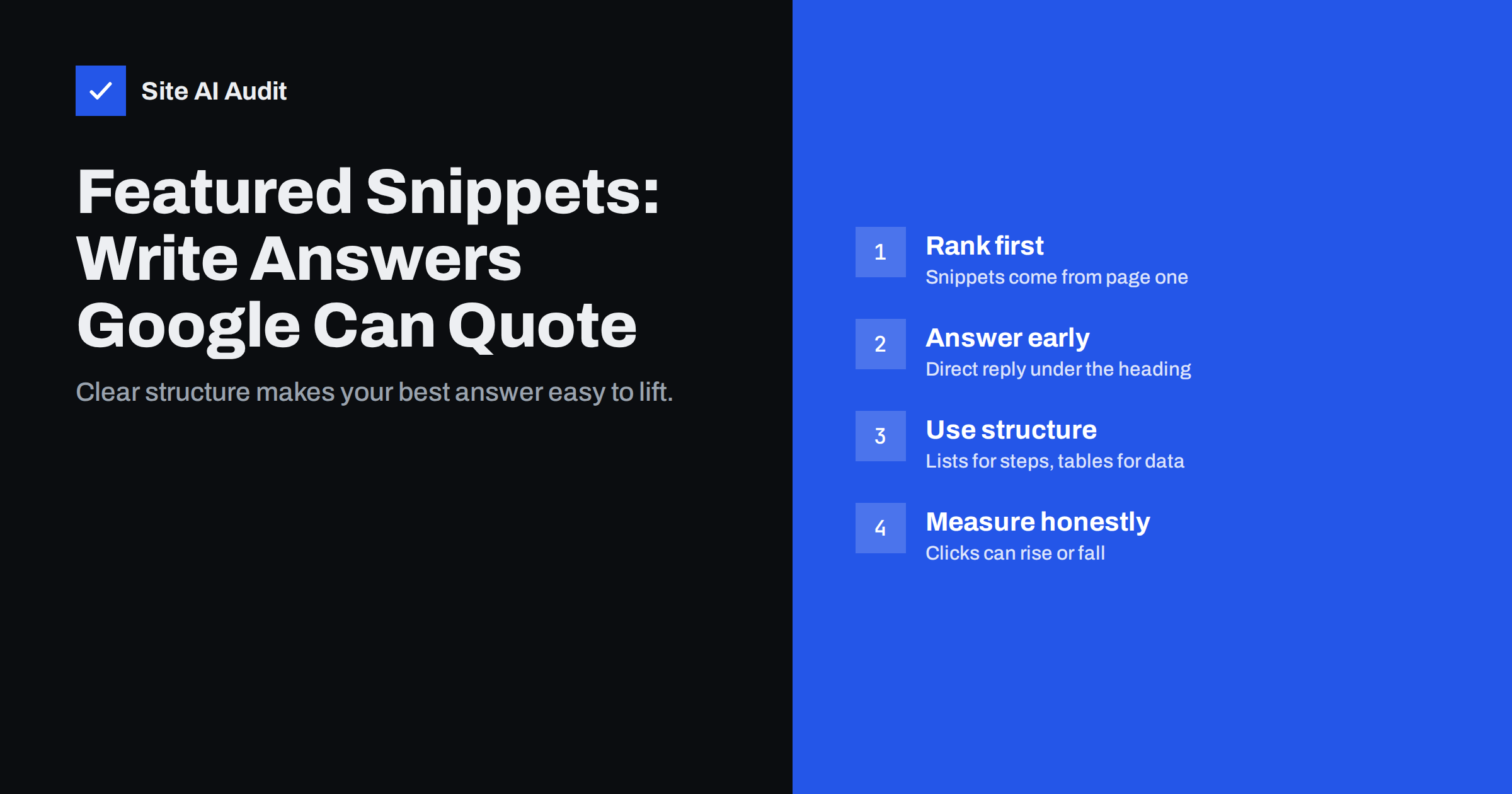
Short answer: A featured snippet is a highlighted answer that Google shows above or among the top results, quoted from one web page. Google chooses it automatically, usually from pages already ranking on the first page. You improve your chances by targeting clear questions, answering each one directly in the first sentences under a descriptive heading, and using proper HTML lists and tables for steps and comparisons. There is no markup that guarantees a snippet, and you can limit or block snippets with nosnippet controls if they cost you clicks.
What a featured snippet is
When someone searches a question such as “how long does DNS propagation take” or “what is a canonical tag”, Google sometimes shows a box with an extract from a page, the page title and a link. That box is a featured snippet. It is chosen by Google’s systems, not bought or requested, and the source page can change from day to day.
Snippets come in several formats:
- Paragraph: a short definition or answer, the most common type.
- List: numbered steps or a bulleted list, often for “how to” and “best” queries.
- Table: rows of data, common for comparisons, prices, sizes and schedules.
- Video: a clip from a video, sometimes starting at the relevant moment.
Google explains the feature and its controls in its documentation on featured snippets.
How Google chooses the snippet
Google does not publish a formula, but a few patterns are well established:
- The page usually already ranks well. Snippets are overwhelmingly taken from pages on the first page of results for that query. If you rank on page three, formatting alone will not help.
- The answer must be easy to extract. A clear question followed by a direct, self-contained answer is easier to quote than an answer spread over several paragraphs.
- Relevance to the exact query matters. Different wordings of a question may produce snippets from different pages.
- Structured data is not required. Snippets are extracted from visible page content, not from schema markup.
This means the work has two parts: rank on page one for the question, then make the answer the easiest one on that page of results to quote.
Find the questions worth targeting
Look for queries where a snippet already appears or where the search is clearly a question:
- Search Console. Filter the Performance report for queries containing “how”, “what”, “why”, “can” or “vs” where you rank in positions 1 to 10. These are your closest opportunities. Our guide to the Search Console Performance report shows how to filter.
- The results page itself. Search your target queries and note which ones show a snippet, its format and who holds it.
- “People also ask” boxes. They reveal related questions that searchers have, many of which can be answered within one article.
- Your customers’ questions. Sales and support questions are often exactly what people type into Google.
Choose questions that match the page’s purpose. The approach in search intent explained helps decide whether a question belongs in a blog post, a service page or an FAQ.
How to format paragraph answers
For definition and “what is” questions:
- Use the question, or a close variant, as a heading. For example,
<h2>What is a canonical tag?</h2>. Proper heading structure is covered in heading tags for SEO. - Answer in the first one or two sentences below it. Start with the subject: “A canonical tag is…”. A self-contained answer of roughly 40 to 60 words is a common guideline, because it fits the snippet box without being cut off.
- Then expand. Details, examples and exceptions come after the direct answer, not before it.
- Avoid pronouns and references to earlier text in the answer sentence. “It does this by…” does not make sense when quoted alone.
This style also helps human readers. Busy visitors get the answer immediately and can decide whether to read on.
How to format lists and tables
For steps and comparisons, structure matters more than word count:
| Query type | Best format | Tips |
|---|---|---|
| How to do something | Numbered list (<ol>) | One action per step, starting with a verb |
| Types, options, examples | Bulleted list (<ul>) | Parallel wording, short items |
| Comparisons, specifications, prices | HTML table | Clear column headings, consistent units |
| Definitions and “why” questions | Paragraph | Direct first sentence, then detail |
Use real HTML elements. Lists built from line breaks or styled paragraphs, and tables built from images or layout boxes, are much harder for search engines to interpret. Page builders sometimes produce such markup, so check the page source.
When a list has more steps than fit in the box, Google often shows the first few with a “More items” link, which can encourage clicks to see the full list.
Featured snippets, clicks and opting out
Winning a snippet does not always mean more traffic. The effect depends on the question:
- Simple facts (a conversion, a date, a short definition) may be answered completely in the box, so fewer people click.
- Complex questions (how to fix a problem, how to choose between options) usually still need the full page, and the snippet sends more visitors.
- Duplication: the page shown in a featured snippet is generally not repeated as a separate regular result on the same first page, so the snippet replaces rather than adds to your listing.
- Other features compete. Answer boxes, “People also ask” and AI-generated summaries can all appear on the same results page and change how many people scroll to the regular results.
Measure the effect in Search Console by comparing clicks and click-through rate for the query before and after the snippet appeared.
Controlling or opting out of snippets
If a snippet gives away everything and costs you clicks, you have options:
<meta name="robots" content="nosnippet">prevents any text snippet for the page, including the normal description. This is a heavy step and usually not advisable.max-snippet:[number]limits the snippet length in characters.- The
data-nosnippetattribute on an HTML element excludes that part of the page from snippets while leaving the rest usable.
Use these carefully. Blocking snippets does not improve rankings; it only changes what is shown.
A worked example: rewriting one section
Imagine a plumbing company’s blog post about low water pressure. The original section is headed “Our thoughts” and begins with two paragraphs about the company’s history before mentioning, halfway down, that clogged aerators, a partly closed valve and pressure regulator faults are the usual causes. The information is good, but nothing about it is easy to quote.
A rewritten version would look like this:
- Heading: “Why is my water pressure low?”, matching how people ask the question.
- First sentence: “Low water pressure in a home is usually caused by a clogged aerator, a partly closed shut-off valve, a faulty pressure regulator or a leak in the supply pipe.”
- A numbered list of checks the reader can do, each starting with a verb: “Unscrew and clean the tap aerator”, “Check that the main valve is fully open”, and so on.
- Detail afterwards: when to call a plumber, typical signs of a hidden leak, and what a repair involves.
Nothing was added for search engines alone. The section simply answers the question the way a helpful expert would when asked in person: the answer first, the explanation second. That is also the format most likely to be quoted.
Common mistakes
- Burying the answer. Long introductions before the answer make extraction harder.
- Vague headings. “Overview” or “Details” does not tell anyone which question the section answers.
- One page for everything. A single page trying to answer dozens of unrelated questions rarely wins any of them.
- Chasing snippets for queries you do not rank for. Improve the content and relevance first.
- Letting answers go stale. Outdated facts lose snippets; refresh them as described in how to update old content for SEO.
How Site AI Audit helps
Featured snippets start with pages that search engines can crawl, index and understand. Site AI Audit checks the foundations: titles and meta descriptions, heading structure, image alt texts, broken links, redirects, robots.txt, sitemaps and noindex rules. Fixing those makes it more likely that your best answers are indexed and eligible in the first place. You can run a free check of your website.
Related reading
- Blog Post SEO Checklist: What to Check Before You Publish
- Keyword Research for Small Businesses: A Simple Method
- Structured Data for Small Business Websites: A Beginner Guide
The bottom line
Featured snippets reward pages that already rank and that answer a clear question in an easily quotable way. Use question-style headings, give the direct answer first, and use real lists and tables for steps and comparisons. Measure whether a snippet actually brings more clicks, and use snippet controls only when it clearly does not.
DUK
How do I get a featured snippet on Google?
Rank on the first page for a question, then answer that question directly under a clear heading, using a short paragraph, a numbered list or a table as fits the query. Google chooses snippets automatically, so nothing guarantees one.
Do I need schema markup for featured snippets?
No. Featured snippets are taken from visible page content. Structured data can help with other search features, but it is not required for featured snippets.
How long should a featured snippet answer be?
For paragraph snippets, a self-contained answer of roughly 40 to 60 words is a common guideline. For lists and tables, clear structure matters more than length.
Can a featured snippet reduce my traffic?
Yes, for simple factual questions that are fully answered in the box. For complex questions, snippets often increase clicks because searchers need the full page.
How do I stop Google showing my page as a featured snippet?
Use the data-nosnippet attribute on the specific section, set a max-snippet limit, or use the nosnippet robots meta tag, which removes all text snippets for the page.