ENEnglish
 LTLietuviškai
 DEDeutsch
 FRFrançais
 RUРусский
 ESEspañol
 PLPolski
 ITItaliano
 UKУкраїнська
 CSČeština
 PTPortuguês
 JA日本語
JA日本語 LVLatviešu valoda
 ETEesti
 HUMagyar
 IDBahasa Indonesia
 TRTürkçe
 HIहिन्दी
 ELΕλληνικά
 ARالعربية
 THไทย
THไทย VITiếng Việt
 RORomână
 MSBahasa Melayu
 BNবাংলা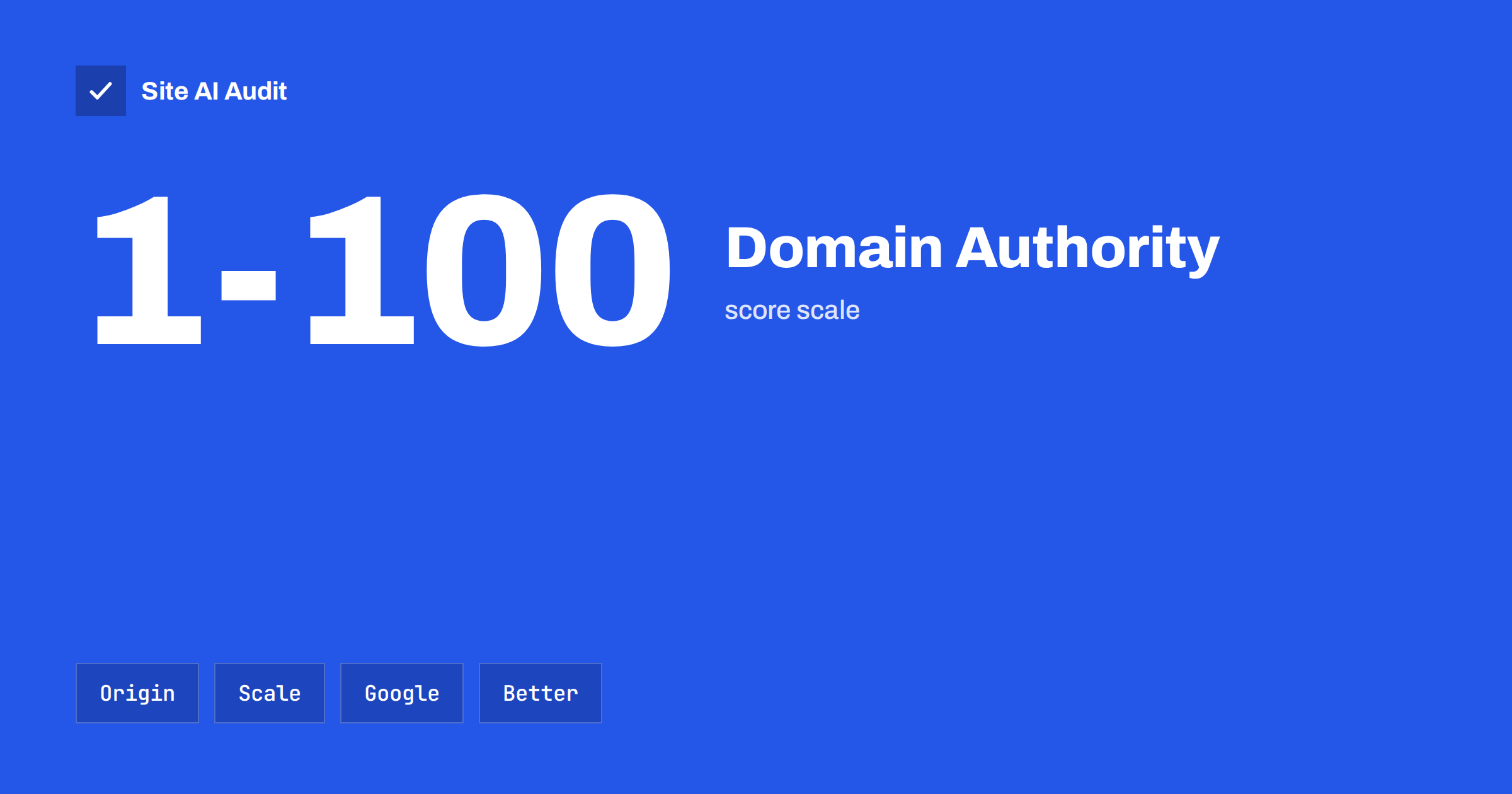
Short answer: Domain Authority, or DA, is a score from 1 to 100 created by the software company Moz to estimate how well a site might rank, based mostly on its links. Google does not use it. It is helpful for comparing sites and judging link opportunities, but it is not a goal in itself. For your own site, track real search impressions, clicks and enquiries instead.
What Domain Authority is
Domain Authority is a metric invented by Moz, and it is calculated from Moz’s own database of links. It combines several signals, such as how many other sites link to yours and how strong those sites are, into one number from 1 to 100. Higher means that the site is more likely to rank well, according to the Moz model.
The scale is logarithmic. That means it is much easier to grow from 20 to 30 than from 70 to 80. A new site normally starts low, and a very large, well-known site sits near the top. Because the number depends on a link index that is updated from time to time, your score can move up or down without any change on your site.
Other companies have their own versions of the same idea. Ahrefs publishes Domain Rating, and Semrush uses an Authority Score. They use different data and different formulas, so the numbers differ from tool to tool and cannot be compared with each other.
What it does not measure
The most important point is that Google does not use Domain Authority. Google’s own staff have said several times that it relies on its own signals, and the third-party scores are only estimates built by outside companies. Having a high DA does not make Google rank you higher, and a low DA does not stop a good page from ranking for a specific query.
The score also says nothing about the quality of your content, how well a page answers a question, how fast your site loads or how happy visitors are. It is a measure for the whole domain, but search rankings are decided page by page and query by query. A small local business with a low score can easily beat a large site on a narrow, local search.
Finally, it does not measure traffic or sales. Two sites with the same DA can have completely different visitor numbers and revenue.
When the score is useful
A third-party score has real uses if you treat it as a rough guide:
- Comparing competitors. If every competitor in your niche sits between 30 and 50 and you are at 12, you know that they have more links, and you can look at where those come from.
- Judging link opportunities. When a site offers a link or a partnership, the score of that site gives a quick first impression. It should never be the only test; look at whether the site is relevant and real.
- Spotting risky sites. A site with a very high number of low-quality links and a suspicious pattern can point to a problem, although the score alone cannot prove it.
- Tracking long-term link growth. If you build links steadily, the score will usually rise over months, which can be a simple way to show progress to a client or manager.
The traps to avoid
- Chasing the number. Making the score your goal leads to bad decisions, such as buying links, which can break Google’s rules and cause a manual action. Read about manual actions in Search Console to see what the penalty looks like.
- Paying for “DA boosting”. Sellers who promise to raise your score quickly usually sell worthless or harmful links. Real authority takes time.
- Judging a link only by the score. A link from a relevant local organisation with a low score can be worth more than a link from an unrelated large site.
- Comparing different tools. A DA of 40 and a DR of 40 are not the same thing.
- Panicking over a small change. Index updates can move the score by a few points with no effect on your results.
What does influence authority in practice
Although the score is not a Google signal, the things it tries to capture are real. Links from relevant, trusted places do matter, as does a reputation that makes people mention your business. Here is how a small business can build both honestly:
- Publish content that other people want to cite, such as clear guides, original data or useful tools. Our article on backlinks for small businesses explains what helps and what hurts.
- Show who you are. Trust signals such as real contact details, author names and clear policies support credibility; see E-E-A-T for small business websites.
- Earn links from local partners, suppliers, associations and the press, by doing something worth mentioning.
- Use the correct attributes for paid or user-generated links, as in nofollow, sponsored and UGC links.
- Keep your own site in order, with clean internal links and no broken pages, so that the value of the links you earn is not wasted.
How to check a score sensibly
Several vendors, including Moz, offer limited free lookups, and paid tools show more detail. If you check a score, follow a few habits to get value from it:
- Pick one tool and keep to it. Compare your site with competitors in the same tool, on the same day, because different tools give different numbers.
- Look at the trend, not a single reading. A line that rises slowly over a year tells you more than a jump in one week.
- Compare with the right sites. Choose the three to five businesses that actually compete for your customers, not the biggest names in your industry.
- Read the links behind the number. Open the list of linking sites and ask which of them are relevant and which look strange. This is where the useful information is.
- Write down what you did. If you publish a guide or win a mention in the press, note the date. Later you can connect changes in links and traffic to real actions.
Used in this way, the score is a small instrument on a larger dashboard. It helps you ask better questions, but it does not give the answers.
Better numbers to watch
Instead of a single score, follow measures that connect to your goals:
- Impressions and clicks from Google for your important pages and queries, found in the Performance report. The guide to the Search Console performance report shows how to read it.
- Pages that bring enquiries, using the analytics tool you have, so that you know which content produces leads.
- Indexed pages. Check that the pages you care about are in the index.
- Referring domains. The number of different relevant sites that link to you, rather than the total number of links.
- Technical health. Speed, security and email setup affect trust and conversions, and they are things you control fully.
If your traffic falls, do not start with the authority score. Follow a method such as finding the cause of a Google traffic drop, which looks at technical changes, content and updates first.
Common myths
You may hear that you need a DA of 50 to rank, that every link should come from a site with a higher score, or that a new domain cannot compete. None of these is true as a rule. Many pages rank on the first page for specific questions with modest scores. For more claims of this kind, see SEO myths small businesses still believe.
What Site AI Audit can and cannot tell you
Site AI Audit crawls up to 50 pages on the free check and looks at titles, descriptions, headings, broken links, redirects, the sitemap, robots.txt and noindex rules, and it also reports speed, SSL, security headers and email authentication. These are the parts of your site’s health that you control. It does not measure backlinks or give you an authority score, because that depends on a large link database. Run a free check or see the plans if you want regular re-checks.
Related reading
- Technical SEO vs On-Page SEO vs Off-Page SEO: The Differences
- Anchor Text Best Practices: How to Write Better Link Text
- Common SEO Mistakes Small Businesses Make (and How to Fix Them)
The bottom line
Domain Authority is a handy estimate made by one company, not something Google reads. Use it to compare sites and think about link quality, but do not make it your target. Build trust with useful content and honest links, fix your technical basics, and judge your progress by search clicks and enquiries.
DUK
Does Google use Domain Authority to rank websites?
No. Domain Authority is a score made by Moz. Google uses its own systems, and third-party scores are only estimates that SEO tools calculate from link data.
What is a good Domain Authority score?
It depends on your niche. Compare yourself with competitors that rank for the searches you want. A score that is similar to or above theirs is good, while a number alone has no fixed meaning.
How can I increase Domain Authority?
Earn links from relevant, trusted sites by publishing useful content and building real relationships, and keep your site technically healthy. Avoid buying links or paying for quick boosts, which can cause penalties.
Why did my score drop when I changed nothing?
The tool updates its link index and recalculates its model, so scores can move without any change on your site. Small movements are normal and do not mean that Google sees your site differently.
Are Domain Rating and Authority Score the same as DA?
They are similar ideas from different companies, with different data and formulas. The numbers cannot be compared directly, so stay with one tool when you track change over time.