ENEnglish
 LTLietuviškai
 DEDeutsch
 FRFrançais
 RUРусский
 ESEspañol
 PLPolski
 ITItaliano
 UKУкраїнська
 CSČeština
 PTPortuguês
 JA日本語
 LVLatviešu valoda
 ETEesti
 HUMagyar
 IDBahasa Indonesia
 TRTürkçe
 HIहिन्दी
 ELΕλληνικά
 ARالعربية
 THไทย
 VITiếng Việt
 RORomână
 MSBahasa Melayu
 BNবাংলা
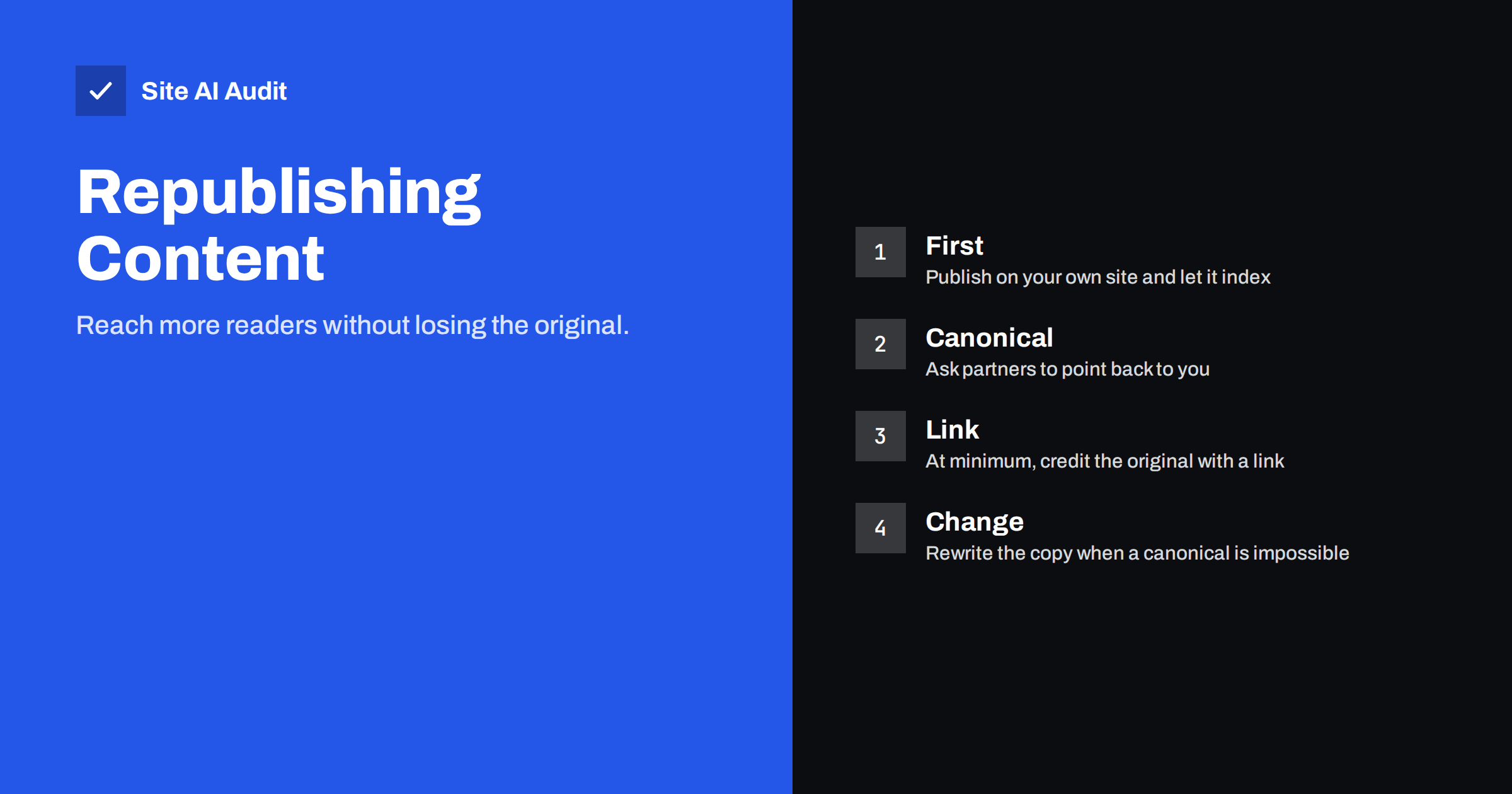
Short answer: You can republish your articles on other sites without harming your SEO if you publish on your own site first, ask the other site to set a canonical tag that points to your original, and make sure the copy links back to it. When a platform will not let you set a canonical, post a rewritten summary or a different version instead of a full copy.
Why people republish content
Republishing, often called syndication, means that the same article appears on more than one website. Small businesses do it to reach readers who will never visit their blog: a trade association’s news page, an industry magazine, a partner’s site, a professional network or a publishing platform with a large audience.
The idea is sound. A good article that is read in two places can bring more visitors, more brand recognition and more links than one that is read in a single place. The risk is that search engines then see two or three identical pages and must choose which to show. If the other site is bigger, stronger or simply faster to be indexed, its copy may outrank your original, and your own page may disappear from the results for that topic.
This does not mean a penalty. Search engines do not usually punish honest syndication. They try to group duplicates and show one version. The goal is to make sure that the version they choose is yours.
How search engines treat duplicates
When Google finds the same content at several addresses, it picks a canonical version for the index and tends to show that one in results. It makes the choice from signals, such as the canonical tag, redirects, internal and external links, the sitemap, the quality of the site and which copy was found first. A canonical tag is a strong hint, not an order, and Google can choose another page. You can read about the basic rules in canonical tags explained and how to fix duplicate content.
If you do nothing, you leave the choice to chance. A site with more authority than yours has an advantage, and a copy that appears before your own page is indexed may be treated as the original. For this reason, the order and the signals matter much more than the republishing itself.
It is worth separating this from other kinds of repetition. Quoting a short passage with a link is normal. Posting the same article on several of your own pages or sites is a duplicate problem of a different kind. Scrapers that copy your pages without asking are another matter. This article deals only with agreed republishing, where you can ask the other side for help and agree on how the copy should be marked.
Step one: publish on your own site first
Put the article on your site, request indexing with the URL Inspection tool and wait until it is indexed, which is often a day or two. Only then give the text to a partner. This gives search engines a clear first sighting, and it also protects you if the partner’s site is crawled more often than yours. Make sure that the article is also in your XML sitemap, as explained in the XML sitemap guide, and in your internal links.
It also helps to wait a few days before the second publication. A short delay costs little and reduces the risk of confusion. For a news item that is only valuable on the first day, you may need to publish at the same time, so rely on the canonical tag and the link back even more.
Step two: ask for a canonical tag
The best arrangement is that the republished copy contains a canonical tag pointing to the original address on your site. This tells search engines that your page is the master and the other is a copy. Some publishing platforms and import tools set this tag for you when you import a story from a web address, and some partner sites will add it if you ask. Others do not support it at all, so check the page source of the published copy to confirm that the tag is really there, and that it points to the exact address of your article.
If a partner cannot use a canonical tag, a second choice is for them to add a noindex tag to their copy. Then the page stays available to their readers but is kept out of search results. Many partners will accept this if you explain the reason.
Keep a copy of the exact text and the date that you sent it. If a later dispute arises about which version came first, this record, together with the publication date in your own site and the indexing history in Search Console, is useful evidence. Agree also on who may edit the republished copy. If the partner changes the text heavily, the match to your original weakens, and so does the clarity of the signal.
Step three: a link back to the original
Even without a canonical, a clear link from the copy to your original helps search engines understand where the article came from, and it sends visitors to you. Ask for a line such as “This article first appeared on the website of Company Name” with a real link to the exact address of the original. Make the link normal and followable, and not hidden in the footer or a script.
Do not expect a large ranking gain from links in syndicated copies, and avoid agreements built on links alone. Value comes first from readers and recognition. See backlinks for small businesses for realistic expectations, and nofollow, sponsored and UGC links if the partner uses link attributes.
When the platform does not allow a canonical
Some large platforms let you post but not set a canonical tag or edit the page head. In that case a full copy competes with your page. You have three reasonable options.
- Post a summary with a link. Publish the first section or a short overview and invite readers to continue on your site. The copy is different from your page and sends traffic to it.
- Write a new version. Use the same idea with a different structure, other examples, a new title and fresh wording. This is a new article, not a copy.
- Accept the risk for low-value pieces. For a short post that has no search value on your own site, a duplicate may not matter, but keep your best articles out of this route.
Whatever you do, give the republished version its own title and introduction when you can. Identical titles on two sites make it harder to tell which should come first.
How to check what Google chose
- Copy a distinctive sentence from the article and search for it in quotation marks. See which sites appear and in what order.
- Inspect your own address in Search Console and look at the “User-declared canonical” and “Google-selected canonical” values. The tool is covered in how to use the URL Inspection tool.
- If Google selected another page than the one you chose, read when Google chooses a different canonical.
- Look for the message “duplicate without user-selected canonical”, explained in that report guide.
- Repeat after a few weeks, because the choice can change as signals update.
If a copy outranks you, first ask the owner to add the canonical or a noindex tag. Contact is nearly always friendlier than anything more formal. If the copy is on a scraper site that you never approved, the situation is different and calls for other steps.
A simple policy for your team
Write down the rules once. Publish on your site first and wait for indexing. Send the partner a final text together with the exact original address. Ask for a canonical tag or a visible link. Keep a list of where each article has been republished, with the date and the result of your check. Reuse of old posts, even updated ones, follows the same principle, as in updating old content for SEO. For the wider planning of what to write and where to share, see the notes on the blog post SEO checklist.
How Site AI Audit helps
Site AI Audit does not monitor other websites or find copies of your content. It checks your own pages for titles and descriptions, headings, broken links, redirects, sitemap, robots.txt and noindex settings, together with speed, security headers, SSL and e-mail authentication. The first check is free, covers up to 50 pages and needs no sign-up. You can run a free check of your website or see the plans for weekly monitoring.
Related reading
- Duplicate Content in SEO: Common Causes and How to Fix Them
- Canonical Tags Explained: How to Handle Duplicate URLs
- Topic Clusters and Pillar Pages: Organise Your Content for SEO
- How Long Should a Page Be? Word Count and SEO Explained
The bottom line
Republishing can widen your audience when it is done in the right order. Publish on your site first, let it be indexed, ask the partner for a canonical tag or at least a clear link back, and rewrite or summarise when a platform leaves you no technical option. Then check what Google chose, and keep a record of where each article appears.
FAQ
Will Google penalise me for syndicating content?
Not for honest syndication. It usually groups the copies and shows one version, so the aim is to make sure that version is yours.
Is a link back enough without a canonical tag?
It helps, but it is weaker. A canonical or a noindex on the copy is a stronger signal, so ask for it where possible.
How long should I wait before republishing?
Until your original is indexed, often a day or two. For urgent news you may publish together and rely on the canonical and the link.
Can I republish on social or publishing platforms?
Yes, but check whether they allow a canonical tag. If they do not, post a summary or a rewritten version with a link.
What if another site copies my article without asking?
Contact the owner first and ask for a canonical or removal. If that fails, report it through the search engine’s copyright process.