ENEnglish
 LTLietuviškai
 DEDeutsch
 FRFrançais
 RUРусский
 ESEspañol
 PLPolski
 ITItaliano
 UKУкраїнська
 CSČeština
 PTPortuguês
 JA日本語
JA日本語 LVLatviešu valoda
 ETEesti
 HUMagyar
 IDBahasa Indonesia
 TRTürkçe
 HIहिन्दी
 ELΕλληνικά
 ARالعربية
 THไทย
THไทย VITiếng Việt
 RORomână
 MSBahasa Melayu
 BNবাংলা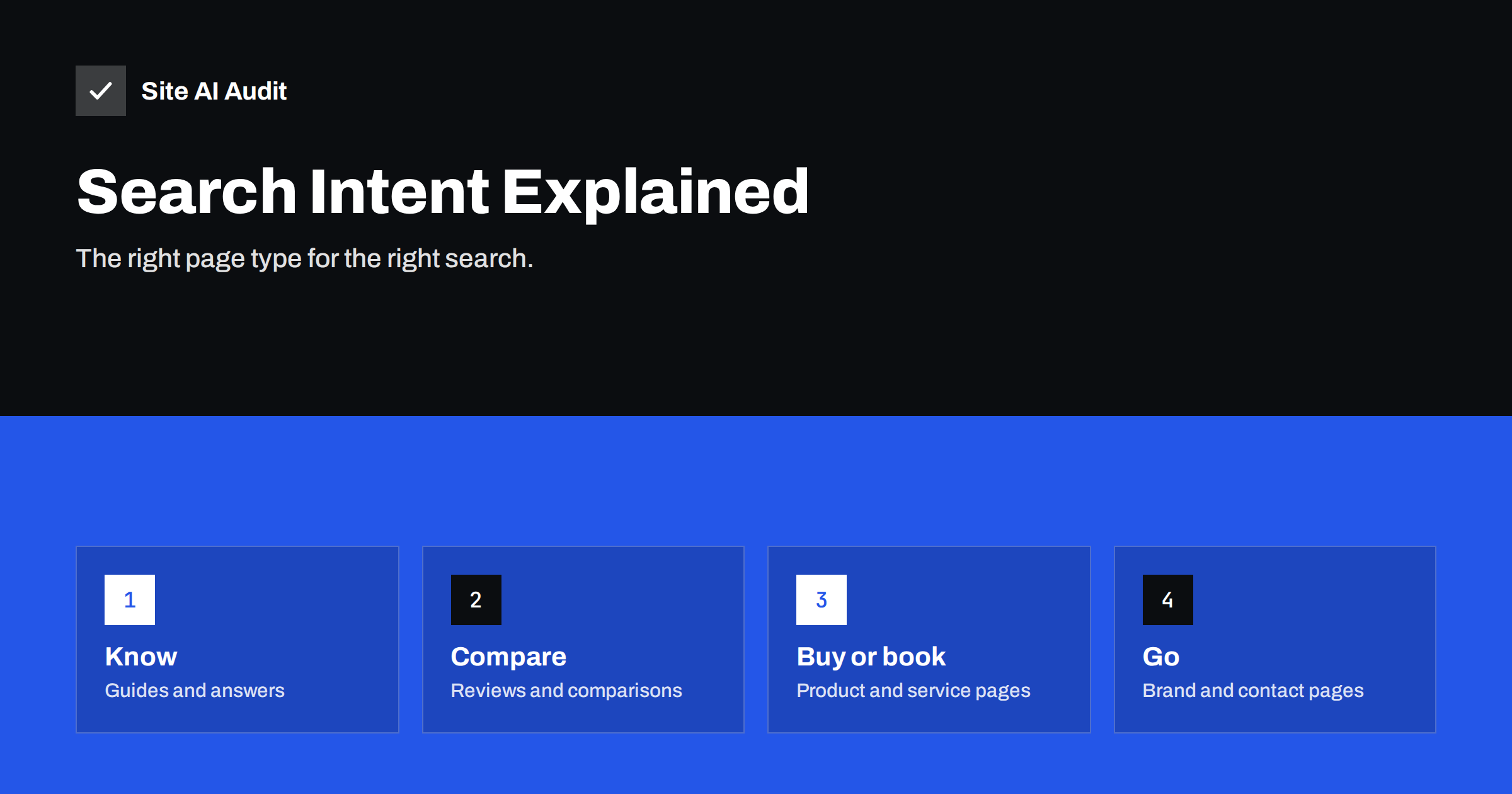
Short answer: Search intent is the goal behind a search: to learn something, to compare options, to buy or book, or to reach a specific website or place. Search engines rank pages that satisfy that goal, so a page that does not match the intent will struggle no matter how well it is optimised. Read the intent from the current results for a phrase, choose the matching page type and format, and answer the searcher’s real question early and clearly.
What search intent means
Two people can type similar words and want very different things. Someone searching “boiler pressure low” probably wants to fix it themselves, right now. Someone searching “boiler repair near me” wants to hire a professional. Someone searching “best combi boiler” is comparing options before buying. The words overlap; the intent does not.
Search engines have become very good at recognising intent, largely by learning which results satisfy people for each type of query. That is why the results for a search often look alike: all guides, all shops, all local businesses on a map, or all videos. They reflect what searchers have shown they want.
For site owners, this has a simple consequence: you cannot rank a page by forcing it onto a search it does not suit. A service page will rarely rank for a how-to question, and a blog post will rarely rank for a “buy” search. Matching intent comes before everything else.
The main types of intent
| Intent | What the searcher wants | Example searches | Page that fits |
|---|---|---|---|
| Informational | To learn or solve a problem | how to bleed a radiator, what is a DMARC record | Guide, explainer, how-to |
| Commercial investigation | To compare before deciding | best hiking boots for wide feet, X vs Y | Comparison, buying guide, review |
| Transactional | To buy, book or sign up | buy waterproof hiking boots, book boiler service | Product, category or service page |
| Navigational | To reach a specific site or page | brand name login, brand name contact | Home, login or contact page |
| Local | To find a nearby business or place | plumber near me, bakery in Bristol | Business Profile and local service page |
Many searches mix intents. “Boiler service cost” is partly informational (how much should it cost?) and partly commercial (who should I book?). A page that answers the cost question clearly and then offers the service can satisfy both.
How to identify intent: look at the results
The most reliable way to understand intent is to search the phrase yourself and study the first page of results. Look at:
- Page types. Are the top results guides, product pages, category pages, local businesses, videos or forums?
- Formats. Are they step-by-step lists, long comparisons, short answers, tools or calculators?
- Angle. Do titles emphasise beginners, price, speed, “near me”, a specific year, or a specific audience?
- Search features. A map suggests local intent; a box of questions suggests informational interest; shopping results suggest buying intent; videos suggest people want to see how something is done.
Search in a private window and, for local businesses, keep in mind that results vary by location. The pattern is what matters, not the exact ranking.
Match the page type
Once you know the intent, choose the page type that fits:
- Informational searches need helpful content: a guide that solves the problem, explains the concept or answers the question. It can mention your service where relevant, but the answer comes first.
- Commercial investigation needs honest comparison: criteria for choosing, pros and cons, who each option suits. Pages that only praise your own products rarely satisfy this intent.
- Transactional searches need a page where the action is easy: product details, prices or price ranges, availability, clear buttons, trust signals.
- Local searches need a complete Business Profile and a service page with location details, service area and contact options.
If you want to be found for both “how to fix low boiler pressure” and “boiler repair Leeds”, create two pages: a guide and a service page, linked to each other. Trying to make one page do both usually makes it worse at each.
Match the format and depth
Intent also shapes how the page should be written:
- A quick question deserves a quick answer near the top, followed by detail for those who want it.
- A process deserves numbered steps, possibly with images or a short video.
- A comparison deserves a table and clear recommendations for different needs.
- A complex decision deserves a thorough guide covering costs, risks and alternatives.
- A transactional page deserves scannable details and a clear next step, not a long essay.
Length follows need. Some searches are best served by 300 words, others by 3,000. Look at what the top results provide, then aim to be clearer, more specific and more helpful, not merely longer.
Answer early
Whatever the intent, searchers want to know quickly that they are in the right place. Put the direct answer, the key offer or the main information near the top of the page:
- for a question, answer it in the first paragraph;
- for a service, state what you do, where, and how to get in touch;
- for a product, show name, price, key features and availability above the fold;
- for a comparison, give the summary recommendation before the detail.
This also helps answer engines and AI-driven search features, which often quote a short, direct passage.
Worked example: one topic, four intents
Take a company that installs heat pumps. Around that single topic, people search with very different goals:
- “How does a heat pump work” is informational. The results are explainers, often with diagrams. The right page is a clear guide that explains the principle, running costs in general terms and whether a heat pump suits different types of homes.
- “Air source vs ground source heat pump” is commercial investigation. The results are comparisons. The right page sets out the differences in cost, space, installation and performance, and says honestly which suits whom.
- “Heat pump installation Bristol” is transactional and local. The results show a map and installer websites. The right page is the company’s installation service page with the area covered, the process, accreditation, typical timelines and a quote form, backed by a complete Business Profile.
- “Company name heat pump reviews” is navigational with research. The right answer is the company’s review profile and a testimonials page.
Four pages, each matched to one intent, linked to each other where the reader’s journey leads from one to the next. Together they cover the topic far better than one page trying to rank for everything.
Signs of an intent mismatch
- The page gets impressions for a search but very few clicks, because the title promises something searchers do not want.
- Visitors from search leave quickly without interacting.
- The page ranks for unexpected searches in Search Console that do not match its purpose.
- A different page on your own site ranks for the search instead of the one you intended.
- Competitors’ pages ranking for the search are all a different type from yours.
When you see these signs, either adjust the page to fit the intent, or create a separate page that does and link the two.
Intent changes over time
Intent is not fixed. Seasonal searches shift, new products change what “best” means, and search engines keep learning what satisfies people. A search that showed mostly guides last year might show product pages this year. Review the results for your most important searches from time to time, especially if a page’s performance changes without an obvious technical cause.
How Site AI Audit fits in
Matching intent is a content decision. Making sure the matching page can actually be found is a technical one. Site AI Audit checks the technical side: whether pages are indexable, whether titles and descriptions are unique and clear, whether headings structure the page, and whether links and redirects work. Run a free check so your well-matched pages are not held back by avoidable issues.
Related reading
- Keyword Research for Small Businesses: A Simple Method
- How to Read the Search Console Performance Report
- Heading Tags for SEO: How to Use H1, H2 and H3 Properly
- How to Write Title Tags: A Practical Guide for Small Sites
The bottom line
Search intent is the goal behind a search, and search engines reward pages that fulfil it. Study the current results to understand what searchers want, pick the matching page type and format, answer early and clearly, and create separate pages for different intents rather than forcing one page to do everything. Revisit your key searches from time to time, because intent can shift.
KKK
What are the main types of search intent?
Informational (to learn), commercial investigation (to compare), transactional (to buy or book), navigational (to reach a specific site) and local (to find something nearby). Many searches combine more than one.
How do I find the intent of a keyword?
Search it and look at the first page of results: the types of pages, their formats and any special features such as maps or shopping results. That pattern shows what searchers want.
Can one page target several intents?
Closely related intents, such as cost information and booking, can share a page. Very different intents, such as a DIY guide and a hiring page, are better served by separate, linked pages.
Why does my service page not rank for a question?
Probably because searchers asking that question want an answer, not a sales page. A helpful guide that links to your service is more likely to rank.
Does search intent matter for local businesses?
Very much. Local searches usually show a map and business profiles first, so a complete Business Profile and a clear local service page are essential.