ENEnglish
 LTLietuviškai
 DEDeutsch
 FRFrançais
 RUРусский
 ESEspañol
 PLPolski
 ITItaliano
 UKУкраїнська
 CSČeština
 PTPortuguês
 JA日本語
 LVLatviešu valoda
 ETEesti
 HUMagyar
 IDBahasa Indonesia
 TRTürkçe
 HIहिन्दी
 ELΕλληνικά
 ARالعربية
 THไทย
 VITiếng Việt
 RORomână
 MSBahasa Melayu
 BNবাংলা
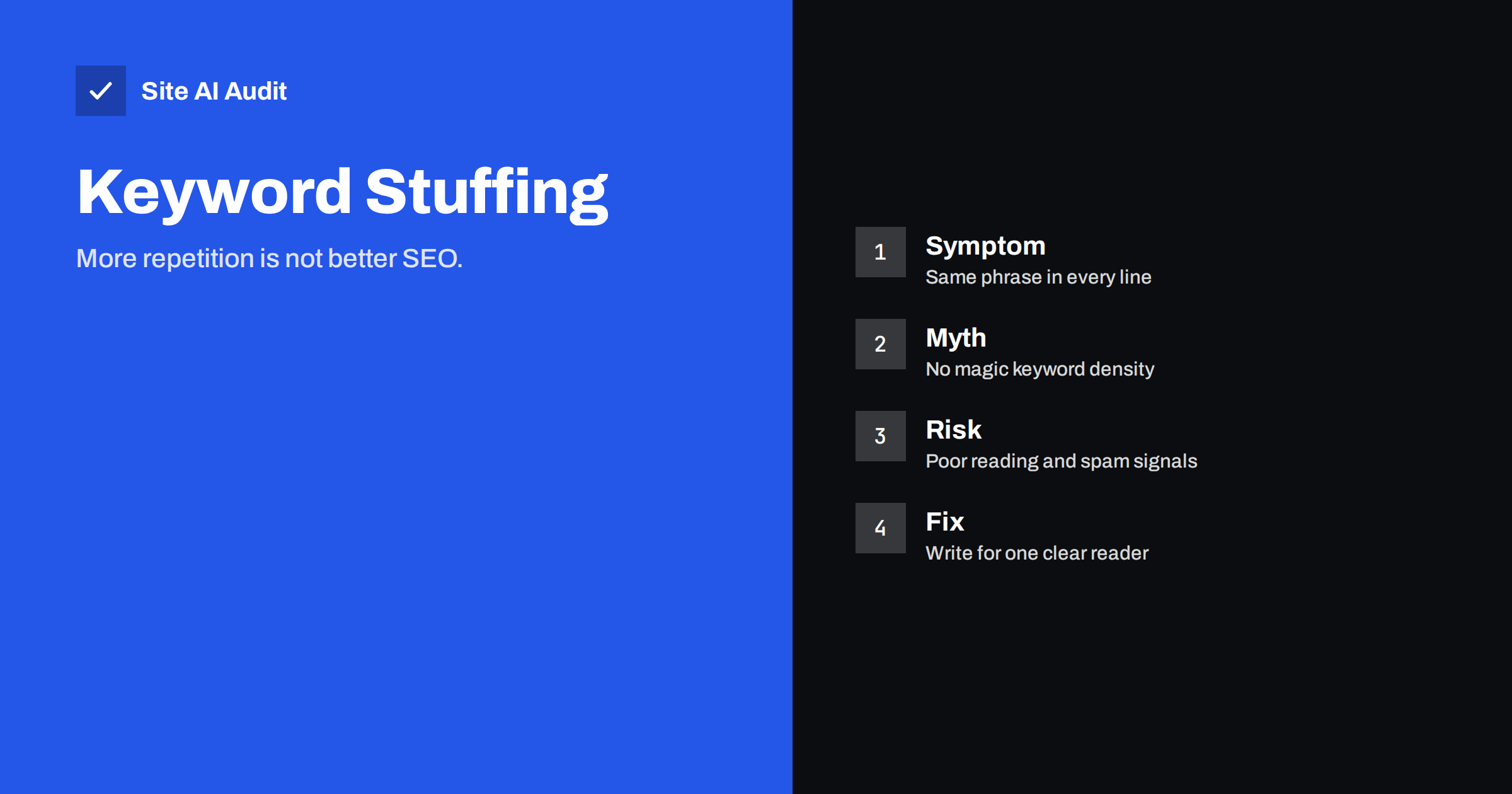
Short answer: Keyword stuffing means repeating a word or phrase far more often than a human would, in the hope of ranking higher. It does not work as a ranking tactic, there is no ideal keyword density, and it makes pages hard to read. Over-optimization is the wider habit of forcing keywords into titles, headings, alt text, anchor text and footers. The cure is to write for a real reader with one clear topic, use natural variations and let structure, not repetition, show what the page is about.
What keyword stuffing looks like
Keyword stuffing is one of the oldest bad habits in SEO. In its crudest form, it is a block of text where the same phrase appears again and again: “Cheap garden furniture. Our cheap garden furniture is the best cheap garden furniture for your garden.” Anyone reading it notices at once that the sentence was written for a machine.
It takes other forms, too:
- long lists of cities, services or product names added to the bottom of a page with no explanation,
- blocks of phone numbers or addresses that are not useful to a visitor,
- the same keyword at the start of every heading, every paragraph and every image description,
- a title tag that is a list of ten search terms separated by pipes,
- text hidden by colour, size or position so that only search engines see it, which is also treated as a deceptive practice,
- a footer or sidebar that repeats the main keyword in dozens of links.
Google lists keyword stuffing in its spam policies. Pages that do this may rank lower, and sites with widespread abuse can receive a manual action. Our guide to manual actions in Search Console explains how those appear.
Why it does not work any more
Years ago, search engines relied heavily on counting words. Repeating a phrase could move a page up. Today, search engines try to understand meaning. They read the whole page, recognise synonyms and related concepts, and compare the page with what searchers actually want. A page about garden furniture is expected to mention chairs, tables, materials, care, delivery and prices. A page that repeats “garden furniture” fifty times but says nothing else looks thin, not relevant.
Repeated phrases also harm the people who matter most. Visitors who find an awkward text leave. Fewer clicks, fewer links and fewer sales follow, which hurts the business even if a search engine tolerated the text.
The keyword density myth
Many older guides recommend a density, for example “use your keyword in 2 percent of words”. There is no such rule. Search engines do not publish a target, and tools that show a density score are measuring something that has no proven link with rankings. Chasing a percentage often produces the stilted text that readers dislike.
A better approach is to ask three questions about each page:
- Is the main topic clear in the title, the first heading and the opening paragraph?
- Does the page cover what a person searching for this topic would expect to find?
- Would the page read well if you removed every SEO tool from the process?
If the answer to all three is yes, the number of times the keyword appears is not a problem. For background on how search engines read meaning, see our guide to search intent.
Over-optimization beyond the body text
Stuffing is not limited to paragraphs. Here are common places where repetition goes too far, with a better approach.
- Title tags. One main phrase, written naturally, followed by the brand if there is room. A title is a headline for a person first. See our title tag guide.
- Meta descriptions. Write a helpful summary that encourages a click. Repeating the keyword does not improve ranking. Read our meta description guide.
- Headings. Use headings to show structure, with variety. Not every heading needs the main phrase. See heading tags and SEO.
- Image alt text. Describe the image for someone who cannot see it. Do not paste a list of keywords. Our alt text guide shows good examples.
- Anchor text. Internal links should describe the target in a natural way; identical exact-match anchors on every link look forced. See anchor text best practices.
- URLs. Short, readable addresses are enough. A long address that repeats the keyword three times adds nothing.
- Footers and sidebars. Repeated blocks of keyword links on every page are a well-known low-quality pattern.
Location and service pages: a special risk
Local businesses are often tempted to create many pages with almost identical text where only the city name changes. Each one repeats the service and location dozens of times. This is a pattern search engines treat as low value. A better page has real information for that place: which areas you serve and how, real examples, local details, opening hours and photos. Our guide to location pages shows what a useful one contains, and the article on thin content explains why near-copies underperform.
A before-and-after example
Here is a stuffed introduction for a plumber: “Plumber London. Our plumber London team are the best plumber London has for plumber London emergencies. Call plumber London today.” It repeats the phrase five times in four short sentences and tells the reader nothing.
A better version says: “We are a team of qualified plumbers serving homes across north and east London. We fix leaks, burst pipes and broken boilers, and we can usually reach you within two hours for emergencies. Call us or send a photo of the problem for a quick estimate.” The phrase appears in a natural form, and the reader learns who the business is, where it works, what it fixes, how fast it responds and what to do next. Search engines learn the same things, with far more useful signals than repetition ever gave.
Notice that the second version contains more facts, not more keywords. That is the pattern to follow: when a paragraph feels stuffed, add information instead of removing words at random.
How to fix a page that is over-optimized
- Read it aloud. Mark every sentence that sounds unnatural. Those are the first to rewrite.
- Replace repetition with variation. Use the full name once, then pronouns, shorter forms and related terms. Add the details a reader wants, such as examples, steps, prices or comparisons.
- Clean the title, headings and description. Make each different and written for people.
- Rewrite alt text as short, truthful descriptions.
- Remove hidden or irrelevant text and keyword-only link blocks.
- Check that each page has its own topic. Pages that compete for the same phrase may need to be merged; see our guide to keyword cannibalization.
- Update gradually and measure. Change the worst pages first, wait a few weeks and watch clicks and impressions in Search Console. Do not expect an overnight jump.
A simple way to write naturally
Start with research, not repetition. Choose one primary topic per page, list the questions people ask about it and answer them in order. Use the words your customers use. Our guide to keyword research for small businesses shows how to find them. Put the main phrase in the title and early in the text because that is where a reader expects to see it, then stop worrying about it. Let the rest of the page be about helping.
Keep a short style note for your team: one topic per page, plain words, no keyword lists, descriptive alt text and varied anchors. A note like this prevents the slow return of old habits whenever a new writer or agency joins.
Finally, ask someone outside your business to read the page. If they can tell in ten seconds what it is about and what to do next, you have probably optimised it enough.
What Site AI Audit can and cannot tell you
Site AI Audit crawls up to 50 pages of your site the way a search engine does. It reports missing, duplicate or badly sized titles and descriptions, heading structure and alt text, which are the places where over-optimization often starts. It does not judge whether your writing sounds natural or whether you repeat a phrase too often, so the read-aloud test stays with you. You can run a free check of your website or see the plans.
Related reading
- How to Write Title Tags: A Practical Guide for Small Sites
- Search Intent Explained: Match Your Pages to What People Want
- SEO Myths Small Businesses Still Believe, and What Is True
- Blog Post SEO Checklist: What to Check Before You Publish
The bottom line
Keyword stuffing is a relic that harms readability and can attract penalties. There is no ideal density. Write clear pages with one topic, use natural wording in titles, headings, alt text and links, give each page its own purpose and judge the result by whether a real reader would be satisfied.
FAQ
What is a safe keyword density?
There is no official safe number. Focus on clear, natural writing that covers the topic, and ignore density scores from tools.
Can keyword stuffing get my site penalised?
Yes, in serious cases. It is part of Google’s spam policies, and pages can be demoted or receive a manual action.
How many times should I use my keyword?
Use it where it fits: in the title, the main heading and the opening text. After that, write naturally and use related terms.
Is repeating a keyword in alt text bad?
Alt text should describe the image. Mention the topic if it is truly in the picture, but do not add lists of keywords.
Are exact-match anchors harmful?
A few are fine. Using the same exact phrase for every internal link looks forced, so vary the wording and describe the target page.