ENEnglish
 LTLietuviškai
 DEDeutsch
 FRFrançais
 RUРусский
 ESEspañol
 PLPolski
 ITItaliano
 UKУкраїнська
 CSČeština
 PTPortuguês
 JA日本語
JA日本語 LVLatviešu valoda
 ETEesti
 HUMagyar
 IDBahasa Indonesia
 TRTürkçe
 HIहिन्दी
 ELΕλληνικά
 ARالعربية
 THไทย
THไทย VITiếng Việt
 RORomână
 MSBahasa Melayu
 BNবাংলা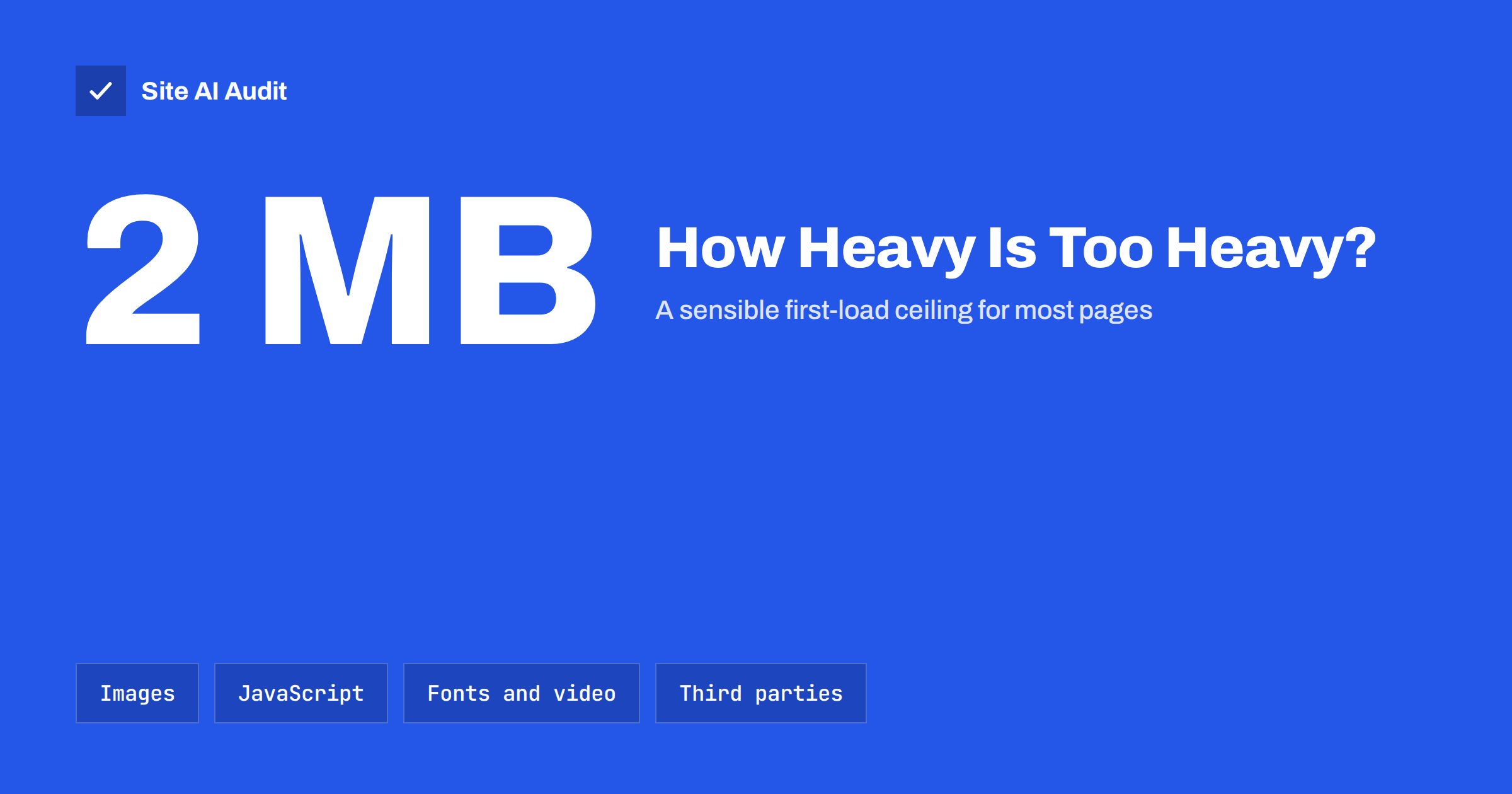
Short answer: Page weight is the total number of bytes a browser downloads to display a page, including HTML, CSS, JavaScript, images, fonts, video and third-party content. There is no official limit, but lighter is faster, especially on mobile. For a typical small-business page, staying around 1–2 MB or less on first load is a reasonable goal, with JavaScript kept as small as possible. Measure with DevTools or a speed test, then trim the biggest categories first: usually images, then JavaScript, then fonts, video and third-party tags.
Web pages have grown steadily heavier for over a decade. The HTTP Archive, which measures millions of websites every month, has recorded median page weights for mobile pages that now run to around two megabytes, with a long tail of pages far heavier. Every byte has to travel over the network and much of it has to be processed on the device. Page weight is not the only factor in speed, but it is one of the easiest to measure and one of the most reliable signs that something is being sent that does not need to be.
What page weight includes
Page weight is usually measured as the transferred size, meaning the bytes sent over the network after compression. It covers:
- HTML documents, including inline CSS and scripts.
- Stylesheets from your theme, plugins and third parties.
- JavaScript from your site and from every external service.
- Images, including background images, icons and tracking pixels.
- Fonts.
- Video and audio, including autoplaying background video.
- Data requests such as JSON responses from APIs.
- Iframes and embeds, which load complete pages of their own.
Two numbers are worth knowing: the weight on first load, before the visitor interacts, and the weight after scrolling to the bottom, when lazy-loaded content has also arrived. The first matters most for speed; the second matters for data usage.
How to measure page weight
- Chrome DevTools. Open the Network panel, tick “Disable cache”, reload, and read the summary at the bottom: number of requests, transferred size and resource size. Filter by type (JS, CSS, Img, Font, Media) to see which category dominates.
- PageSpeed Insights / Lighthouse. The “Avoid enormous network payloads” diagnostic lists total size and the largest files.
- WebPageTest and similar tools break down bytes by content type and by domain, which shows how much comes from third parties.
- A site-wide audit shows which templates or sections are heaviest, so you do not optimise one page while the rest stays heavy.
Measure on mobile, and measure several page types. A blog post, a product page and the home page can differ by several megabytes.
How heavy is too heavy?
There is no universal threshold, and Google does not rank pages by weight directly. But weight affects loading time, especially on mobile networks and for first-time visitors with nothing cached. Useful rules of thumb for business sites:
| First-load weight | Typical assessment |
|---|---|
| Under 1 MB | Lean; loading will rarely be limited by bandwidth |
| 1–2 MB | Reasonable for image-rich pages |
| 2–4 MB | Heavy; mobile visitors on weaker connections will notice |
| Over 4 MB | Very heavy; almost certainly contains oversized images, video or excess scripts |
Weight is not everything. A 1 MB page with 700 KB of JavaScript can feel slower than a 2 MB page that is mostly well-optimised images, because JavaScript must also be executed. Look at what the bytes are, not only how many there are.
Trim images first
On most small-business sites, images are the largest category. The fixes are well known and safe:
- Resize images to the size they are displayed at, with responsive versions for smaller screens.
- Convert photos to WebP or AVIF and compress them sensibly.
- Lazy-load images below the fold so they do not count toward first-load weight.
- Replace PNG photos and animated GIFs with better formats or short videos.
- Remove decorative images that add little, such as large background textures.
Then JavaScript
JavaScript is usually the second-largest category and the most expensive per byte, because it has to be parsed and run.
- Remove plugins, libraries and tags that are no longer used.
- Load scripts only on pages that need them.
- Replace heavy sliders, animation libraries and page-builder widgets with simpler alternatives where possible.
- Delay or remove third-party widgets that load large bundles.
- Make sure all JavaScript is served compressed with Gzip or Brotli.
Fonts, video and CSS
- Fonts: limit families and weights, use WOFF2, subset where possible. A dozen font files is a common and easily avoidable source of weight.
- Video: avoid autoplaying background videos on mobile, or serve a much smaller version. Embed hosted videos behind a click-to-load preview.
- CSS: large theme and builder stylesheets are rarely the heaviest category, but unused CSS still adds weight and blocks rendering. Remove styles for components you do not use.
- HTML: very large HTML documents often come from inlined data, huge menus or page builders nesting many containers. Keeping the DOM lean helps both weight and rendering.
Third-party weight you do not see
Third-party content often makes up a large share of total bytes, and it is invisible in your own files. Chat widgets, video players, social embeds, advertising and analytics can each add hundreds of kilobytes. Group network requests by domain to see the total for each vendor, and ask for each: is this worth the weight? Could it load later, only on some pages, or only on a click?
Set a page weight budget
Once you have trimmed pages, a budget keeps them lean. Decide maximum sizes per page type, for example first-load weight and JavaScript size for the home page and a typical article, and check them after every significant change. The budget does not need to be enforced by tools on a small site; a quick look at DevTools after adding a new plugin or campaign is enough to catch problems before they reach customers. Agencies can include page weight in their monthly reports so that clients see the cost of each new feature they request.
Why weight matters more than it seems
It is tempting to think that page weight stopped mattering when fast mobile networks arrived. In practice, several things keep it relevant. Mobile connections are fast on paper but inconsistent in real life: inside buildings, on trains, at busy events or in rural areas, bandwidth drops sharply and every megabyte takes noticeably longer. Many visitors still use prepaid or capped data plans and notice heavy sites. Devices must also decode and process what they download, so a heavy page costs battery and memory even on a fast connection. And weight adds up across a visit: a visitor who opens five pages on a site with 4 MB pages downloads twenty megabytes, while the same visit on a lean site might cost a tenth of that. Keeping pages light is one of the few optimisations that helps every visitor, on every device, in every situation.
Common reasons pages suddenly get heavier
- A new hero image uploaded straight from a camera.
- A new plugin that loads its scripts and styles on every page.
- A marketing campaign adding several tags and a pop-up tool.
- A background video added to the home page.
- A theme update that enables a new feature or icon library by default.
- An embedded social feed or review widget.
How Site AI Audit helps
Page weight is one of the speed checks in Site AI Audit, reported next to compression, server response time, the Google PageSpeed mobile score and Core Web Vitals. The free check crawls up to 50 pages, and the report explains in plain words what makes a page heavy and what to trim first. Paid plans add re-checks and weekly monitoring, which is useful for catching the sudden weight increases described above; see the plans.
Related reading
- Image Optimization for Faster Websites: A Practical Guide
- How to Reduce Unused JavaScript and Speed Up Your Pages
- Web Font Performance: How to Load Fonts Without the Wait
- Why Your Website Is Slow on Mobile and How to Fix It
The bottom line
Page weight is a simple, honest measure of how much you ask visitors to download. Measure it on mobile for your main page types, trim images first and JavaScript second, keep fonts and video under control, question every third-party widget, and set a simple budget so pages stay light as the site grows.
الأسئلة الشائعة
What is a good page size for a website?
There is no official limit, but a first-load weight of around 1–2 MB or less is a reasonable goal for most business pages. Lighter pages load faster on mobile networks. What the bytes consist of also matters, since JavaScript costs more than images per byte.
Does page size affect SEO?
Not directly. Google does not rank by page weight, but heavy pages usually load more slowly and can have worse Core Web Vitals, which are part of page experience. Very large HTML documents can also be harder to crawl efficiently.
How do I check the size of my web page?
Open Chrome DevTools, go to the Network panel, disable the cache and reload. The bottom bar shows the number of requests and the transferred size. PageSpeed Insights also lists total network payload and the largest files.
Why is my page so heavy when it looks simple?
Simple-looking pages can still load oversized images, large theme and plugin scripts, many font files, hidden elements and third-party widgets. Filter the Network panel by type and domain to see where the bytes come from.
Does lazy loading reduce page weight?
It reduces first-load weight, because images below the fold are downloaded only when needed. The total weight after scrolling to the end stays the same. First-load weight is what matters most for perceived speed.