ENEnglish
 LTLietuviškai
 DEDeutsch
 FRFrançais
 RUРусский
 ESEspañol
 PLPolski
 ITItaliano
 UKУкраїнська
 CSČeština
 PTPortuguês
 JA日本語
JA日本語 LVLatviešu valoda
 ETEesti
 HUMagyar
 IDBahasa Indonesia
 TRTürkçe
 HIहिन्दी
 ELΕλληνικά
 ARالعربية
 THไทย
THไทย VITiếng Việt
 RORomână
 MSBahasa Melayu
 BNবাংলা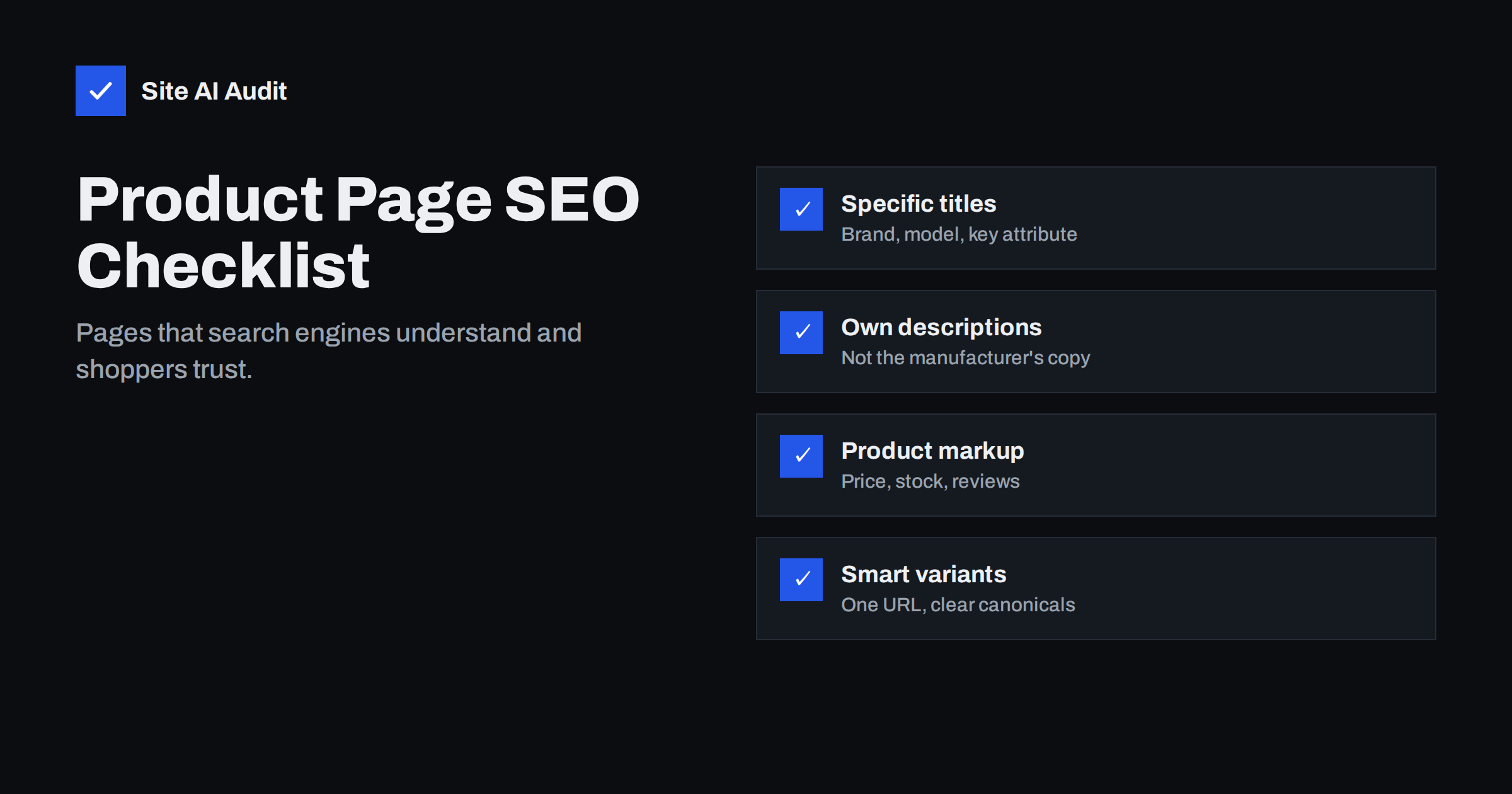
Short answer: A well-optimised product page has a specific title with brand, model and key attribute, an original description that answers buyers’ questions, descriptive images with alt text, accurate Product structured data with price and availability, one canonical URL for all variants, and links to and from its category and related products. Handle out-of-stock and discontinued products deliberately instead of deleting pages, and keep every product page crawlable and indexable unless it truly has no search value.
Why product pages are hard to rank
Product pages face a problem most other pages do not: many shops sell exactly the same item. If ten shops use the same manufacturer description, the same photos and similar titles, search engines have little reason to prefer one over another. Large marketplaces and brand sites often win by default.
Small shops compete by being more useful: clearer information, original photos, honest details about sizing and use, fast delivery information, real reviews and good answers to the questions buyers actually have. Technical basics make sure that effort is visible to search engines.
Titles and headings
- Make titles specific. Include brand, product name or model, and the most important attribute: “Trailmaster Women’s Waterproof Hiking Boots – Brown Leather | ShopName”. Avoid titles that are just a model code or a vague name.
- Keep them unique. Variants and similar products often end up with identical titles, which makes them hard to tell apart.
- Use one clear H1, usually the product name, matching the title in substance.
- Structure the description with subheadings such as “Features”, “Sizing”, “Materials and care” and “Delivery and returns”, so shoppers and search engines can scan it.
For large catalogues, build titles from a template that pulls brand, name and key attributes, then hand-edit the best sellers.
Descriptions that sell and rank
The manufacturer’s description is a starting point, not the finished page. Add what only you can say:
- who the product is for and which problem it solves;
- how it compares with similar products you sell;
- real sizing advice, such as “runs small, choose one size up”;
- materials, dimensions, weight, compatibility and other details buyers ask about;
- care, installation or usage instructions;
- answers to the questions your customer service receives most often.
Length is not a goal in itself. A few well-written paragraphs and a clear specification list are better than long filler. What matters is that the page answers the questions a buyer has before purchasing.
Images and alt text
- Use your own photos where possible, showing the product from several angles, in use and in detail. Original images stand out against the manufacturer’s standard shots.
- Give each image a descriptive file name and alt text, such as “Trailmaster waterproof hiking boot, side view, brown leather”.
- Compress images and serve modern formats so the page stays fast, especially on mobile.
- Make sure the main image is a real
<img>element that search engines can find, not only a CSS background or a script-loaded gallery.
Product structured data
Product markup, usually in JSON-LD, helps search engines understand the product and can make the page eligible for rich results showing price, availability and review ratings. Include:
name,image,description,brandand identifiers such asskuorgtinwhere available;offerswithprice,priceCurrencyandavailability;aggregateRatingandreviewonly if genuine reviews are visible on the page.
The most important rule is accuracy: the price and availability in the markup must match the page. Most shop platforms generate Product markup automatically, so check the output with the Rich Results Test rather than adding a second, conflicting block. Shops that also use Google’s merchant listings should keep feed data and page data consistent.
Variants, parameters and duplicate URLs
Size and colour variants are a common source of duplicate content:
- Preferred approach: one product page with selectors for size and colour, and variant URLs (such as
?color=brown) canonicalised to the main product URL. - Separate variant pages make sense only when a variant has its own search demand and you can give it distinct content, such as a colour that people search for by name.
- Products in several categories should have one product URL, not a different URL per category path. If your platform creates category-based product URLs, make sure they all canonicalise to one version.
- Internal links should point to the canonical product URL, without tracking or sorting parameters.
Out of stock and discontinued products
Deleting product pages whenever stock runs out creates broken links and throws away the page’s search history. Handle each case deliberately:
- Temporarily out of stock: keep the page live and indexable, mark it clearly as out of stock with an expected date if known, offer a back-in-stock notification, and show alternatives. Update the availability in structured data.
- Permanently discontinued with a successor: 301 redirect to the new model, or keep the old page with a clear notice and a prominent link to the successor if the old page still gets useful traffic, for example from people looking for manuals or spare parts.
- Permanently discontinued with no replacement: return a 404 or 410, or redirect to a closely matching category if it genuinely serves the searcher. Do not redirect everything to the home page.
- Seasonal products: keep the same URL year after year so it builds history, rather than creating a new page each season.
Internal links and navigation
- Every product should be linked from at least one category page that is itself well linked.
- Breadcrumbs, such as Home › Boots › Hiking boots › Trailmaster, help visitors and search engines understand where the product sits.
- Related products and “often bought together” blocks create useful links between products, as long as they are real HTML links.
- Buying guides and blog posts can link to relevant products and categories, and products can link back to guides that help choose them.
- Avoid products that exist only in the sitemap or internal search. Orphan products are crawled less and rarely perform well.
Reviews and trust signals
Genuine customer reviews add unique content, answer questions in customers’ own words and help shoppers decide. Display them on the product page as text that search engines can read, not only inside an image or an external widget that loads late. Reply to negative reviews helpfully. Never create fake reviews or copy reviews from other sites.
Other trust signals matter too: clear delivery costs and times, return conditions, secure checkout, contact details and payment options. They mainly affect conversion, but pages that satisfy visitors tend to perform better over time.
Prioritising a large catalogue
Few shops can rewrite thousands of product pages at once. A realistic plan:
- Fix templates first. Titles, H1s, structured data, canonical tags and breadcrumbs come from templates. One fix improves every product.
- Rewrite best sellers next. Your top 20 to 50 products by revenue or search impressions deserve hand-written descriptions, original photos and a FAQ section.
- Then products close to page one. Use the Search Console Performance report to find products with many impressions at positions 5 to 20.
- Use templates for the long tail. For the rest, a structured template with specifications, sizing notes and delivery information is far better than a bare manufacturer paragraph.
- Add new products properly from the start. It is easier to write a good description when a product is added than to return to it later.
Technical checks for product pages
- Product pages return 200, are indexable and self-canonical.
- Titles and H1s are unique across products.
- Structured data validates and matches visible price and availability.
- Images load quickly and have alt text.
- Variant and parameter URLs canonicalise to the main product.
- The page works well on mobile, with a visible price and add-to-cart button.
- Discontinued products are redirected or return proper status codes, with no broken internal links left behind.
How Site AI Audit helps
Site AI Audit crawls up to 50 pages on the free check and reports the product page basics that are easy to miss: duplicate titles such as many variants sharing one name, missing descriptions, missing H1s and alt texts, broken links to removed products, redirects and noindex rules, plus mobile speed from Google PageSpeed. Findings are ranked by impact with a plain-language fix. Check your shop for free, or see plans with larger crawls and monitoring.
Related reading
- Structured Data for Small Business Websites: A Beginner Guide
- Duplicate Content in SEO: Common Causes and How to Fix Them
- Image Alt Text: How to Write It for SEO and Accessibility
- Crawl Budget Explained: Does It Matter for Your Website?
The bottom line
Product pages rank when they are clearly described, genuinely useful and technically clean. Write specific titles, original descriptions and helpful specifications, use your own photos with alt text, keep structured data accurate, give each product one canonical URL, link products from strong categories and related content, and treat out-of-stock and discontinued items deliberately instead of deleting them.
الأسئلة الشائعة
Can I use the manufacturer’s product descriptions?
You can, and it will not cause a penalty, but your page will look like every other shop’s. Adding original information, photos and answers to buyer questions gives search engines a reason to choose your page.
Should out-of-stock products be removed?
Not if they will come back. Keep the page live, mark it as out of stock and suggest alternatives. Redirect or remove only products that are permanently gone.
Do product variants need separate pages?
Usually not. One page with variant selectors and canonicalised variant URLs works best. Separate pages make sense only for variants with distinct search demand and content.
Does Product structured data improve rankings?
Not directly, but it helps search engines understand the product and can make the page eligible for rich results with price and availability, which can make listings more attractive.
How long should a product description be?
Long enough to answer what buyers need to know. For simple products, a few paragraphs and a specification list are enough; complex or expensive products deserve more detail.