ENEnglish
 LTLietuviškai
 DEDeutsch
 FRFrançais
 RUРусский
 ESEspañol
 PLPolski
 ITItaliano
 UKУкраїнська
 CSČeština
 PTPortuguês
 JA日本語
JA日本語 LVLatviešu valoda
 ETEesti
 HUMagyar
 IDBahasa Indonesia
 TRTürkçe
 HIहिन्दी
 ELΕλληνικά
 ARالعربية
 THไทย
THไทย VITiếng Việt
 RORomână
 MSBahasa Melayu
 BNবাংলা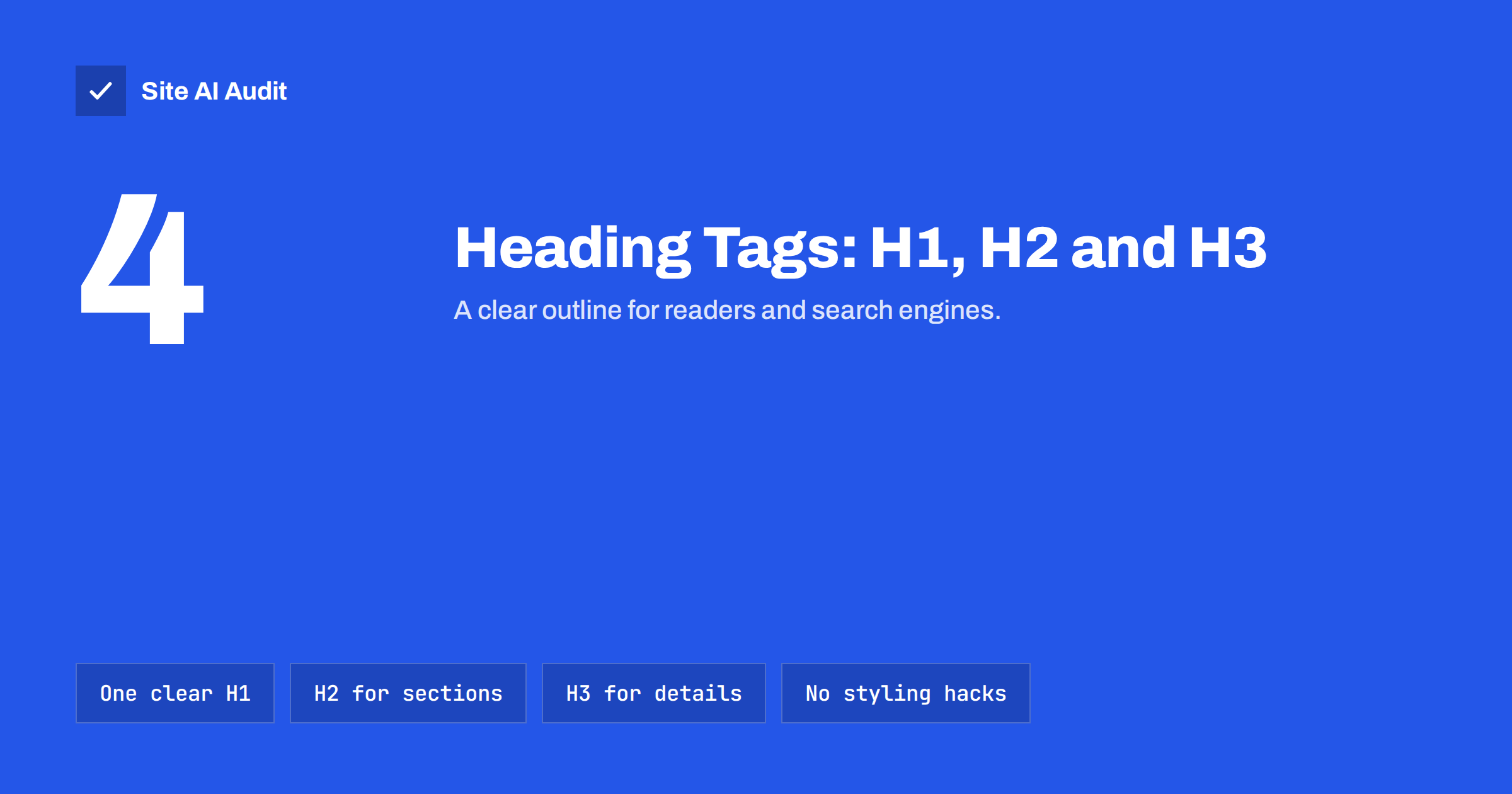
Short answer: Heading tags (H1 to H6) create the outline of a web page. Use one H1 that names the page topic, H2 headings for the main sections, and H3 headings for details inside those sections, without skipping levels for visual effect. Clear headings help visitors scan the page and help search engines and AI answer engines understand what each part of the page is about.
What heading tags are
HTML has six heading levels, from <h1> to <h6>. They are not just bigger or bolder text. They tell browsers, screen readers and search engines how the content is organised, much like the chapter titles and subheadings in a book.
A well-structured page reads like a table of contents when you look only at its headings:
- H1: Emergency Boiler Repair in Leeds
- H2: Signs your boiler needs urgent repair
- H2: What happens during a call-out
- H3: Diagnosis
- H3: Parts and pricing
- H2: Areas we cover
- H2: Frequently asked questions
Anyone reading only these lines knows what the page offers and where to find each piece of information. That is exactly the goal.
Why headings matter for SEO and for people
Headings serve several audiences at once:
- Visitors scan before they read. Most people skim a page to decide whether it answers their question. Descriptive headings let them jump to the part they need instead of leaving.
- Search engines use headings as context. Headings are a strong hint about the topic of the page and of each section. They are not a ranking trick, but a clear outline makes it easier for search engines to match sections to specific questions.
- Answer engines quote sections. AI-driven search features often extract a short passage that answers a question. A heading phrased like a question, followed by a direct answer, is easy to extract and cite.
- Accessibility depends on them. Screen reader users often navigate by headings, jumping from one to the next. A page without proper headings is a wall of text for them. The MDN reference on heading elements explains the accessibility side in detail.
The H1: one clear topic per page
The H1 is the main heading visitors see at the top of the page. In most cases, each page should have exactly one H1 that names its topic.
A good H1:
- describes the page precisely, using the words a visitor would search for;
- agrees with the title tag, even if the wording is slightly different;
- appears near the top of the main content, not in the logo or sidebar;
- is written as real text, not as part of an image.
Technically, HTML allows more than one H1, and search engines cope with it. In practice, multiple H1s are usually a sign of a theme problem: the logo, the site name or a widget title marked as H1 on every page. That means the real page topic competes with repeated boilerplate. One H1 per page is the simplest rule, and it avoids ambiguity.
The H1 and the title tag work as a pair. The title is written for the search results page and can include the brand; the H1 greets the visitor who has already arrived. When they tell the same story, search engines are also less likely to rewrite your title.
H2 and H3: building a logical outline
Below the H1, headings should follow a simple hierarchy:
- H2 for main sections. Each H2 introduces one subtopic of the page. A service page might have H2s for benefits, process, pricing, coverage area and FAQ.
- H3 for parts of a section. Use H3 only inside an H2 section, to break it into steps, options or questions.
- H4 and below rarely. Most business pages never need them. Deep nesting often means a section should be its own page.
Do not skip levels to get a certain look, such as jumping from H2 straight to H5 because the H5 font size looks right. Styling belongs in CSS. The heading level should reflect the structure, not the design.
Write each heading so that it makes sense on its own. “Overview” and “More info” tell a scanning reader nothing. “How long does a boiler repair take?” or “Delivery times and costs” tell them exactly what follows.
Common heading mistakes found in audits
When websites are crawled, the same heading problems appear again and again:
- Missing H1. The page starts with a big slider or an image, and the actual topic never appears as a heading.
- Multiple H1s from the template. The logo, the site name or footer widgets are coded as H1 on every page.
- Duplicate H1s across pages. Several pages share the same H1, such as “Our Services”, which blurs their differences.
- Empty headings. Page builders sometimes leave empty heading elements that contain only spaces or an icon.
- Headings used for styling. Phone numbers, call-to-action text or testimonials marked up as H2 or H3 because they needed to look bigger.
- Keyword-stuffed headings. Every heading repeats the same phrase, which reads badly and adds nothing.
- No headings at all. Long pages written as one block of paragraphs, common on older sites and in pasted content.
How to check and fix your headings
You can check a single page quickly and a whole site with a crawler.
- Look at one page’s outline. Browser extensions and developer tools can list all headings on a page. Alternatively, view the source and search for
<h1,<h2and so on. - Crawl the whole site. An audit tool collects headings for every page and highlights missing, duplicate and multiple H1s.
- Fix the template first. If the logo or site name is an H1 on every page, change it in the theme so the page title becomes the only H1. One template fix can solve hundreds of findings.
- Rewrite weak headings on key pages. Start with the home page, main services or categories and top landing pages. Make each heading descriptive and specific.
- Restructure long pages. Add H2s every few paragraphs where the topic changes, and use H3s for steps or questions.
- Re-check. Crawl again to confirm every important page has one clear H1 and a logical outline.
In WordPress and most page builders, you choose the heading level from a dropdown in the block or widget settings. Make sure you pick the level by meaning, then adjust the size with the design settings if needed.
Headings, questions and answer engines
Search features that answer questions directly, including AI summaries, work best with content that is easy to split into clear parts. A practical pattern is to phrase some H2 or H3 headings as the questions people actually ask, and then answer the question in the first one or two sentences below the heading before adding detail.
For example, under the heading “How often should a boiler be serviced?”, start with “Most manufacturers recommend a service once a year” and then explain why. This helps visitors, and it gives search engines a clean, quotable answer. It works especially well for FAQ sections, which pair naturally with FAQ structured data.
The same logic applies to lists and tables placed under a heading. A short numbered list of steps directly under “How to reset the boiler pressure” is easy for readers to follow and easy for search features to understand, because the heading states the task and the list delivers it.
Do not turn every heading into a question, though. Section headings like “Prices” or “Areas we cover” are perfectly clear. Use questions where they match how people search.
How Site AI Audit checks headings
Site AI Audit crawls your pages the way a search engine does and checks headings and alt texts as part of its SEO section. It flags pages without an H1, pages with several H1s and duplicated headings, lists the affected pages, and explains each finding and its fix in plain language. Because findings are ranked by impact, you can see whether headings are a priority or whether other issues deserve your time first. Check your website for free to see its heading findings.
Related reading
- How to Write Title Tags: A Practical Guide for Small Sites
- Meta Descriptions: What They Do and How to Write Them
The bottom line
Headings are the skeleton of a page. Give each page one descriptive H1 that matches its title tag, divide the content with H2 sections and H3 details, and never pick a heading level for its looks. Fix template-level problems first, then improve the headings on your most valuable pages, so both visitors and search engines can understand the page at a glance.
الأسئلة الشائعة
Can a page have more than one H1?
HTML allows it and search engines can handle it, but one H1 per page is the clearest structure. Multiple H1s are usually caused by a theme marking the logo or widgets as H1. Fixing that lets the real page topic stand out.
Should the H1 be the same as the title tag?
Not necessarily identical, but they should describe the same topic. The title can include the brand and be tuned for search results, while the H1 speaks to the visitor on the page.
Do headings help rankings?
Headings help search engines understand the topic and structure of a page, which supports relevance. They are not a shortcut to higher rankings on their own. Their bigger benefit is making content easier to read and quote.
Is it bad to skip heading levels?
Skipping from H2 to H4 will not break your site, but it makes the outline confusing, especially for screen reader users. Choose levels by structure and adjust the appearance with CSS.
Should I put keywords in every heading?
No. Use the words your visitors use where they fit naturally. Repeating the same phrase in every heading reads badly and does not help.