ENEnglish
 LTLietuviškai
 DEDeutsch
 FRFrançais
 RUРусский
 ESEspañol
 PLPolski
 ITItaliano
 UKУкраїнська
 CSČeština
 PTPortuguês
 JA日本語
JA日本語 LVLatviešu valoda
 ETEesti
 HUMagyar
 IDBahasa Indonesia
 TRTürkçe
 HIहिन्दी
 ELΕλληνικά
 ARالعربية
 THไทย
THไทย VITiếng Việt
 RORomână
 MSBahasa Melayu
 BNবাংলা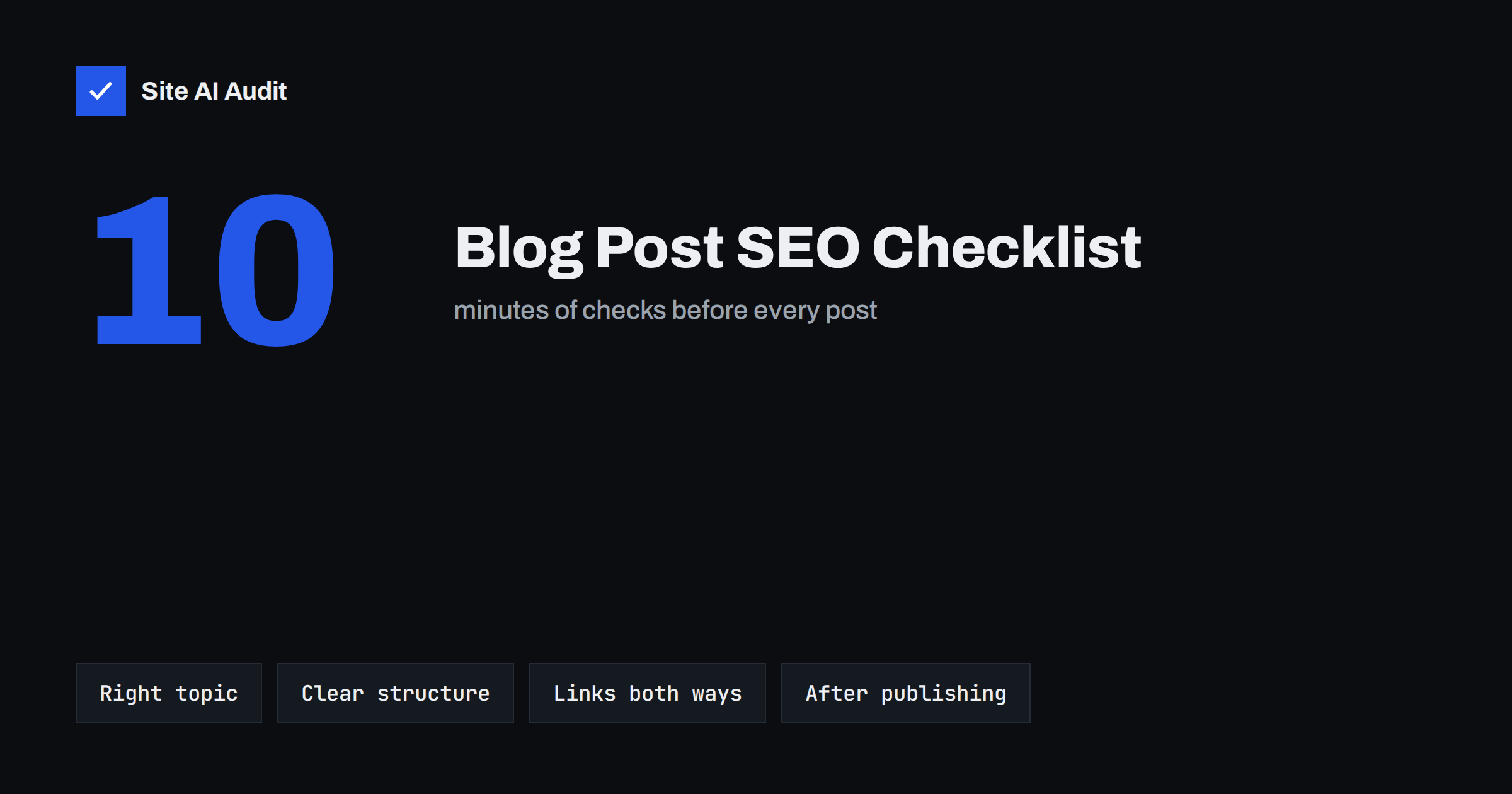
Short answer: Before publishing a blog post, check that it answers a real question your customers search for, that the title and URL are clear and specific, that the answer appears early, that headings structure the content, that images have alt text, that the post links to related pages and your relevant service, and that the meta description summarises it well. After publishing, link to it from existing posts, confirm it is indexed and review its performance in Search Console after a few weeks.
Why a checklist helps
Most blog posts on small business websites are written in spare moments and published as soon as the text is done. The writing may be good, but small omissions add up: a vague title, a long URL with filler words, no internal links, images without alt text, no description. Each takes a minute to fix before publishing and much longer to find and fix later across dozens of posts.
A short checklist turns good intentions into habits. Print it, pin it or add it to your publishing workflow.
How to use this checklist
You do not need to tick every item for every post. Short news updates need less than a cornerstone guide. Treat the sections as a quick scan: topic and intent before you write, title, structure and links while you write, metadata and a final preview just before you press Publish, and the follow-up steps in the weeks after. If several people publish on your site, agree on the checklist together so everyone uses the same standards.
Before writing: topic and intent
- ☐ The topic answers a real question. It comes from customer conversations, Search Console queries, autocomplete or related questions in search results, not only from what you want to say.
- ☐ The intent is clear. You searched the main phrase and the results are guides or articles, not product pages or local listings.
- ☐ It does not duplicate an existing post. Search your own site first. If you already have a post on the topic, update it instead.
- ☐ It connects to your business. There is a natural link to a service, product or category that the reader may need next.
- ☐ You can add something specific. Your own experience, examples, photos or data make the post worth reading compared with what already exists.
Title and URL
- ☐ The title is specific and starts with the topic. “How to Store Winter Tyres: 7 Steps That Prevent Damage” rather than “Tyre Tips”.
- ☐ It is roughly 50–60 characters, so it is not cut off in search results.
- ☐ It promises only what the post delivers.
- ☐ The URL slug is short and descriptive, such as
/store-winter-tyres/, without dates, filler words or stop words where they add nothing. - ☐ The H1 matches the title in substance.
Structure and content
- ☐ The answer comes first. The first paragraph answers the main question directly in two to four sentences. Details follow.
- ☐ H2 headings divide the post into clear sections, with H3s for steps or sub-points. Headings make sense on their own when skimmed.
- ☐ Some headings mirror real questions people ask, followed by a direct answer.
- ☐ Paragraphs are short, and lists or tables are used where they make information easier to scan.
- ☐ Facts are accurate and current. Prices, rules, product names and dates are checked.
- ☐ Claims are honest. No invented statistics or promises. Where you cite a fact, it comes from a reliable source.
- ☐ The author is shown, with a short note on why they know the topic, especially for advice content.
- ☐ Length fits the question. Complete enough to be genuinely useful, without padding.
Images and media
- ☐ Images add information, such as real photos, screenshots, diagrams, rather than decoration only.
- ☐ File names are descriptive before upload:
winter-tyres-stacked-flat.jpg. - ☐ Alt text describes each meaningful image; decorative images have empty alt.
- ☐ Images are resized and compressed to reasonable dimensions.
- ☐ The featured image is set, since it appears in listings and social shares.
- ☐ Embedded videos are relevant and do not slow down the page excessively.
Links
- ☐ The post links to your relevant service or product, once or twice where it fits naturally.
- ☐ It links to two to four related posts or guides with descriptive anchor text.
- ☐ External links point to reliable sources and are used sparingly.
- ☐ Paid or affiliate links are marked with rel=”sponsored” and disclosed to readers.
- ☐ No links point to redirects or broken pages.
Metadata and settings
- ☐ A meta description of about 120–160 characters summarises what the reader gets.
- ☐ The post is in the right category, and tags, if you use them, are few and meaningful.
- ☐ The post is indexable: no accidental noindex from a plugin setting or template.
- ☐ Structured data such as Article or BlogPosting is output by your theme or SEO plugin; FAQ markup matches any visible FAQ.
- ☐ Social preview title, description and image look right when shared.
- ☐ The publication date is correct, and an update date is shown when the post is later revised substantially.
Final check before publishing
- ☐ Preview on a phone: readable text, working layout, no oversized images.
- ☐ Read the first screen as a stranger: is it clear what the post answers and why to keep reading?
- ☐ Proofread headings, the first paragraph and any numbers.
- ☐ Click every link once.
After publishing
- Link to the new post from existing content. Add links from two or three related, already-visited posts and, where relevant, from the service page. This is one of the fastest ways to get a new post discovered.
- Check the sitemap includes the new URL; most CMS plugins do this automatically.
- Request indexing for important posts with URL Inspection in Search Console.
- Share it where your customers are: newsletter, social channels, relevant communities.
- Review performance after four to eight weeks in Search Console: which queries it appears for, impressions, clicks and position. Adjust the title, add sections for unexpected questions or improve internal links.
- Schedule a review date for posts on topics that change, such as prices, laws or software.
Example: one post through the checklist
A heating company plans a post after customers keep asking the same question on the phone. The draft is titled “Some thoughts on radiators”. Running it through the checklist changes a lot in a few minutes:
- The topic is refined to the real question: why radiators are cold at the top. Searching that phrase shows guides with step-by-step fixes, so a how-to format fits.
- The title becomes “Radiator Cold at the Top? How to Bleed It in 5 Steps”, and the slug becomes
/radiator-cold-at-top/. - The first paragraph now says immediately that trapped air is the usual cause and that bleeding the radiator usually fixes it, with a note on when to call a professional.
- H2 headings cover the causes, the tools needed, the steps, what to do if it still does not heat up and when a power flush may be needed.
- Two photos from a real job get descriptive file names and alt text.
- The post links to the company’s boiler servicing page and to an older guide about low boiler pressure, and that older guide gets a link back.
- A meta description summarises the fix and mentions the five steps.
The writing itself hardly changed. The checklist made it findable and useful.
Common blog post mistakes
- Writing about company news that nobody searches for, while customer questions go unanswered.
- Several short posts on the same topic instead of one complete guide.
- Titles that are clever but vague.
- Long introductions before any useful information.
- No link to the service the post is supposed to support.
- Publishing and never looking at the post again.
How Site AI Audit helps
Individual checklists catch problems in new posts; an audit catches what slipped through across the whole blog. Site AI Audit crawls your pages and reports duplicate or missing titles and descriptions, missing H1s, images without alt text, broken links, redirects and noindex rules, with a plain-language fix for each. Run a free check to see how your existing posts measure up.
Related reading
- How to Write Title Tags: A Practical Guide for Small Sites
- Search Intent Explained: Match Your Pages to What People Want
- Anchor Text Best Practices: How to Write Better Link Text
- How to Update Old Content for SEO: Refresh, Merge or Remove
The bottom line
A blog post performs best when it answers a real question, says so clearly in its title and first paragraph, is well structured, links to related content and to your services, and has clean metadata and images. Ten minutes of checks before publishing and a few minutes of linking and measuring afterwards turn a good post into one that search engines can find and readers can use.
الأسئلة الشائعة
How long should a blog post be for SEO?
There is no ideal word count. It should be long enough to answer the question completely and clearly. Look at what currently ranks for the topic and aim to be more useful, not just longer.
How many internal links should a blog post have?
A few relevant ones: usually a link to the related service or product and two to four links to related guides. Add them where they genuinely help the reader.
Should I update the date when I edit a post?
Only when you make substantial changes. Showing an “updated” date for real revisions helps readers; changing dates without changes is misleading.
Do blog tags help SEO?
Rarely on their own. A few meaningful tags can help navigation, but many thin tag pages add little. Categories usually organise content better.
How soon will a new post appear in Google?
Often within days on an established site, especially if it is linked from existing pages and submitted for indexing. New sites may take longer.