ENEnglish
 LTLietuviškai
 DEDeutsch
 FRFrançais
 RUРусский
 ESEspañol
 PLPolski
 ITItaliano
 UKУкраїнська
 CSČeština
 PTPortuguês
 JA日本語
JA日本語 LVLatviešu valoda
 ETEesti
 HUMagyar
 IDBahasa Indonesia
 TRTürkçe
 HIहिन्दी
 ELΕλληνικά
 ARالعربية
 THไทย
THไทย VITiếng Việt
 RORomână
 MSBahasa Melayu
 BNবাংলা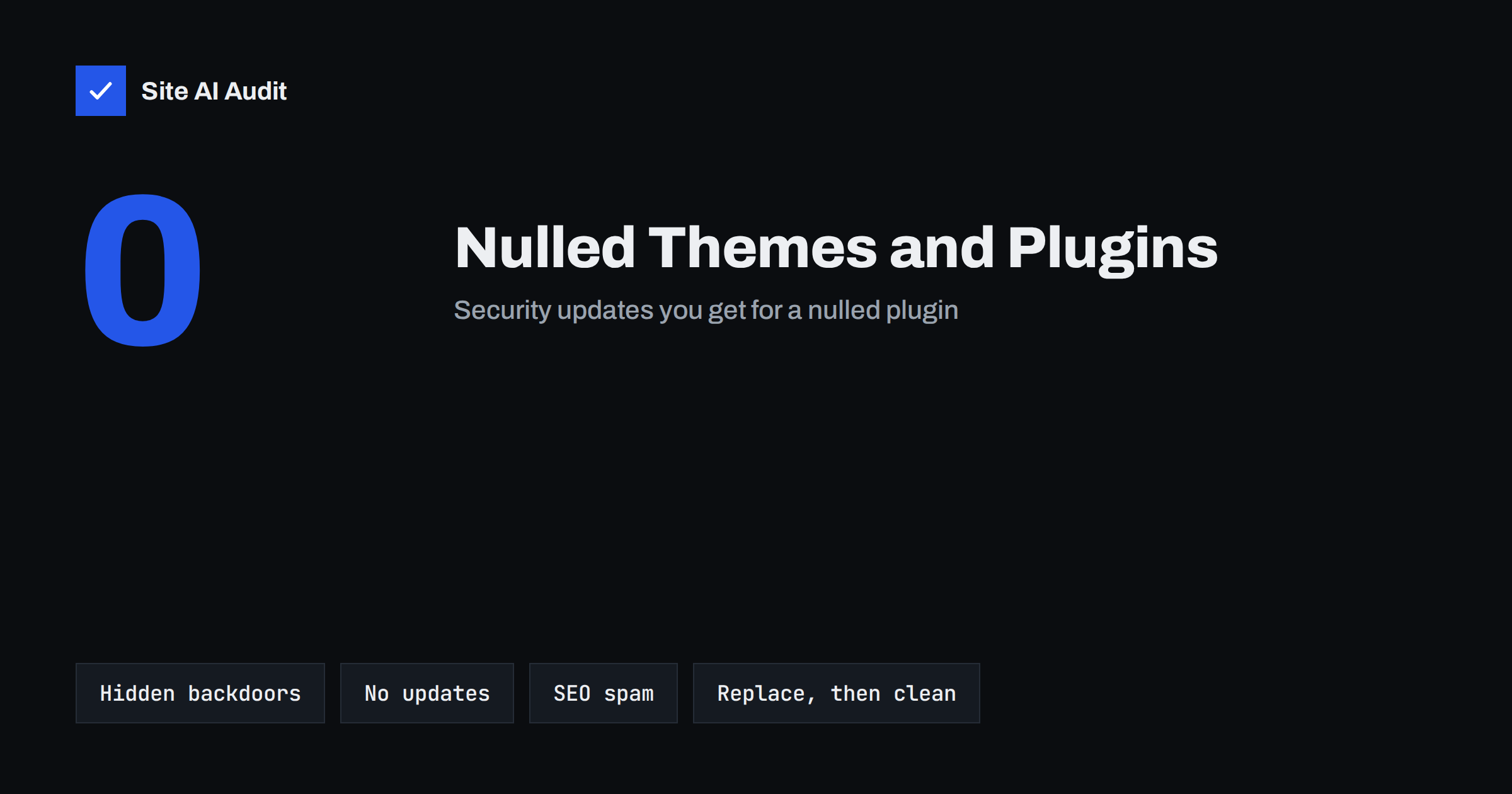
Short answer: A nulled theme or plugin is a premium product with its licence check removed, shared for free on unofficial sites. Many of these copies are modified to include backdoors, hidden spam links or redirect code, and none of them receive the vendor’s security updates. The money saved is small compared with the cost of cleaning a hacked site. If you have one installed, replace it with a legitimate copy or a free alternative, then check the site for anything it may have left behind.
What “nulled” means
Premium themes and plugins for WordPress and other content management systems are usually sold with a licence key. The key unlocks automatic updates, support and sometimes extra features. A “nulled” version is a copy in which someone has removed or bypassed that licence check, then published it on a download site, a forum or a file-sharing service.
For WordPress, the code of themes and plugins is often released under the GPL licence, which does allow redistribution. That is why some sellers argue that sharing it is legal. But the licence status of the code is not the real issue for a website owner. The issue is that you are running code from an unknown source, modified by an unknown person, with no way to receive fixes.
How nulled software ends up on business websites
Most owners who run nulled code did not set out to take a risk. It usually arrives in one of a few ordinary ways:
- A developer cut costs. A freelancer or agency quoted a low price for the site and used downloaded copies of premium themes and page builders instead of buying licences.
- A licence expired. The original developer’s licence lapsed, updates stopped, and someone later “fixed” the update warnings by installing a nulled version.
- A demo became production. A theme downloaded “just to try it” was never replaced after the site went live.
- A bundle looked like a bargain. Sites offering hundreds of premium plugins for a small monthly fee are often redistributing copies of unknown origin.
If you took over a site from someone else, it is worth asking directly which premium components it uses and who holds the licences. The answer often reveals problems before they turn into a hack.
Why nulled copies are dangerous
People who distribute nulled software are rarely doing it out of generosity. The downloads attract traffic and advertising income, and a modified copy installed on thousands of websites gives its author access to all of them. Security researchers have repeatedly found nulled packages carrying malicious additions. The common patterns are:
- Backdoors. A few lines of hidden code that let the author run commands, upload files or create an administrator account on your site at any time.
- Hidden administrator users. Accounts created silently and hidden from the users list in the dashboard.
- SEO spam. Links to gambling, pharmacy or counterfeit sites injected into your pages, often shown only to search engine crawlers so you do not notice them.
- Malicious redirects. Visitors from search results or mobile devices are sent to scam sites, while you, logged in, see the normal page.
- Resource abuse. Scripts that use your server to send spam or attack other sites, which can get your hosting suspended or your IP blocklisted.
The code is usually obfuscated, with long encoded strings and functions such as eval or base64_decode, so it is hard to spot by reading.
The update problem, even without malware
Suppose you found a clean nulled copy. It still has a serious flaw: it will never update itself. Plugins and themes regularly receive security fixes for vulnerabilities discovered after release. When a vulnerability becomes public, attackers scan the web for sites running the affected version.
A licensed copy gets the fix through the normal update screen. A nulled copy stays vulnerable until you notice, find a newer nulled copy from another unknown source, and install that, with the same risks as before. Over time, the site ends up running old code with known holes. Our safe update strategy explains why regular updates are the backbone of website security.
Signs a nulled component has compromised your site
Problems caused by nulled code often look like any other hack. Watch for:
- Administrator accounts you did not create, or more administrators in the database than in the dashboard.
- Search results for your site showing unfamiliar titles, foreign-language text or spam keywords.
- Visitors reporting redirects that you cannot reproduce while logged in.
- A “Deceptive site ahead” or similar browser warning.
- Unknown files in the uploads folder, especially PHP files, or recently modified core files.
- Your host warning about high resource use or outgoing spam.
- A Security issues message in Google Search Console.
Our checklist of signs your website has been hacked explains how to check each of these, and the guide to removing a Deceptive site ahead warning covers the browser warnings specifically.
Nulled vs licensed vs free alternatives
| Nulled copy | Licensed copy | Free plugin from official directory | |
|---|---|---|---|
| Source of code | Unknown, possibly modified | Vendor | Developer, reviewed on submission |
| Security updates | None | Automatic while licensed | Through the normal update screen |
| Support | None | From the vendor | Community forum, sometimes developer |
| Hidden code risk | High | Low | Low |
| Cost | Free up front, expensive if hacked | Licence fee | Free |
For many needs a well-maintained free plugin is enough. Where a premium product is genuinely better, the licence fee is usually small compared with even one hour of emergency clean-up.
How to replace a nulled theme or plugin safely
If you discover nulled software on a site, whether you installed it or inherited it from a previous developer, deal with it in two steps: replace it, then check for leftovers.
- Take a full backup of files and database before changing anything, and keep it separate in case you need evidence or rollback.
- Get a legitimate copy from the vendor, or choose a free alternative from the official directory.
- Delete the nulled folder completely and install the clean copy. Do not just upload over it; backdoor files may have names the clean version does not contain.
- Check users. Look in the database for administrator accounts, not only in the dashboard, and remove unknown ones.
- Scan for other changes. Compare core files with fresh copies, look for PHP files in the uploads folder, and review scheduled tasks and must-use plugins.
- Change every credential. Admin passwords, hosting, FTP or SFTP, database password and the security keys and salts in the configuration file.
- Check what search engines see. Use URL Inspection in Search Console to view the crawled page and look for hidden links.
If you find signs of compromise, follow a full clean-up process such as our step-by-step recovery plan for hacked websites. Replacing the plugin alone does not remove a backdoor planted elsewhere.
Preventing it in the future
- Install themes and plugins only from the official directory or directly from the vendor’s website.
- Keep a simple inventory of premium components, their licence owner and renewal date. Licences often belong to a former agency or freelancer and quietly expire.
- When a developer builds your site, ask for licences registered to your business, not to them.
- Limit who can install plugins; only a small number of trusted administrators need that ability.
- Remove components you no longer use instead of just deactivating them.
- Keep automatic backups and test that they can be restored.
The WordPress security checklist puts these habits into a wider routine.
How Site AI Audit helps
Site AI Audit checks your website from the outside, the way visitors and search engines see it: SSL certificate and expiry, HTTPS redirect, security headers and exposed software versions, together with SEO, speed and e-mail authentication. It does not scan server files for malware, but outdated software versions and unexpected changes in a regular report are often the first visible hints that something needs attention. You can start with a free check.
Related reading
- Website Security for Small Businesses: Where to Start
- Website Backup Strategy: How to Back Up So You Can Restore
- Exposed Software Versions: How to Hide Server and CMS Details
The bottom line
A nulled theme or plugin saves a licence fee and costs you control of your website. It may carry backdoors, spam or redirects from day one, and it will never receive security fixes. Use licensed copies or good free alternatives, keep an inventory of what you run, and if nulled code is already on a site, replace it and check thoroughly for anything it left behind.
FAQ
Are nulled plugins illegal?
For WordPress, much of the code is GPL-licensed and may be redistributed, but trademarks, support and update services are not included. Legality aside, the security risk of running modified code from unknown sources is the real problem.
Can a nulled theme be safe?
You cannot be sure. Even a copy without malware never receives security updates, so it becomes vulnerable as soon as a new flaw is published.
Is replacing the nulled plugin enough?
Not always. A backdoor may have created admin users or files elsewhere. After replacing it, check users, uploads, core files and scheduled tasks, and change all passwords and security keys.
How do I know if a plugin on my site is nulled?
Check whether you or your developer bought a licence, whether the plugin receives updates normally, and whether its files contain obfuscated code or references to download sites. When in doubt, ask the vendor.
What are safer alternatives to nulled software?
Buy a licence from the vendor, or use a well-maintained free theme or plugin from the official directory. Many free options cover the needs of a typical small business site.