ENEnglish
 LTLietuviškai
 DEDeutsch
 FRFrançais
 RUРусский
 ESEspañol
 PLPolski
 ITItaliano
 UKУкраїнська
 CSČeština
 PTPortuguês
 JA日本語
JA日本語 LVLatviešu valoda
 ETEesti
 HUMagyar
 IDBahasa Indonesia
 TRTürkçe
 HIहिन्दी
 ELΕλληνικά
 ARالعربية
 THไทย
THไทย VITiếng Việt
 RORomână
 MSBahasa Melayu
 BNবাংলা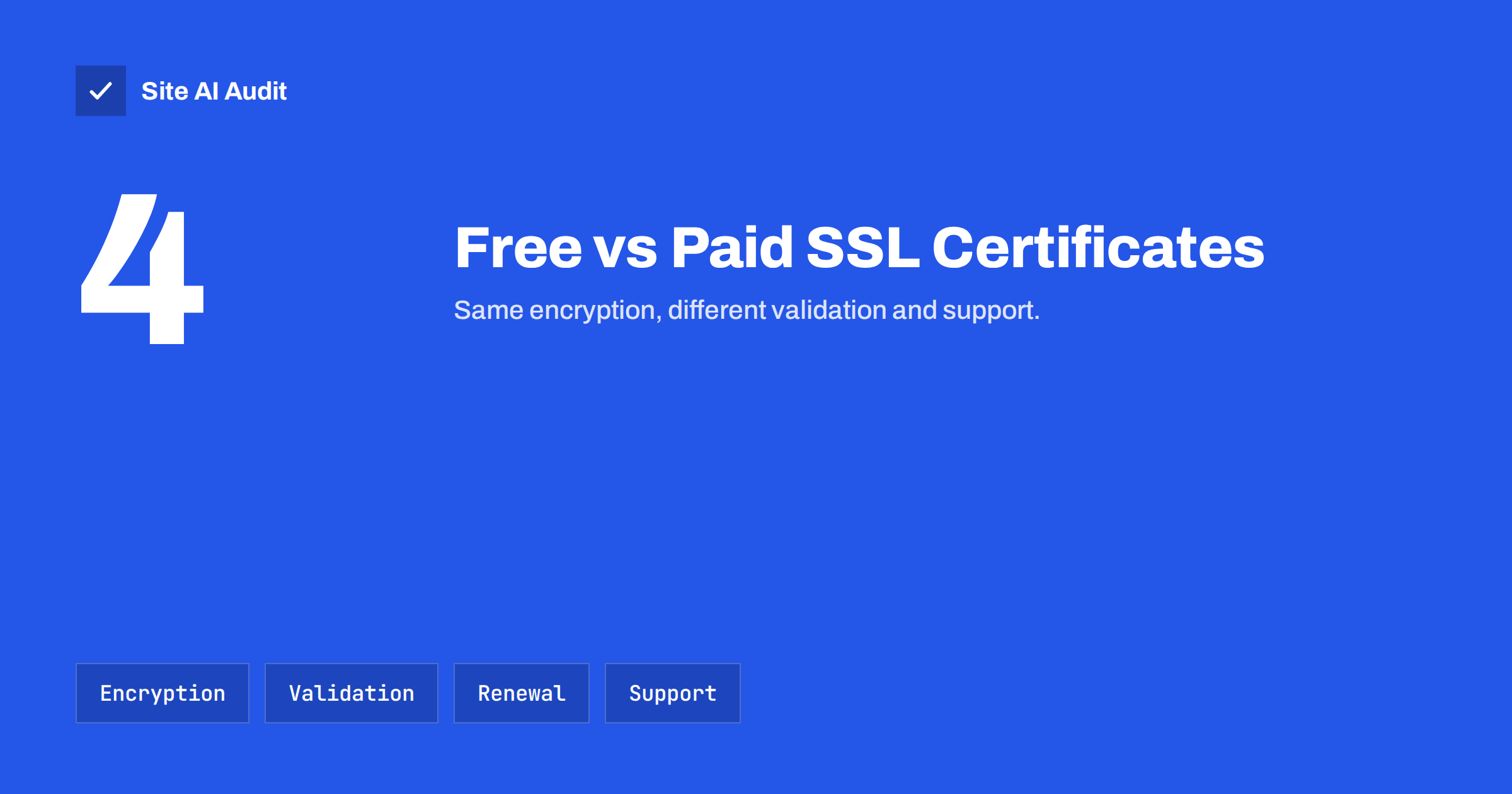
Short answer: For most websites a free, domain-validated certificate from Let’s Encrypt or a similar authority is the right choice: it uses the same encryption as a paid certificate and is trusted by all major browsers. Paid certificates make sense when you need organisation or extended validation, a contractual warranty, specific certificate types your platform cannot automate, or vendor support. Whichever you pick, the deciding factor for reliability is automated renewal plus monitoring, not the price.
Hosting companies and certificate resellers still sell SSL certificates at prices ranging from a few euros to several hundred per year, while free certificates are one click away in most control panels. It is natural to wonder whether the paid ones are “more secure”. They are not – but they are not pointless either. This comparison explains what you really get for the money, which features matter for which kinds of websites, and how to decide without overpaying or under-protecting.
What is identical in free and paid certificates
The part of a certificate that protects your visitors’ data is the same regardless of price:
- Encryption strength. The encryption is negotiated between the browser and your server using TLS. The certificate’s key type (RSA or ECDSA) and size are chosen when the certificate is requested, not by how much you pay.
- Browser trust. Free authorities such as Let’s Encrypt are trusted by every major browser and operating system, the same as commercial CAs.
- The padlock. Browsers show the same padlock (or, in newer versions, a neutral icon) for any valid certificate. There is no “premium padlock”.
- SEO effect. Search engines treat HTTPS as a lightweight signal; they do not distinguish between free and paid certificates.
If someone tells you a paid certificate gives “stronger encryption” or “better rankings”, that is sales language, not a technical fact.
Where they really differ
| Aspect | Free (typically Let’s Encrypt) | Paid (commercial CA) |
|---|---|---|
| Validation levels | Domain validation (DV) only | DV, organisation (OV) and extended validation (EV) |
| Lifetime | 90 days, renewed automatically | Up to about 13 months today, being reduced by industry rules |
| Wildcard certificates | Yes, with DNS validation | Yes |
| Warranty | None | Included, amount depends on product |
| Support | Community forums, your host | Vendor support by e-mail, chat or phone |
| Installation | Automated by host panel or ACME client | Often manual, sometimes automated via ACME |
| Company details in certificate | No | Yes, for OV and EV |
Validation levels explained
Domain validation (DV) proves only that whoever requested the certificate controls the domain, for example by placing a file on the web server or a record in DNS. It is fully automatic and takes seconds. Both free and cheap paid certificates are DV.
Organisation validation (OV) adds a check that the company named in the certificate legally exists and has authorised the request. The company name appears in the certificate details, which a curious visitor can view, but browsers no longer show it prominently.
Extended validation (EV) uses a stricter verification process. Years ago browsers showed the company name in a green address bar for EV certificates. Major browsers removed that display, so today EV mostly matters for compliance requirements, some procurement rules and organisations that want the most thoroughly verified identity in their certificate.
For a typical company website, blog, local business or small online shop, DV is sufficient. Visitors cannot easily see the difference, and phishing protection today relies much more on browser safe-browsing systems and user awareness than on validation levels.
The warranty: what it actually covers
Paid certificates often advertise warranties of tens of thousands or even a million dollars. It is important to read what they cover: typically losses suffered by a relying party (a visitor) because the certificate authority wrongly issued a certificate, and only under specific conditions. They do not cover your site being hacked, a data breach, or losses caused by an expired certificate. Claims under these warranties are rare. For most small businesses the warranty is not a meaningful reason to buy.
Lifetime and renewal: the real reliability question
A longer certificate lifetime sounds convenient – renew once a year instead of every few months. In practice, yearly manual renewal is one of the main causes of expired certificates: the person who bought it has left, the reminder e-mail went to an old address, or nobody remembers how it was installed. Free certificates avoid this by design: they are short-lived and meant to be renewed by software, usually 30 days before expiry.
The industry is also moving in this direction. The CA/Browser Forum, which sets the rules certificate authorities follow, has approved a phased reduction of maximum certificate lifetimes over the coming years, down to well under two months by the end of the decade. Manual renewal will become impractical even for paid certificates, so many commercial CAs now support the same ACME automation protocol that Let’s Encrypt uses.
In other words, the question “free or paid?” matters less than “is renewal automated, and will someone notice if it fails?”
The hidden cost: time and attention
The purchase price is rarely the biggest cost of a certificate. The larger cost is the work around it, and it differs a lot between the two options:
- Manual paid certificates need a certificate signing request, validation e-mails or DNS records, downloading the files, installing the certificate and intermediates, and reloading servers – every year, on every server, and increasingly more often as lifetimes shrink.
- Automated free certificates take a few minutes to set up once. After that the cost is making sure automation keeps working through DNS changes, hosting moves and server rebuilds.
- Both need an owner: someone whose job it is to react when a renewal fails, and a way for that person to find out quickly.
When you compare offers, count the hours of the person who will actually do the renewal, and the cost of an outage if they forget. That calculation usually settles the question for small teams.
When to choose which
When a paid certificate makes sense
- You need OV or EV because of a contract, a regulator, a procurement requirement or an internal policy.
- Your platform cannot automate ACME, for example certain appliances, legacy servers, some load balancers or specialised hosting, and you prefer fewer manual renewals.
- You want vendor support with a service-level agreement, for example for many certificates across an organisation.
- You need certificate types or features that free CAs do not offer, such as code signing, document signing or client certificates (these are separate products from website certificates).
- You use a managed certificate service that bundles discovery, inventory and alerting for a large number of domains.
When a free certificate is the better choice
- Your host or control panel issues and renews certificates automatically.
- You run your own server and can install an ACME client such as Certbot.
- You use a CDN that provides edge certificates as part of the service.
- You have many subdomains or short-lived environments, where automation matters most.
- You want to avoid being dependent on one person remembering a yearly renewal.
Common misconceptions to ignore
- “Free certificates are only for testing.” They are production certificates used by a very large share of all HTTPS websites.
- “Paid certificates protect against hackers.” A certificate encrypts the connection; it does nothing against vulnerable plugins, weak passwords or malware on the server.
- “A site seal increases conversions.” Trust badges from certificate vendors are a marketing element; there is no reliable public evidence that they make a meaningful difference compared with a clean, well-built checkout.
- “Paid certificates cannot expire unexpectedly.” They can, and because renewal is often manual, they frequently do.
A simple decision checklist
- Does any contract, regulator or policy require OV or EV? If yes, buy a paid certificate of that type.
- Does your hosting or CDN offer automatic free certificates for all your hostnames? If yes, use them.
- Can you automate renewal on your own server? If yes, use a free ACME certificate.
- If none of the above applies, a paid certificate with a long lifetime and good support may save effort – but put a named owner and external monitoring in place.
Let’s Encrypt publishes clear documentation on how its certificates and renewal work, which is useful background whichever option you choose.
How Site AI Audit helps
Whether your certificate cost nothing or a lot, it fails in the same ways: expiry, missing hostnames and broken chains. Site AI Audit checks the certificate, its expiry date and the HTTP to HTTPS redirect as the first step of every audit. On paid plans, monitoring sends an alert when a certificate is about to expire, which is the safety net that both free and paid certificates need. See what each plan includes.
Related reading
- What Is an SSL Certificate and Why Does Your Website Need One?
- SSL Certificate Expired: What Happens and How to Fix It Fast
- Why Your Website Says “Not Secure” and How to Fix It
The bottom line
Free and paid certificates encrypt traffic in exactly the same way. Paid certificates add identity validation, warranty and support, which some organisations genuinely need. For most small and medium websites, a free, automatically renewed domain-validated certificate is the practical choice – as long as someone monitors it from the outside and gets an alert when renewal fails.
FAQ
Is Let’s Encrypt safe for a business website?
Yes. Let’s Encrypt certificates are trusted by all major browsers and use the same encryption as commercial certificates. Many businesses, shops and large platforms use them in production.
Does an EV certificate still show the company name in the browser?
Not in the address bar. Major browsers removed the special EV display, so the company name is only visible when a visitor opens the certificate details.
Will switching from a paid to a free certificate cause downtime?
Not if you install the new certificate before the old one is removed and reload the server. Visitors see no difference apart from a different issuer name in the certificate details.
Why do free certificates expire after 90 days?
Short lifetimes limit the damage if a key is compromised and encourage automated renewal. Renewal software typically renews them about 30 days before expiry, so the short lifetime is invisible when automation works.
Do I need a wildcard certificate?
Only if you have many subdomains or create them often. Free wildcard certificates are available but require DNS validation; for a few fixed subdomains, a certificate listing each name is usually simpler.